University of Iowa Opens Revolutionary Spaceflight Lab Boosted by Historic $171M NASA Project
IOWA CITY, Iowa — The University of Iowa is breaking new ground in space science and technology with the recent opening of its state-of-the-art spaceflight laboratories, fueled by the largest NASA grant in the university’s history worth $171 million. This milestone project places Iowa at the forefront of spacecraft instrumentation design and testing, offering unprecedented research and hands-on opportunities for students and faculty alike.
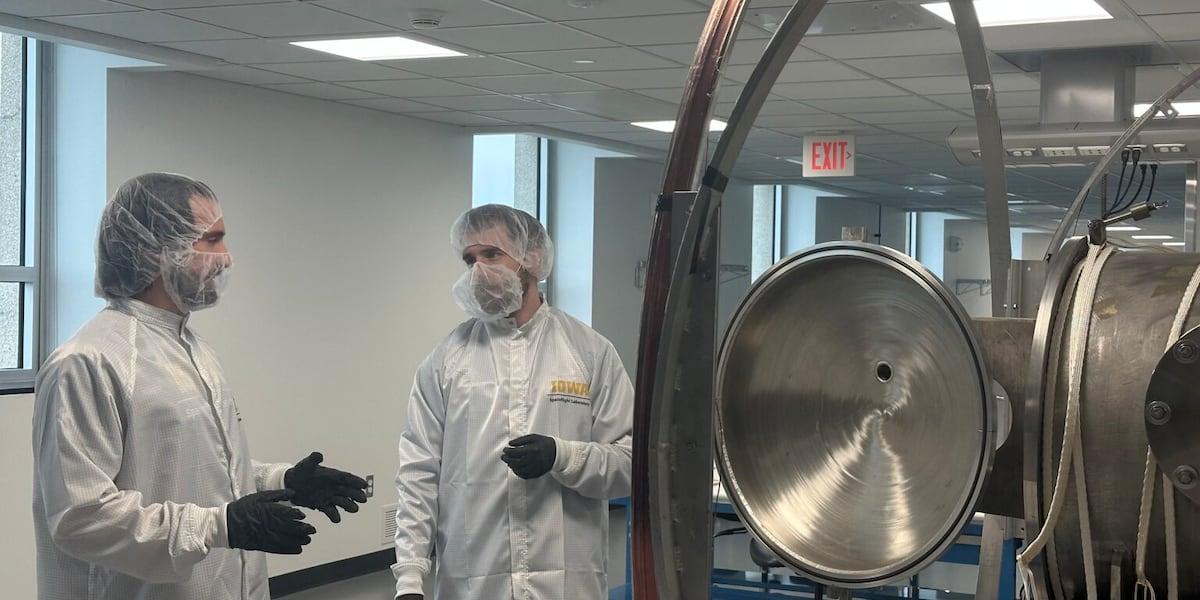
The newly completed labs occupy much of the seventh floor of Van Allen Hall, transforming the historic physics building’s namesake space into a futuristic hub. Construction finished this month, with researchers already deploying the facilities for cutting-edge work on space hardware, including prototypes and thermal tests traditionally done offsite.
NASA-Funded TRACERS Mission Powers Lab Innovation
The catalyst behind this leap forward is the NASA-funded TRACERS mission—Tandem Reconnection and Cusp Electrodynamics Reconnaissance Satellites. These two satellites, equipped with instruments developed and tested by UI physicists, launched last July and remain operational in Earth’s orbit, gathering vital data on solar wind and magnetic interactions. David Miles, TRACERS principal investigator and associate professor of physics and astronomy, confirmed that scientific findings from this mission will soon be published and that new applications for the data are underway.
Inside the lab rests a third TRACERS spacecraft, a never-to-be-launched prototype used exclusively for testing and development. This illustrates how UI’s new facility supports every development stage—from concept through assembly to delivery—under one roof.
Largest University Grant Spurs Advanced Testing and Student Training
The success of TRACERS brought in the university’s largest-ever grant and piqued support from NASA, the Roy J. Carver Charitable Trust, and internal UI funding totaling approximately $7.87 million. These funds enabled the purchase of cutting-edge testing equipment and renovation of lab spaces, including clean rooms with humidity and temperature controls essential for sensitive equipment assembly.
Casey DeRoo, associate professor and director of research and operations in physics and astronomy, emphasized the critical role of the lab in providing hands-on experiences for physics students, a rare opportunity in the US. “It’s really, really hard to gain professional experience without access to labs like this,” DeRoo said, highlighting the facility’s ability to accelerate student readiness for space science careers.
A One-Stop Space Engineering Hub with National Impact
The spaceflight lab operates as a multi-service center not only for UI researchers but also for external academic and industry partners. This capability drastically reduces costs and timelines by centralizing satellite instrument testing and development. Previously, engineers had to travel to Maryland for thermal tests and other validations; now, those projects come to Iowa.
Interim research administrator Rich Dvorsky underscored the lab’s agility: “When components fail or need redesign, having in-house capability allowed us to create new parts within weeks, a game-changer during TRACERS preparation.”
Empowering the Next Generation of Space Scientists
The lab further strengthens Iowa’s commitment to nurturing early and mid-career faculty, boosting its reputation as a magnet for emerging space scientists. Graduate students, like third-year Ph.D. candidate Brendan Powers, are already building instruments designed to collect data flying above TRACERS satellites in orbit, ensuring UI remains a vital contributor to space physics research.
With this new facility fully operational today, the University of Iowa is poised to shape the future of spacecraft innovation from the heart of the Midwest, advancing US space exploration capabilities and providing local students with rare access to real spaceflight hardware—a boon extending far beyond Iowa’s borders.
Casey DeRoo: “Our investment now ensures we can deliver cutting-edge research and education for years to come.”