Backyard Find by 8-Year-Old Reveals Revolutionary Ant-Plant-Wasp Relationship
North Carolina and U.S. readers are gaining fresh insight into nature’s complexity thanks to a curious 8-year-old boy whose backyard discovery is rewriting biological textbooks today. Hugo Deans found tiny, BB-sized spheres near an ant nest under a fallen log—spheres that scientists have confirmed are oak galls carrying parasitic wasp larvae, but more importantly, are part of a never-before-documented ecological partnership involving ants, wasps, and oak trees.
Hugo’s father, Andrew Deans, a Penn State entomology professor, recognized the spheres instantly. However, what they uncovered challenged a century-old understanding of how insects interact with plants. Their joint research, in collaboration with scientists from SUNY, reveals ants treat these wasp galls similarly to how they disperse seeds—shifting the science behind ecological interactions and signaling.
New Behavior Changes How We See Ant-Mediated Dispersal
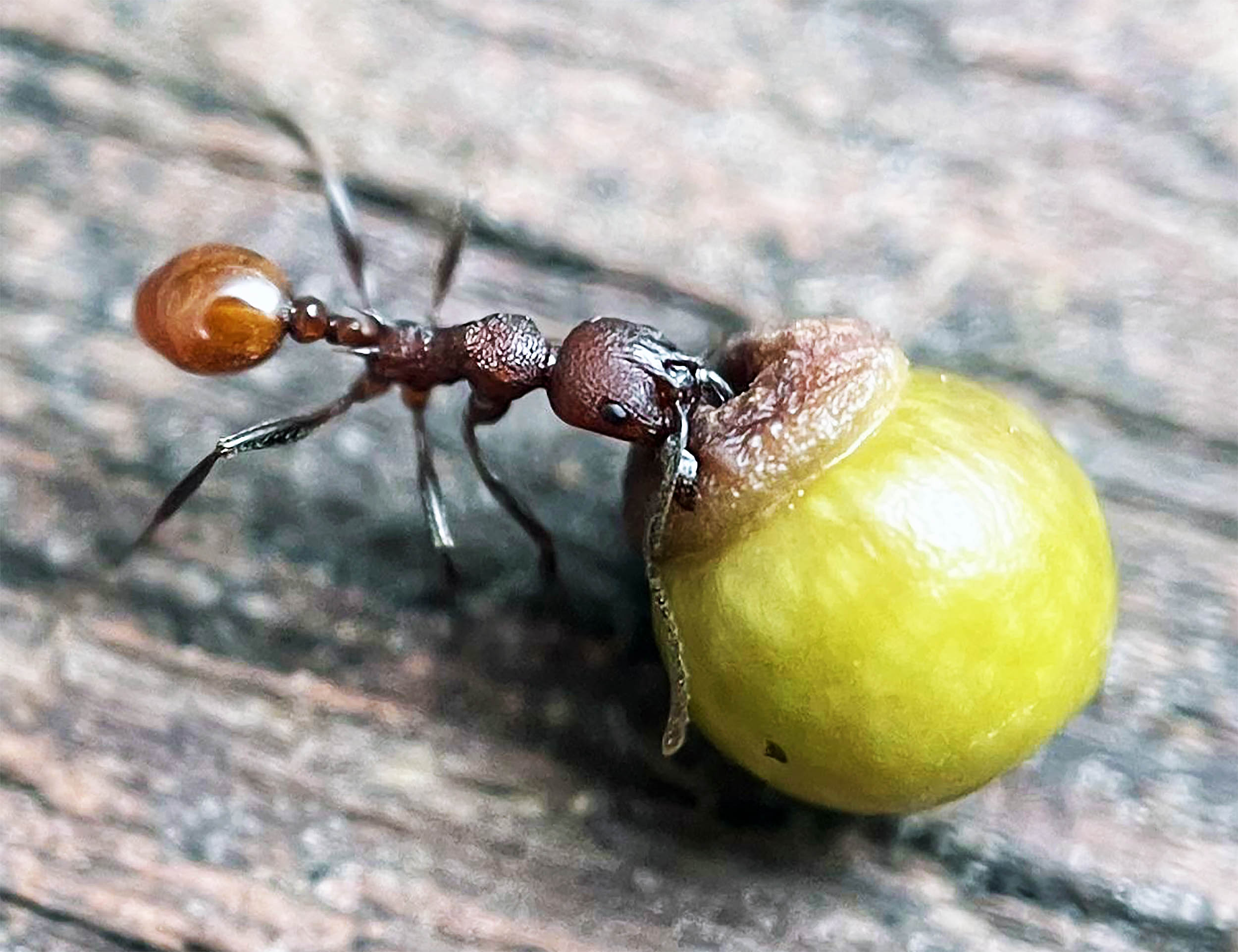
Biologists have long understood myrmecochory—the process where ants disperse seeds that bear a fatty attachment called an elaiosome. Ants carry seeds to their nests, consume the nutritious elaiosome, and discard the seed in protected environments where plants can thrive. Now, researchers report ants similarly pick up wasp galls with a special “hat” structure called the kapéllo, consuming the “hat” but preserving the larva inside by depositing the gall safely underground.
In controlled tests in a New York forest, ants Aphaenogaster picea removed wasp galls at rates comparable to bloodroot seeds. Lab experiments confirmed ants focus their attention chiefly on the kapéllo, ignoring gall bodies without it or galls from unrelated species. Chemical analysis using gas chromatography unveiled that the kapéllo carries many of the same free fatty acids that prompt ants to disperse seeds, including lauric, palmitic, oleic, and stearic acids.
Redefining Ecological Symbiosis and Protection
Unlike seeds, wasp larvae can fly as adults, meaning the real benefit of ant dispersal is likely protection, not distribution distance. Ant nests underground provide a chemical shield against predators, parasites, and fungi that threaten gall larvae on the forest floor. This hidden network of interactions between oak trees, wasps, and ants shifts nutrient and pathogen dynamics in ecosystems, hinting at a microhabitat influence overlooked by science—until now.
The study, recently published in the American Naturalist journal, demonstrates a convergent evolutionary strategy where unrelated species develop fatty attachments to manipulate ant behavior, securing transport and shelter. This breakthrough discovery, triggered by an inquisitive child in his backyard, could inspire future ecological research and deepen our understanding of biodiversity in American forests and beyond.
Why This Matters to North Carolina and Beyond
While this discovery unfolded in a New York forest, its implications ripple across U.S. ecosystems, including habitats in North Carolina. Oak trees and native ants are widespread across the state, making it likely similar interactions occur locally. Understanding this can reshape how conservationists view pest management, forest health, and the delicate balance of species supporting soil and plant vitality.
Experts emphasize the power of curiosity-driven science and urge readers to explore nature’s everyday wonders. Hugo’s story reminds us that groundbreaking discoveries can start close to home—and that microinteractions between insects and plants may hold solutions for resilient ecosystems amid global environmental changes.
Next Steps and Continuing Research
Deans and his team plan to expand studies to map ant-transported galls’ impact on microbial communities, predator-prey relations, and nutrient cycles. Meanwhile, their findings encourage ecologists nationwide to reexamine seemingly simple insect behavior and its broad influence.
This evolving story is a vital reminder: science doesn’t only break news in labs or conferences—it often begins in the backyards of the curious and observant.
“I was surprised that ants would collect galls because why would they do that?” — Hugo Deans, now 13
Stay updated with more breaking natural science news on The NC Voice and join our newsletter for exclusive insights. For quick nature updates on the go, check out EarthSnap, a free app from Earth.com.