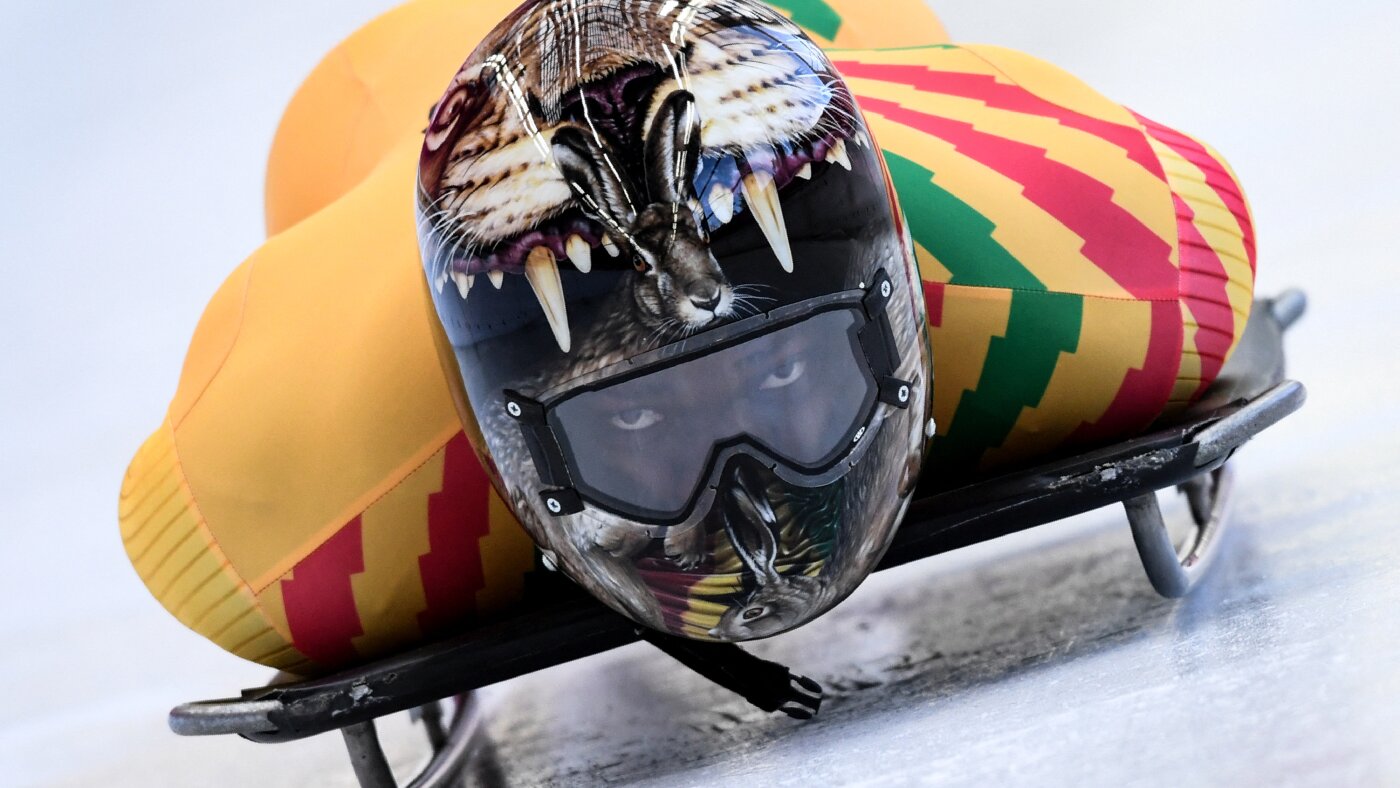
Akwasi Frimpong made headlines as the first male Black African skeleton racer to compete in the Olympics, achieving this milestone during the 2018 Winter Games in Pyeongchang, South Korea. Frimpong’s journey from an undocumented immigrant in the Netherlands to an Olympic athlete highlights both his dedication and the unique challenges faced by athletes from underrepresented backgrounds in predominantly white sports.
Born in Ghana, Frimpong moved to the Netherlands at the age of eight. He initially pursued a career in track and field, encouraged by a coach who saw potential in him. Despite making the pre-Olympic 4×100 meter relay team for the 2012 London Olympics, an injury prevented him from competing. Following this setback, he transitioned to bobsledding, ultimately serving as a brakeman for the Dutch team and becoming an alternate for the 2014 Sochi Olympics.
Frimpong’s journey took a dramatic turn when he decided to pursue skeleton, a sport that involves racing headfirst down a track on a small sled. Reflecting on his decision, he explained, “I was recruited to try skeleton, going head first. At first I was like, ‘Hell no, no please.’ Bobsled was already crazy.” Nonetheless, he embraced the challenge, stating, “As I made it down, I wanted to go back to the top and do it again.”
Choosing to represent Ghana rather than the Netherlands was a significant decision for Frimpong. He sought to inspire others from similar backgrounds, believing that his journey could send a powerful message of perseverance and achievement. “I wanted to represent the people of my country, 30 million people,” he said. “It was about teaching people to come out of their comfort zone.”
Training for skeleton presented unique challenges for Frimpong, primarily due to the limited resources available to athletes from Ghana. “We don’t have our own skeleton track in Ghana,” he noted, explaining that he trained extensively in various countries, including the United States, Canada, and Europe. He acknowledged the importance of fear in the sport, stating, “Fear is a big part of it; you have to learn how to embrace it.”
As Frimpong competed in a sport dominated by wealthier nations, he faced both scrutiny and support from fellow athletes. Initially, he noted the surprise from competitors, but as he improved, the dynamics shifted. “They’re like, ‘Oh, there’s a kid from Africa that I can beat,’ until you start beating them,” he remarked.
Frimpong’s participation in the 2018 Winter Olympics was a moment of pride, not just for himself but for his country and continent. “To be the first Black male from Africa to compete in skeleton, representing 1.4 billion people, that itself was worth gold,” he said. He received an outpouring of support from various countries, with individuals expressing interest in taking up the sport.
Following his Olympic debut, Frimpong continued to compete with a commitment to improve, stating, “I never wanted to be the African athlete who just made headlines; I wanted to be competitive.” He faced significant financial hurdles in seeking sponsorships, describing the difficulties of balancing a family life with his athletic ambitions. Despite these challenges, he achieved notable success, including becoming the first African to win an elite skeleton race in Park City, Utah.
Unfortunately, Frimpong did not qualify for the 2026 Winter Olympics. He reflected on his performance, attributing part of the outcome to equipment challenges and the increasing competitiveness of the sport. Yet, a significant health scare followed. Frimpong underwent surgery for a ruptured appendix, which he realized could have posed a serious threat had he been competing in Italy at the time. “If I’d have been in Italy, I probably would have ignored the pain and may not have been here to talk right now,” he shared.
Looking ahead, Frimpong is focused on his foundation, the Hope of a Billion, which aims to inspire young people. He and his wife travel to schools, imparting lessons on resilience and self-belief. “When you can help a kid find their passion, they move differently in the world,” he explained.
As he turns 40 and reflects on his Olympic journey, Frimpong remains committed to mentoring young athletes from underrepresented nations. While he may hang up his sled, his influence in the sport and his dedication to inspiring the next generation continue to drive him forward. “I’m not done being involved in inspiring,” he concluded, signaling his intent to foster a new wave of athletes.