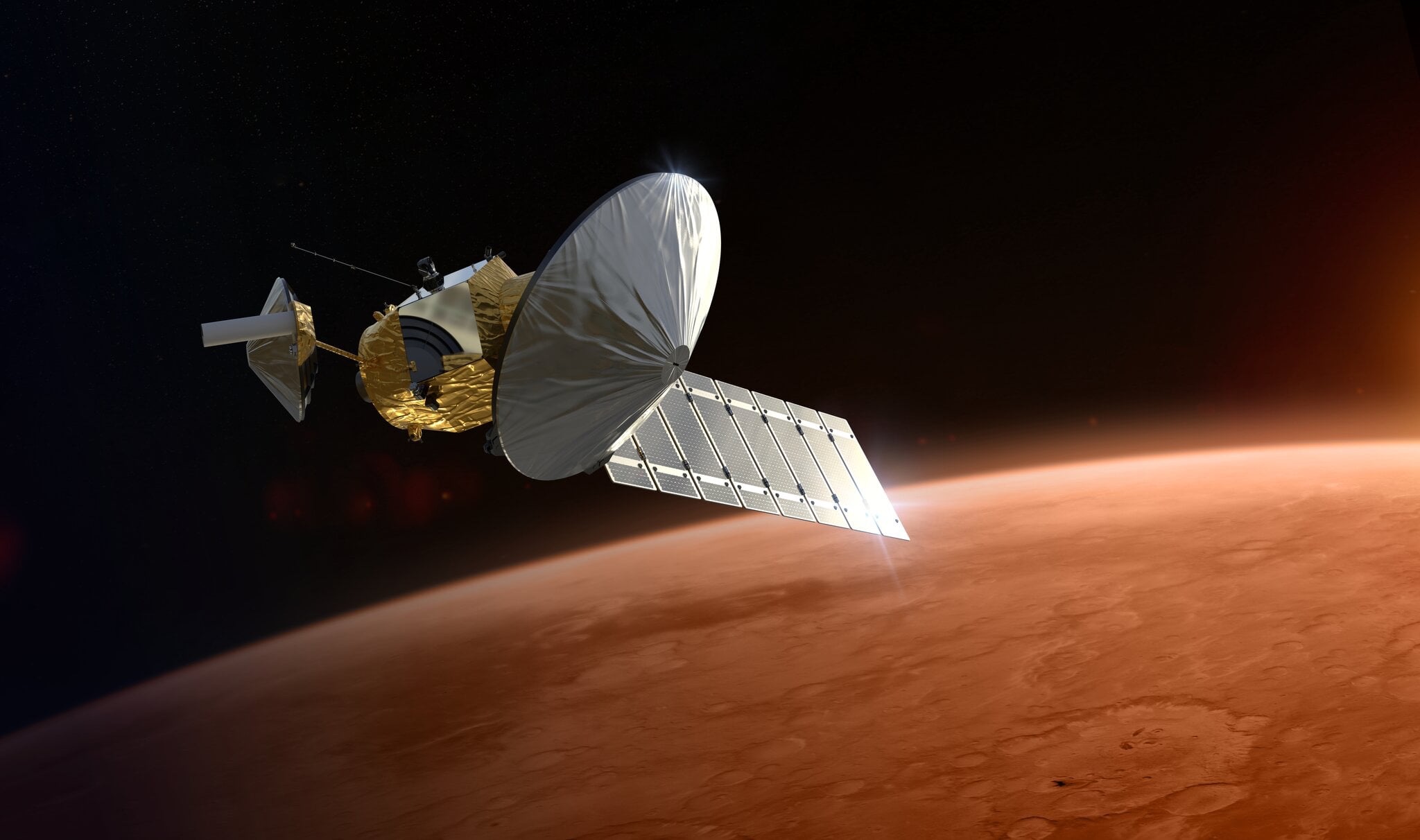
NASA has unveiled detailed plans for a new Mars communications orbiter, part of its Mars Telecommunications Network initiative. This project, funded by the budget reconciliation bill passed in July 2025, allocates $700 million for developing a spacecraft aimed at providing “robust, continuous communications” for various assets operating on or around Mars. The agency published draft objectives and requirements for the orbiter on February 24, 2026, as numerous companies prepare to compete for the contract.
According to the budget reconciliation act, the spacecraft must be delivered to NASA by the end of 2028, although a specific launch date is not mandated. The project aims to support operations through 2035, including four primary objectives: to provide communications services for spacecraft operating at Mars; to deliver positioning, navigation, and timing (PNT) services; to support existing Mars spacecraft; and to facilitate communications for missions testing entry, descent, and landing technologies.
NASA’s draft requirements indicate that the orbiter must operate for a minimum of five years and support data rates of up to 100 megabits per second on direct links to Earth. The spacecraft is designed to be compatible with NASA’s Deep Space Network. Although optical communications links are not required, the draft does not rule them out, potentially enabling higher data rates in the future.
The focus on communications and navigation means that the spacecraft will not include scientific instruments. Some scientists had hoped for additional payloads, but budget constraints and timelines likely limit the project to its primary objectives. NASA is expected to release a draft request for proposals shortly, with comments due by March 10, 2026.
The procurement notice emphasizes eligibility criteria, limiting participation to companies that have received NASA funding in fiscal years 2024 or 2025 for commercial design studies related to alternative Mars Sample Return approaches. Eligible companies must also propose a separate Mars telecommunications orbiter that supports an end-to-end Mars sample return mission.
In late January, NASA issued a procurement notice listing eligible companies, including Blue Origin, L3Harris, Lockheed Martin, Northrop Grumman, Rocket Lab, SpaceX, Quantum Space, and Whittinghill Aerospace. However, this notice was withdrawn within a day, leaving the reasons unclear.
Both Blue Origin and Rocket Lab have been particularly vocal about their interest in the Mars Telecommunications Network. Blue Origin highlighted its integrated solution that combines its New Glenn launch vehicle with the Blue Ring Mars-capable spacecraft platform, stating that both have demonstrated flight-proven heritage. Despite having successfully launched New Glenn twice, Blue Origin has yet to fly a complete Blue Ring spacecraft, having only tested components in space.
Rocket Lab emphasized its unique qualifications, citing a combination of proven spacecraft and deep space mission experience. The company recently launched twin spacecraft to Mars and has supported components for other missions. In a statement, Rocket Lab noted, “A Rocket Lab Mars Telecommunications Orbiter also brings a non-Artemis performer into the mix to contribute to a national space objective.” The company is focused on delivering a reliable orbiter to enhance America’s capabilities on Mars.
During a recent earnings call, Rocket Lab’s Chief Executive, Peter Beck, reiterated the company’s strong position in the competition. “We’ve made no secret of the fact that we think Rocket Lab is the strongest contender to deliver NASA’s Mars Telecommunications Orbiter program,” he stated, expressing confidence in the company’s ability to meet NASA’s requirements.
As the competition heats up, NASA’s Mars Telecommunications Network promises to play a crucial role in enhancing communication capabilities for future Mars missions, furthering humanity’s exploration of the Red Planet.