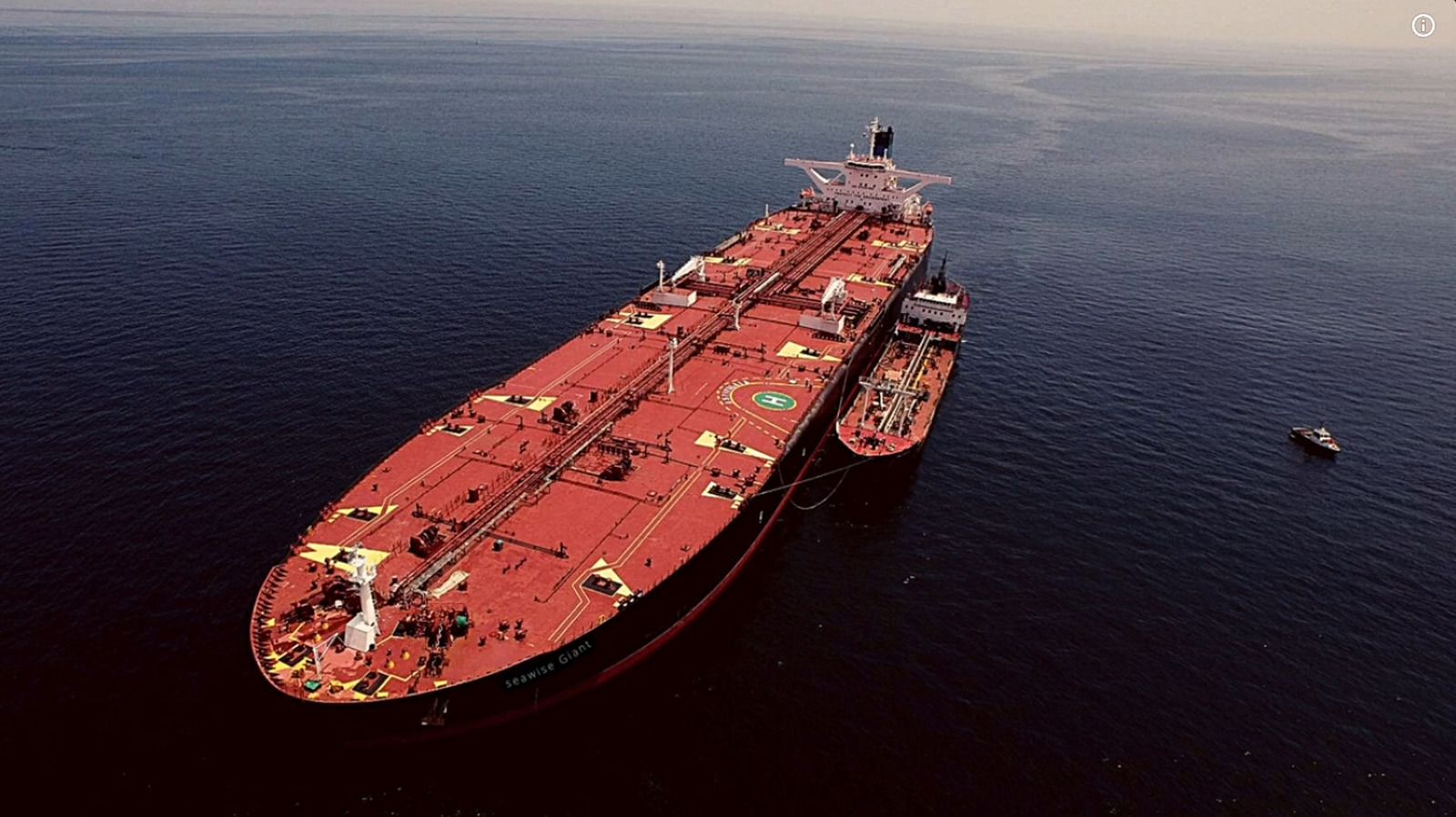
The **Seawise Giant**, once the largest ship ever constructed, holds a remarkable place in maritime history. Designed as an ultra-large crude carrier (ULCC) by **Stavros Niarchos**, a Greek shipping magnate, this colossal vessel was not only monumental in size but also rich in a colorful history that spanned several decades.
**A Vision Realized in 1981**
Construction of the Seawise Giant began in 1979 at the **Oppama shipyard** in Japan, built by **Sumitomo Heavy Industries**. Originally named for the shipyard, the vessel faced financial turmoil early on. Reports vary regarding Niarchos’s fate—some state he went bankrupt, while others suggest he walked away due to market fluctuations. Despite these challenges, the ship was ultimately sold to **C.Y. Tung**, a Hong Kong-based tycoon, who extended the vessel’s length before its launch in 1981.
Once completed, the Seawise Giant measured an astounding **1,504 feet**—over four football fields in length. If positioned vertically, it would surpass the heights of the **Petronas Towers** in Kuala Lumpur and the **Empire State Building** in New York. With a deck area of **339,500 square feet**, crew members often pedaled bicycles to navigate its vast expanse.
**An Engineering Marvel**
The Seawise Giant was equipped with **46 oil tanks**, capable of transporting over **four million barrels** of crude oil. Its sheer size rendered it unparalleled; even the current largest container ships could not compete with its oil capacity. The ship’s specifications were impressive, featuring a **230-ton rudder** and a **50-ton propeller**. When fully loaded, it required nearly six miles to stop and had a turning radius exceeding two miles. Constructed with a one-inch-thick reinforced double hull, it was designed to withstand harsh conditions at sea.
Despite these advancements, the ship struggled with navigation in crucial maritime passages such as the **English Channel**, **Suez Canal**, and **Panama Canal**, forcing it to take longer routes around the **Cape of Good Hope**. With a maximum speed of just **16 knots (approximately 18 mph)**, its operational efficiency was hindered.
**A Tumultuous History and Transformation**
The Seawise Giant’s journey took a perilous turn during the **Iran-Iraq War** in **1988** when it was struck by Iraqi missiles while traversing the **Strait of Hormuz**. The vessel sank in shallow waters, leading its owner, **Orient Overseas Container Line (OOCL)**, to declare it a total loss. However, the ship was salvaged by **Normal International**, a Norwegian firm, which invested millions to restore it, renaming it the **Happy Giant**.
Shortly after its refurbishment, the vessel was sold to **Jørgen Jahre**, a Norwegian shipping magnate, for **$39 million** and renamed **Jahre Viking**. For the next decade, it continued its role in the global oil market until advancing technologies rendered its design obsolete. In **2004**, Jahre sold the vessel to **First Olsen Tankers**, which transformed it into a floating storage and offloading (FSO) unit, renaming it **Knock Nevis**.
**End of an Era**
The vessel’s remarkable journey concluded in **2009** when it was sold to a ship-breaking company in **Gujarat, India**. Dismantling the massive structure proved to be a monumental task, requiring **18,000 workers** over a year to complete the job. Ultimately, the only remnant of the Seawise Giant is its **36-ton anchor**, now displayed at the **Hong Kong Maritime Museum** in Anchor Plaza.
The story of the Seawise Giant reflects humanity’s ambition to create monumental achievements and the intricate histories that accompany such grand endeavors. Despite its decommissioning in **2010**, its legacy as the largest ship and man-made moving object in history endures, celebrated by maritime enthusiasts and historians alike.