Researchers at the Massachusetts Institute of Technology (MIT) have developed a new superconducting nanowire memory array that significantly reduces error rates in memory storage. This advancement could play a crucial role in the future of quantum computing, which demands efficient and fast memory components for complex operations. The study was published in the journal Nature Electronics on January 25, 2026.
Superconducting memory is distinguished by its ability to conduct electricity without resistance when cooled below a specific temperature. These memory systems promise enhanced speed and lower energy consumption compared to traditional memory technologies. However, scaling these systems has been challenging due to high error rates in existing designs. The innovative approach from MIT introduces a scalable memory based on one-dimensional nanowires, which exhibit unique optoelectronic properties.
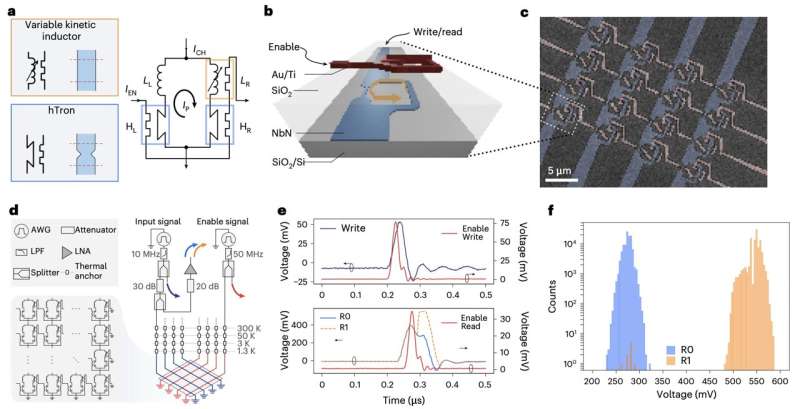
The researchers designed a compact array featuring superconducting memory cells, each consisting of a nanowire loop integrated with two superconducting switches and a kinetic inductor. These components work together to manage electrical current and temperature variations effectively. The operational temperature for the array is set at 1.3 K, facilitating stable memory functions.
“Our results indicate that scalable superconducting memory is essential for developing low-energy superconducting computers and fault-tolerant quantum computers,” the authors, including Owen Medeiros and Matteo Castellani, stated in their paper. They emphasized the limitations of traditional superconducting memory cells, which have larger footprints that hinder scalability.
The newly developed memory array, featuring a 4 × 4 configuration, is designed for efficient row–column operations. It boasts a functional density of 2.6 Mbit cm −2, a significant achievement in compact memory design. The incorporation of carefully timed electrical pulses allows for precise data storage and retrieval, with the system achieving a remarkable minimum bit error rate of 10 −5, or approximately 1 error in 100,000 operations.
This breakthrough in superconducting memory technology marks a pivotal step towards making these systems practical for real-world applications. The team’s initial tests demonstrate that the memory can effectively store and manipulate information with minimal errors, paving the way for future advancements in superconducting memory systems.
The research team is optimistic about the potential for further enhancements to their design, which could lead to even more reliable and efficient memory systems in the future. As the demand for high-performance computing continues to grow, this innovative memory solution could play a significant role in advancing the capabilities of next-generation computers.
This development underscores the ongoing efforts in the field of superconducting technology, with implications that extend beyond quantum computing into various sectors reliant on advanced memory solutions. The work of Medeiros, Castellani, and their colleagues represents a significant contribution to the field and could accelerate the timeline for deploying superconducting memories in practical applications.