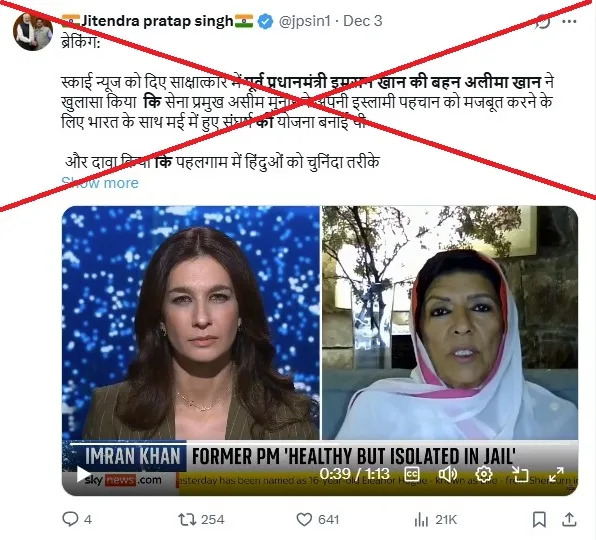
A manipulated video featuring Aleema Khan, sister of former Pakistani Prime Minister Imran Khan, has circulated widely on social media, misrepresenting her statements about the country’s army chief, Asif Munir. The clip suggests that Aleema Khan labelled Munir a “radicalised Islamist” who seeks war with India. However, this portrayal has been identified as a deepfake, raising serious concerns about the dissemination of false information.
In the original interview broadcast by Sky News on December 3, 2025, Aleema Khan did not make any such claims. Instead, she expressed her distress regarding the lack of access her family has to Imran Khan, who has been imprisoned since 2023 on corruption charges. The controversy began when a post on the platform X (formerly Twitter) inaccurately quoted her comments, asserting that Munir was responsible for escalating tensions between India and Pakistan during a conflict in May 2025.
During the Sky News interview, Aleema Khan discussed the implications of her brother’s imprisonment, noting his belief that Munir is accountable for the family’s difficulties in visiting him. She referenced another sister’s visit to him in prison and quoted Imran Khan’s assertion that Munir is responsible for his treatment. “I hold him responsible for what’s being done to me because it is against all regulations,” she stated. At no point did she connect Munir to the India-Pakistan conflict or use the term “Islamist.”
Deepfake Technology Raises Concerns
The emergence of this altered video has drawn significant attention. Yalda Hakim, the interviewer from Sky News, condemned the altered clip as “deeply disturbing” and confirmed its classification as a deepfake. Following the incident, she reiterated these concerns in a report on Sky News, highlighting the dangers of misinformation in the digital age.
A reverse image search conducted by various media outlets revealed that the original interview had been uploaded to Sky News’ official YouTube channel on the same date it aired. The modified video diverged significantly from the authentic content and contained no references to Aleema Khan calling Munir an “Islamist.”
The implications of this misinformation extend beyond mere public confusion. Aleema Khan’s comments were shared widely, creating a narrative that could incite further division in an already strained political environment in Pakistan. Supporters of Imran Khan expressed outrage over the altered statements, particularly in light of the recent tensions surrounding his imprisonment.
Background on Imran Khan’s Imprisonment
Imran Khan was ousted from power in a no-confidence vote in April 2022 and has faced numerous legal challenges since then. His supporters assert that the charges against him are politically motivated and that he has been denied proper access to legal counsel and family visits. Following a social media post alleging Munir’s persecution, rumors about Khan’s health sparked protests outside Adiala Jail in Rawalpindi on November 26, 2025. Supporters gathered in large numbers, demanding transparency and justice for the former leader.
On December 3, 2025, after three weeks of uncertainty, his sister, Uzma Khan, confirmed that he was “alive and well” following a visit. This confirmation came amid escalating fears regarding his treatment and health in custody.
The use of AI technology to manipulate public opinion poses a critical challenge for media integrity and democracy. As digital platforms continue to evolve, the responsibility to verify information before sharing becomes increasingly vital. The incident involving Aleema Khan serves as a stark reminder of the potential consequences of misinformation in the current political landscape.
As investigations into the origins of the altered video continue, media organizations and fact-checkers aim to educate the public about the risks associated with deepfake technology, ensuring that audiences remain vigilant against misleading content.