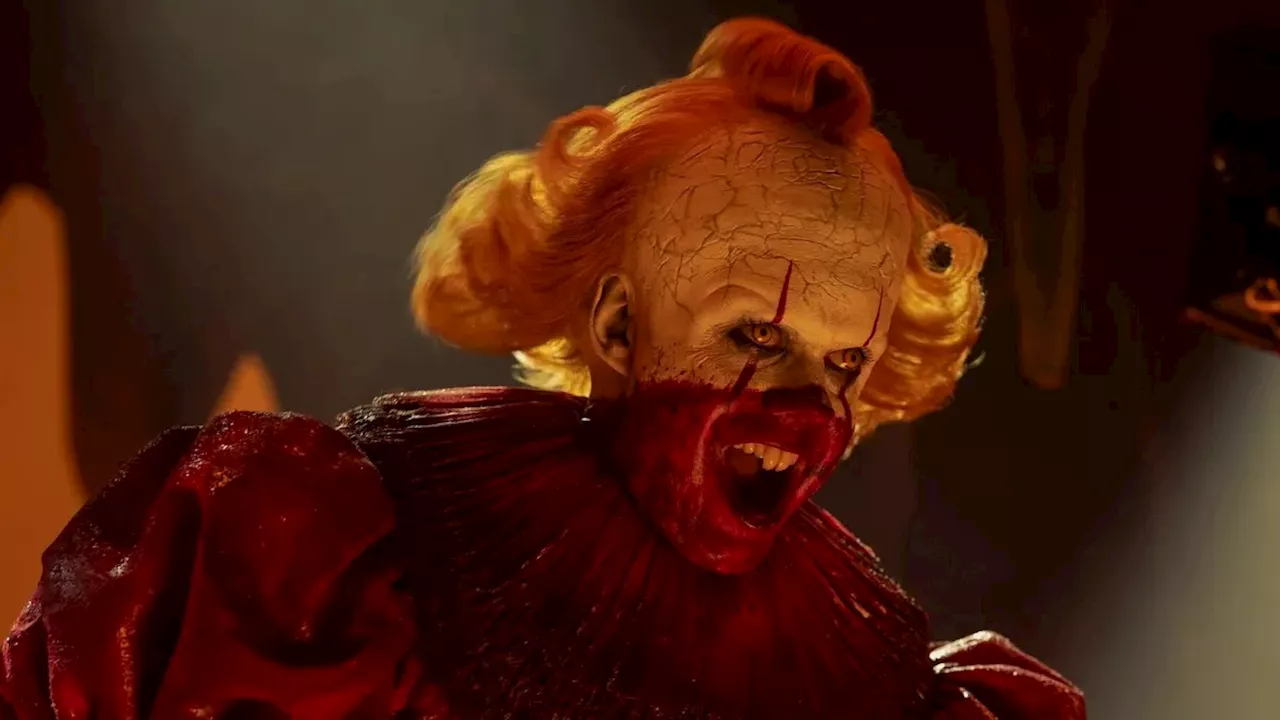
The conclusion of the first season of the *IT* franchise’s latest installment, *Welcome to Derry*, introduces significant developments regarding Pennywise’s abilities and sets the stage for a potential third film. The finale reveals that Pennywise can perceive timelines across the past, present, and future, a power that allows him to target members of the Losers’ Club even before their birth. This new narrative direction promises to delve deeper into the character’s origins and motivations.
Pennywise’s ability to foresee the moment when the Losers’ Club defeats him creates a compelling twist. Aiming to eliminate the future threats to his existence, he seeks to disrupt the very lineage of those who will ultimately confront him. The storyline now suggests that the horror unfolds not only in the present but also through an exploration of the past, as Pennywise attempts to thwart the parents of the Losers’ Club before they can conceive.
The original Losers’ Club, which confronted Pennywise in 1962, initially managed to seal him away, ensuring 27 years of dormancy. However, the finale implies that their victory was not as absolute as previously thought. The revelation that Pennywise can manipulate time suggests a broader narrative arc where his evil legacy transcends generations. This raises questions about the effectiveness of the Losers’ attempts to rid the world of this entity.
Strongly linked to this evolving tale is actor Bill Skarsgård, who has gained acclaim for his portrayal of Pennywise. The upcoming film could explore how the entity becomes self-aware and begins to consolidate its power, potentially leading to his iconic form, Bob Gray, known as Pennywise. It opens up opportunities for Skarsgård to deepen his interpretation of the character, expanding beyond the boundaries set by Stephen King’s original novel.
As the narrative unfolds, it may incorporate a time-loop mechanism, allowing audiences to witness events from different historical perspectives. This could mirror themes found in previous adaptations and offer a fresh take on the lore surrounding Pennywise. Fans of the franchise can expect to see a richer tapestry of storytelling that intertwines the destinies of multiple generations.
In a significant scene, Pennywise confronts Marge Truman, revealing that he perceives events across all timelines. This revelation adds layers to the storyline, indicating that the moment of his defeat is intrinsically linked to the circumstances of his own origins. Such twists could deeply impact how audiences understand the character’s motivations and the implications of his actions.
Overall, the developments in *Welcome to Derry* provide fertile ground for future adaptations and explorations of the *IT* universe. The potential for a third film now appears more plausible, with the narrative poised to dive into the origins of Pennywise and the dynamics of evil that connect the past to the present.
The intricate storytelling elements introduced in the series finale not only challenge perceptions of good and evil but also enrich the legacy of *IT* as it continues to captivate audiences around the world. With a focus on the power of love and friendship as weapons against darkness, the series highlights the enduring struggle between the Losers’ Club and the malevolent entity that haunts them.