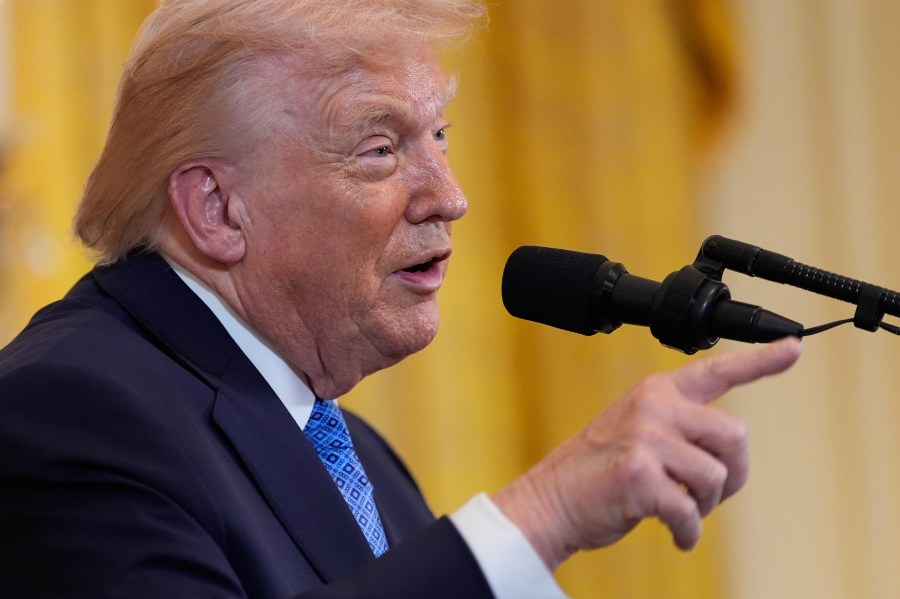
The recently unveiled U.S. National Security Strategy outlines President Donald Trump‘s ambition to frame his foreign policy legacy as one of peace. The strategy highlights eight peace agreements achieved over the past year, including a notable agreement involving Gaza. However, elements within the strategy raise concerns that Trump may inadvertently enable Russian President Vladimir Putin to miscalculate and potentially instigate a new major conflict in Europe.
Trump’s strategy, while aiming for peace through strength, revives historical U.S. foreign policy approaches. It prioritizes the Western Hemisphere and introduces a new Trump Corollary to the Monroe Doctrine, reminiscent of Teddy Roosevelt‘s interventionist policies. Additionally, it incorporates economic strategies akin to those of past presidents like William Howard Taft and William McKinley, though it also reveals isolationist tendencies similar to those seen in the post-World War I era.
Despite its constructive elements, such as calling for allies to meet their defense commitments under NATO, the strategy contains a critical flaw regarding Article 5 of the NATO treaty. While it states that the U.S. supports its allies in preserving European freedom and security, this language diverges from the traditional “attack on one is an attack on all” commitment. This shift could undermine NATO’s deterrent effect, leading to a perception of vulnerability in Europe.
Concerns Over European Defense Readiness
The strategy further critiques European economies as being in decline, attributing this to over-regulation. It suggests that European nations must rapidly become their own primary defenders, proposing a target year of 2027. Experts caution that this timeline is overly ambitious, as Europe would require years to develop capabilities such as operational intelligence and missile defense systems. Misjudging the timing of this transition could have severe consequences.
Moreover, the strategy emphasizes military deterrence in Asia, particularly regarding the South China Sea and Taiwan, while downplaying the necessity for similar deterrence in Europe. The portrayal of Russia as an existential threat is minimized, which contrasts sharply with the views of European leaders who view the situation differently. The document’s overall inclination towards non-intervention could be viewed as a reassurance for some regions but is likely to concern European allies relying on U.S. support to deter Russian aggression.
The strategy calls for a swift cessation of hostilities in Ukraine and aims to restore strategic stability with Russia. These goals, while well-intentioned, overlook Russia’s role as the aggressor. The document criticizes European governments for having “unrealistic expectations” regarding peace negotiations, further complicating the already tense situation.
Historical Miscalculations and Current Implications
Historical precedents illustrate the dangers of miscalculation in international relations. Leaders like Kaiser Wilhelm II in 1917 and Adolf Hitler in 1938 misjudged the resolve of their adversaries, leading to catastrophic wars. Vladimir Putin has already underestimated Ukraine’s resilience, and there is a risk he could miscalculate again, particularly if he perceives a lack of U.S. commitment to European defense.
To avert a dangerous miscalculation, the United States and Europe must reinforce credible deterrence strategies. Trump should reaffirm America’s commitment to NATO and avoid significant troop withdrawals from Europe. It is crucial to treat Russia as the aggressor in the ongoing Ukrainian conflict. In parallel, European nations should accelerate their defense spending efforts and continue supplying necessary military aid to Ukraine.
In the long term, a new transatlantic compact could be essential to redefine roles within the NATO alliance. Such a shift could ensure that both the United States and Europe are adequately prepared to address emerging threats and maintain stability.
As discussions around U.S. foreign policy evolve, the implications of Trump’s strategy will be closely monitored. The potential for miscalculation looms large, and timely adjustments may prove vital in securing peace and stability in Europe.