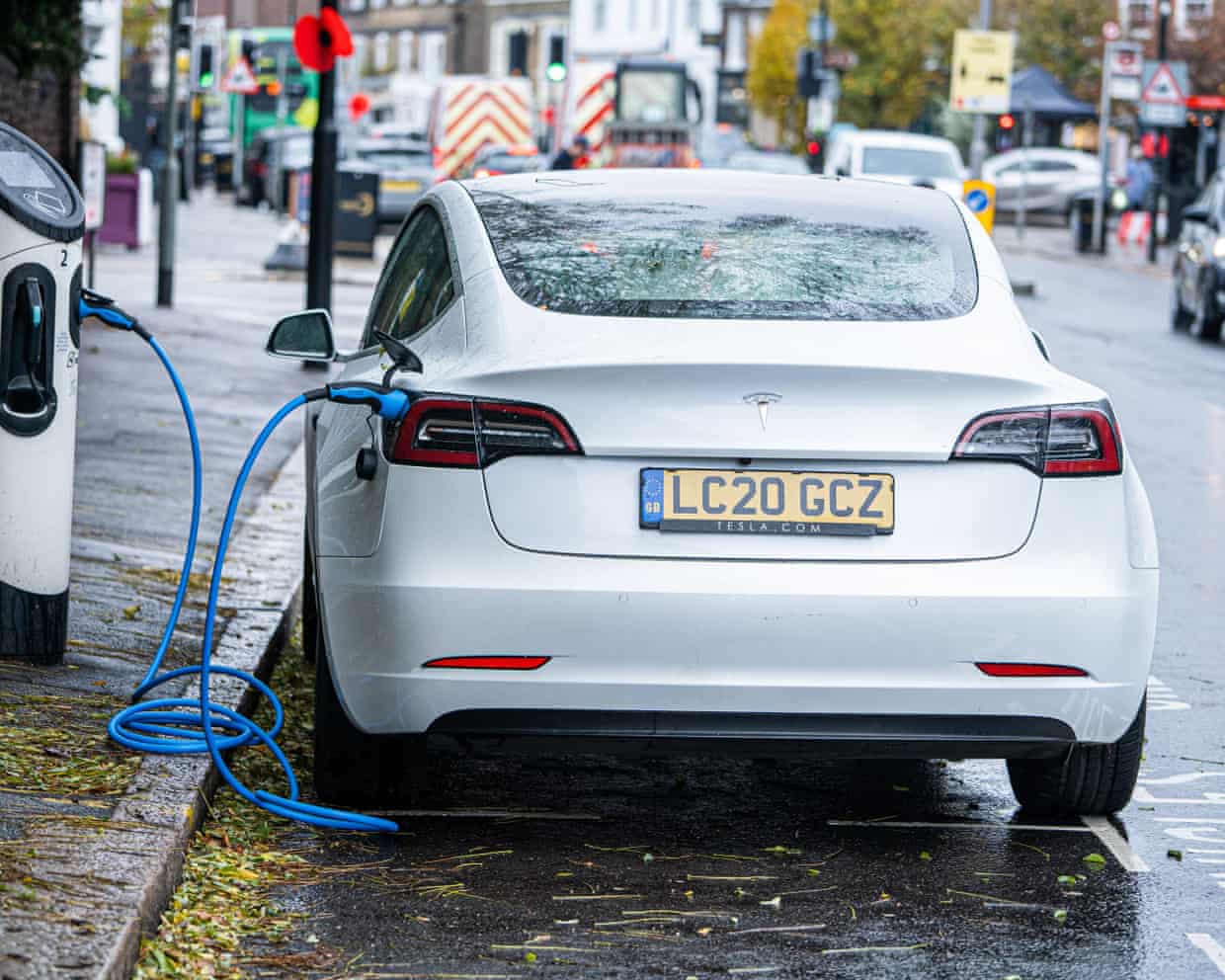
Tesla has privately alerted the UK government that potential changes to electric vehicle (EV) regulations could adversely impact sales of battery-operated cars and jeopardize the country’s carbon dioxide emissions targets. Documents obtained by the newsletter Fast Charge reveal details of Tesla’s concerns regarding the weakening of the zero-emission vehicle (ZEV) mandate, which requires an annual increase in EV sales.
The Labour government’s decision in April to relax certain rules has raised alarms among electric car manufacturers. Although the ZEV mandate was designed to promote the sale of electric vehicles, new loopholes permit carmakers to sell a larger number of petrol and diesel vehicles. Critics have also pointed to new taxes on electric vehicles introduced in last week’s budget as a further threat to demand.
Several car manufacturers, including **BMW**, **Jaguar Land Rover**, **Nissan**, and **Toyota**, expressed their concerns during a government consultation earlier this year. They claimed that the existing mandate was hindering investment because they were selling electric vehicles at a loss. In contrast, environmental advocates and brands that focus primarily on electric vehicles argue that the current regulations are achieving their intended outcomes. Reports indicate that no car manufacturers have faced fines concerning sales for the year 2024.
Tesla emphasized the importance of maintaining stringent regulations, warning that introducing new loopholes, referred to as “flexibilities,” would suppress the supply of battery electric vehicles (BEVs). The company stated that such changes could have “significant emissions impacts” and risk the UK failing to meet its carbon budgets.
The situation was further complicated by remarks from **Rachel Reeves**, the Chancellor of the Exchequer, who announced plans for a “pay-per-mile” charge on electric vehicles starting in **2028**. This policy is expected to diminish the appeal of electric cars compared to more polluting petrol and diesel options. In a positive move for the sector, Reeves also announced an extension of grants for new electric vehicles, a decision welcomed by many in the industry.
Tom Riley, the editor of Fast Charge, commented on the government’s contradictory stance, saying, “Just as the EV transition looked settled, the budget pulled it in two directions at once.” He added that if manufacturers continue to push for a more lenient ZEV mandate, the Labour government could be held accountable for any failures to meet climate targets.
Documents from Tesla, **Ford**, and **Mercedes-Benz** were obtained through a freedom of information request, as these companies objected to their responses being made public. Notably, many pages contained redactions. One section indicated that Tesla called for “support for the used-car market,” but the specifics of this support remain unclear.
Ford and Mercedes-Benz voiced their opposition to the imposition of stricter rules post-2030, arguing that such regulations would compel them to further decrease their average carbon dioxide emissions. Ford has criticized European governments for retracting support for electric vehicle sales, stating that “policymakers in many European jurisdictions have not delivered their side of the deal.” The company has reversed its previous support for stronger emission targets, citing the risk of being undercut by Chinese manufacturers, who do not have a UK presence and operate on a lower cost basis.
Mercedes-Benz has suggested that the UK should reduce VAT on public charging from **20%** to **5%** to align it with home electricity rates, in addition to proposing a price cap on public charging costs. Tesla has also advocated for a ban on plug-in hybrid electric vehicles with a battery-only range of less than **100 miles** after **2030**, a measure that would eliminate many popular models in that category.
As the UK navigates its electric vehicle transition, the balance between fostering industry growth and achieving environmental goals remains a critical challenge. Tesla, Ford, and Mercedes-Benz did not provide further comments on the evolving situation.