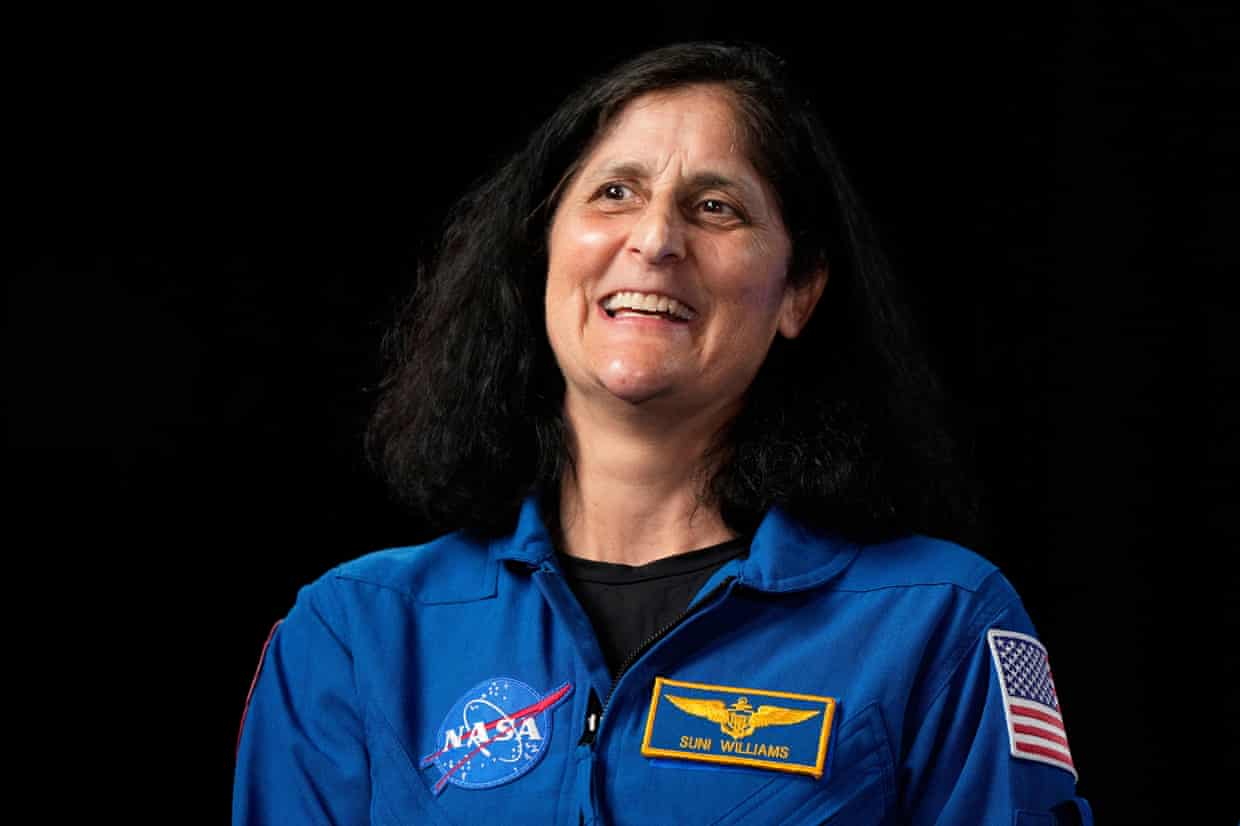
Suni Williams, a prominent NASA astronaut, has officially retired after an impressive 27-year career with the agency. The 60-year-old former Navy captain announced her departure in December 2023, as confirmed by a recent press release from NASA. Williams is celebrated for her extensive contributions to space exploration, including holding the record for the most accumulated spacewalk time by a woman, totaling over 62 hours across nine separate missions.
Historic Space Missions and Achievements
Williams’s career highlights include three separate spaceflights. Her first mission was on the Space Shuttle Discovery in December 2006, followed by a journey aboard a Russian Soyuz spacecraft in July 2012. Most notably, she participated in the first crewed flight of Boeing’s Starliner capsule in June 2024. What was intended to be a short test mission to the International Space Station (ISS) unexpectedly extended to 286 days due to technical difficulties.
The extended stay sparked significant political discourse on Earth. Prominent figures, including former President Donald Trump and Elon Musk, CEO of SpaceX, publicly claimed that Williams and her fellow astronaut, Barry “Butch” Wilmore, were “stuck” in space and “abandoned” by the Biden administration. Both astronauts returned to Earth in March 2025 on a SpaceX Dragon capsule, a journey that Trump characterized as a “rescue” by Musk, his then-ally.
During a post-landing press conference, Williams and Wilmore addressed the political narrative surrounding their mission. Wilmore admitted, “In certain respects, maybe we were stuck,” while Williams emphasized the team’s focus on their objectives, stating, “We were just really focused on what we were doing and trying to be part of the team.”
Williams’s career is distinguished not only by her time in space but also by her pioneering achievements. She was the first astronaut to complete a marathon in orbit, running on a treadmill in April 2007 during the Boston Marathon, which took place 250 miles below.
A Legacy of Inspiration and Future Endeavors
In a statement, Vanessa Wyche, director of the Johnson Space Center in Houston, praised Williams as “a pioneering leader,” noting that her dedication would inspire future generations of explorers. Williams’s retirement coincided with the 96th birthday of Buzz Aldrin, the second man on the moon, marking a significant moment in the legacy of space exploration.
The announcement came shortly after NASA moved the Artemis II rocket to its launchpad at Florida’s Kennedy Space Center. The Artemis II mission, scheduled for February 6, 2024, aims to carry four astronauts, including NASA personnel Reid Wiseman, Victor Glover, and Christina Koch, along with Canadian astronaut Jeremy Hansen. This mission will be the first crewed lunar flight since 1972, paving the way for future lunar exploration.
Jared Isaacman, NASA’s new administrator, acknowledged Williams’s role in advancing science and technology, stating that her efforts have laid a foundation for upcoming Artemis missions and the goal of reaching Mars. More than 2.5 million individuals have expressed interest in the Artemis II mission through an educational initiative, allowing their names to be digitally stored on an SD card that will travel around the Moon aboard the Orion capsule.
Williams reflected on her experiences at the ISS, highlighting its inspiring environment and the potential for new exploration toward the Moon and Mars. As she steps away from her role at NASA, her contributions and achievements are likely to influence aspiring astronauts and scientists for years to come.