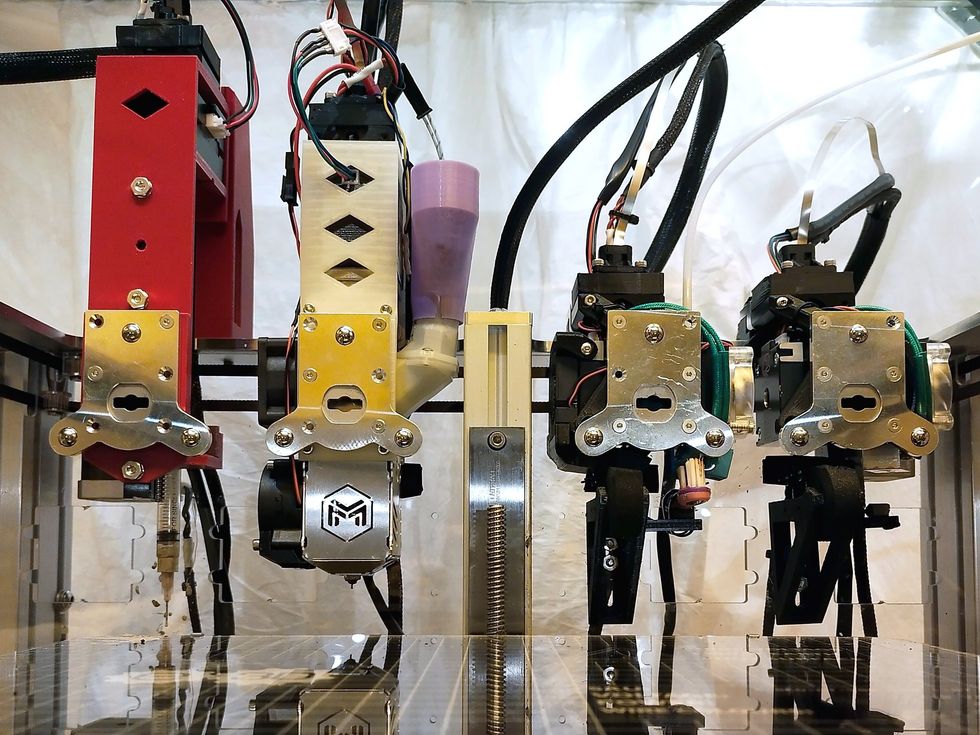
A research team at the Massachusetts Institute of Technology (MIT) has introduced a groundbreaking 3D-printing platform capable of producing functional electric motors in a fraction of the time and cost of traditional methods. In a paper published in Virtual and Physical Prototyping last month, the group revealed their multimaterial printing system can create a working electric linear motor in approximately three hours, utilizing five distinct functional materials.
Typical 3D printers are often limited to producing plastic parts, which poses challenges when creating sophisticated devices like electric motors. These motors require various materials for different functions: some conduct electricity, others insulate it, and some generate or guide magnetic fields. The MIT team aims to bridge the gap between 3D printing technology and functional hardware design, offering a solution that could drastically reduce hardware production costs and time.
The cost to produce the motor is around $0.50 in raw materials. The researchers believe this platform can make hardware engineering faster, more localized, and less susceptible to supply chain disruptions. Conventional methods for manufacturing electric motors involve assembling individually manufactured components through multiple fabrication steps. In contrast, the MIT system integrates these functional structures into a single print process, requiring only a post-print step to magnetize the motor’s hard magnetic parts.
Innovative Multimaterial Printing Technology
3D printing technology has evolved significantly since its inception in rapid prototyping. Yet, most current printers are still single-material devices optimized for plastics. Even those labeled as “multi-material” often utilize similar polymers rather than genuinely distinct materials. According to Luis Fernando Velásquez-García, principal research scientist at MIT Microsystems Technology Laboratories and the study leader, few applications can be satisfied with just one material. He asserts that producing functional hardware typically requires a combination of different materials.
MIT’s 3D-printing prototype can switch between four tools: a filament extruder, a pellet extruder, a heater for curing ink, and a custom ink extruder. The pellet-based tool is particularly advantageous as it enables higher concentrations of magnetic particles, enhancing the magnetic performance of printed components. Velásquez-García emphasizes the importance of using capable materials rather than merely printable ones. The limitations of printed devices often arise from the fundamental properties of the materials, which can impact performance significantly.
“The goal should be to deliver hardware that meets users’ needs,” states Velásquez-García. He argues that if materials can be used effectively in printing, it represents a win-win situation for both manufacturers and consumers.
Demonstrating the Potential of 3D-Printed Motors
For their demonstration, the MIT team focused on a linear motor, commonly used in high-precision applications such as chip wafer manufacturing and robotics. This motor serves as an effective testing ground for printed electromagnetics. Velásquez-García noted that the prototype system was constructed from a mix of off-the-shelf components and custom parts, costing “on the order of a few thousand dollars.”
The team reported that the printed motor performed comparably to or better than devices produced through conventional multi-step fabrication methods. It generated more actuation than standard linear systems that rely on hydraulic amplifiers, while only requiring a single post-print step to magnetize the motor.
Despite these advancements, the team is cautious not to overstate the current capabilities of their technology. Velásquez-García mentioned that they are still far from creating a fully functional electric vehicle drivetrain. The next target for the research team is to develop more complex rotating motors, which present additional challenges around coil density, thermal management, and mechanical durability.
Velásquez-García acknowledged the long journey ahead: “There’s a long way between what we have and a 3D-printed engine in an electric car. We need something that rotates and can handle temperature, load, and other factors.” He remains optimistic, noting that this research represents an exciting first step toward more sophisticated systems.
The MIT team plans to incorporate magnetization directly into the printing process and expand the system with additional tools. Ultimately, their goal is to create fully 3D-printed rotary motors, paving the way for more complex electronic systems produced entirely on a single platform.
This innovation could empower engineers to combine dissimilar materials and manufacture functional electromechanical designs remotely, potentially revolutionizing the way specialized components are fabricated without reliance on global logistics.