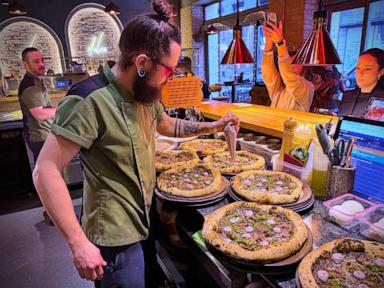
In a creative culinary venture, Neverland Pizzeria in Budapest has introduced a limited-edition pizza inspired by ancient Roman cuisine. This unique offering invites diners to experience flavors from a time when tomatoes and mozzarella were unknown in Europe, showcasing a blend of history and gastronomic innovation.
Josep Zara, the founder of Neverland Pizzeria, spearheaded this project following a recent archaeological discovery. In February 2023, researchers uncovered a fresco in Pompeii depicting a flatbread topped with ingredients like pomegranate seeds and spices. The image sparked Zara’s curiosity about what pizzas might have looked like in ancient Rome, prompting him to explore the culinary practices of that era.
While the Romans did not have pizza as we know it today, they did enjoy oven-baked flatbreads topped with various ingredients. Zara consulted historical texts, including De re coquinaria, believed to have been authored around the 5th century, to compile a list of ingredients that were commonly used during the Roman Empire.
The challenge was significant. Zara and his team had to exclude all ingredients that originated from the Americas, which meant omitting staples like tomatoes and mozzarella. László Bárdossy, the pizzeria’s head chef, described the constraints as a driving force behind their creative process. “We had to discard a couple ideas,” he recalled, noting that the lack of infrastructure, such as running water in ancient times, complicated the development of the pizza dough.
To overcome this obstacle, the team experimented with an innovative approach, using fermented spinach juice to help the dough rise. They incorporated ancient grains like einkorn and spelt, which were widely cultivated during Roman times. The result was a denser dough, distinct from modern pizza.
The toppings reflect the flavors associated with Roman aristocracy, featuring ingredients like epityrum, an olive paste, garum, a fermented fish sauce, confit duck leg, toasted pine nuts, ricotta, and a grape reduction. Bárdossy emphasized that while this creation is a modern interpretation, it is designed to be accessible to contemporary diners.
“Our creation can be called a modern pizza,” he said, “although we wouldn’t use all its ingredients for everyday dishes.” He acknowledged that while it caters to a niche market curious about historical cuisine, most customers still prefer traditional pizza options.
This project embodies the broader philosophy of Neverland Pizzeria. Zara expressed that the restaurant aims to blend innovation with tradition, constantly seeking to offer new and interesting culinary experiences. However, he made it clear that there are certain modern boundaries they will not cross. “We do a lot of experimentation with our pizzas. But of course, we definitely do not use pineapple,” Zara stated.
As Budapest’s dining scene continues to evolve, Neverland Pizzeria’s ancient Roman-inspired pizza stands out as a testament to culinary creativity and historical exploration, inviting guests to taste a slice of history.