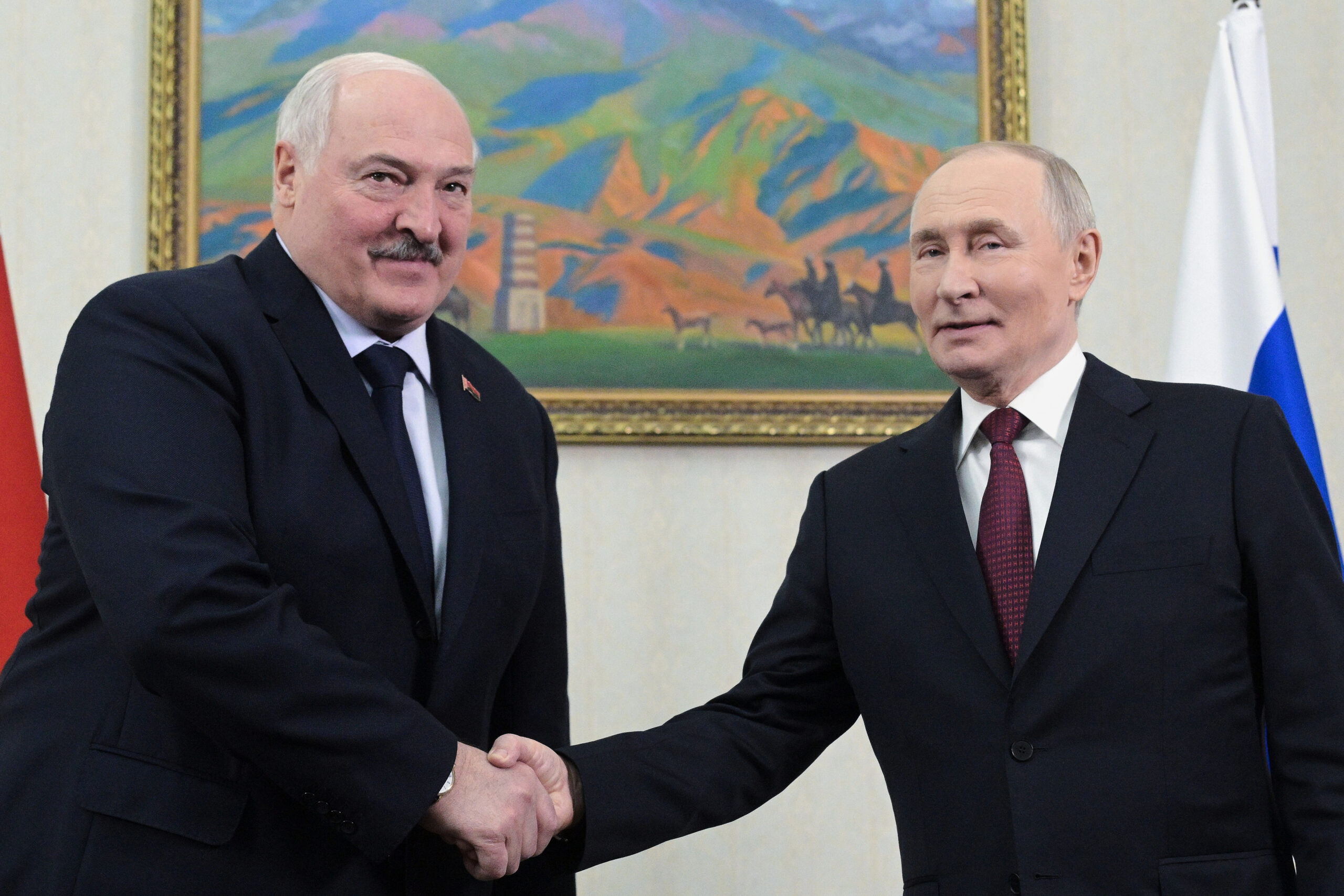
Belarusian President Alexander Lukashenko announced on Thursday that Russia has deployed its latest nuclear-capable missile system, the Oreshnik, to Belarus. This development comes as negotiations aimed at resolving the ongoing conflict in Ukraine have intensified. According to Lukashenko, the Oreshnik missile system arrived in Belarus on Wednesday and is now operational, although he did not disclose the number of missiles involved or provide additional specifics.
The Oreshnik is classified as an intermediate-range ballistic missile system. Russian President Vladimir Putin confirmed on the same day that the missile system would enter combat duty within the month, but he also refrained from sharing further information. This announcement occurred during a meeting with senior military officials, where Putin reiterated his commitment to expand Russian territorial gains in Ukraine if the demands set forth by the Kremlin are disregarded by Kyiv and its Western allies.
The United States has been actively engaged in diplomatic efforts to bring an end to the nearly four-year conflict that escalated following Russia’s full-scale invasion of Ukraine in February 2022. However, these efforts have faced significant obstacles due to conflicting demands from both Moscow and Kyiv.
Russia has a history of deploying tactical nuclear weapons on Belarusian soil, which has been used as a launch point for its military actions in Ukraine. Lukashenko previously indicated that Belarus hosts several dozen Russian tactical nuclear weapons. The Oreshnik missile, which translates to “hazelnut tree” in Russian, was first tested in November 2024 against a Ukrainian facility. Putin has claimed that the missile’s speed and advanced design make it nearly impossible to intercept.
Russian state media highlighted that the Oreshnik could reach a base in Poland in approximately 11 minutes and NATO headquarters in Brussels in around 17 minutes. The missile can carry either a nuclear or conventional warhead, making it difficult to ascertain its payload until impact. Intermediate-range missiles like the Oreshnik have a range of 500 to 5,500 kilometers (approximately 310 to 3,400 miles), a capability that was banned under a treaty abandoned by both Washington and Moscow in 2019.
Both Putin and Lukashenko have stated that the Oreshnik would be fully operational in Belarus by the end of 2024. During a security pact signing in December 2024, Putin indicated that while Russia would control the missile system, Belarus would still have input on target selection. He also noted that if the missiles targeted locations closer to Belarus, they could potentially carry a heavier payload.
The Kremlin’s revised nuclear doctrine, released in 2024, outlines that any conventional attack on Russia supported by a nuclear power will be perceived as a joint assault on the nation. This stance aims to deter the West from allowing Ukraine to employ longer-range weaponry against Russian targets and lowers the threshold for the potential use of nuclear weapons.
Lukashenko, who has maintained an authoritarian grip on Belarus for over three decades, has faced multiple sanctions from Western nations due to his government’s human rights violations and complicity in the invasion of Ukraine. While he continues to foster close ties with Moscow, Lukashenko has also sought to improve relations with the United States. Recently, he released 123 political prisoners, including Ales Bialiatski, a Nobel Peace Prize laureate, in a bid to ease U.S. sanctions impacting Belarus’s potash industry, a critical revenue source.
Belarusian opposition leader Sviatlana Tsikhanouskaya expressed concern over the deployment of the Oreshnik missiles, stating that it deepens Belarus’s military and political reliance on Russia. “The deployment of Oreshnik turns Belarus into a target and militarizes the country, and we stand categorically against it,” Tsikhanouskaya remarked. She accused Putin of using Lukashenko as a pawn in Russia’s broader strategic maneuvers.
As tensions continue to rise in the region, the implications of the Oreshnik’s deployment extend beyond military capabilities, affecting the geopolitical landscape and the balance of power in Eastern Europe.