President Donald Trump announced significant airstrikes on Kharg Island, Iran, on the evening of March 15, 2024. This military action is the most aggressive U.S. measure to address growing concerns about global oil supply and to ensure safe shipping through the vital Strait of Hormuz. In a post on Truth Social, Trump stated that under his direction, Central Command executed a powerful bombing raid that targeted military installations on the island. He emphasized that while the oil infrastructure was spared, any future interference with maritime traffic would prompt a reassessment of this decision.
Details surrounding the airstrikes remain limited. The action follows a statement from Iran’s newly appointed supreme leader, Mojtaba Khamenei, who indicated a determination to block the Strait of Hormuz. This declaration was broadcast on Iranian state television, marking Khamenei’s first major communication since succeeding his father, Ayatollah Ali Khamenei, who died on February 28. Since the onset of the conflict, over a dozen vessels have reportedly faced attacks in the Persian Gulf. The Islamic Revolutionary Guard Corps has claimed responsibility for several of these incidents, asserting that they would target any ship attempting to navigate the strait.
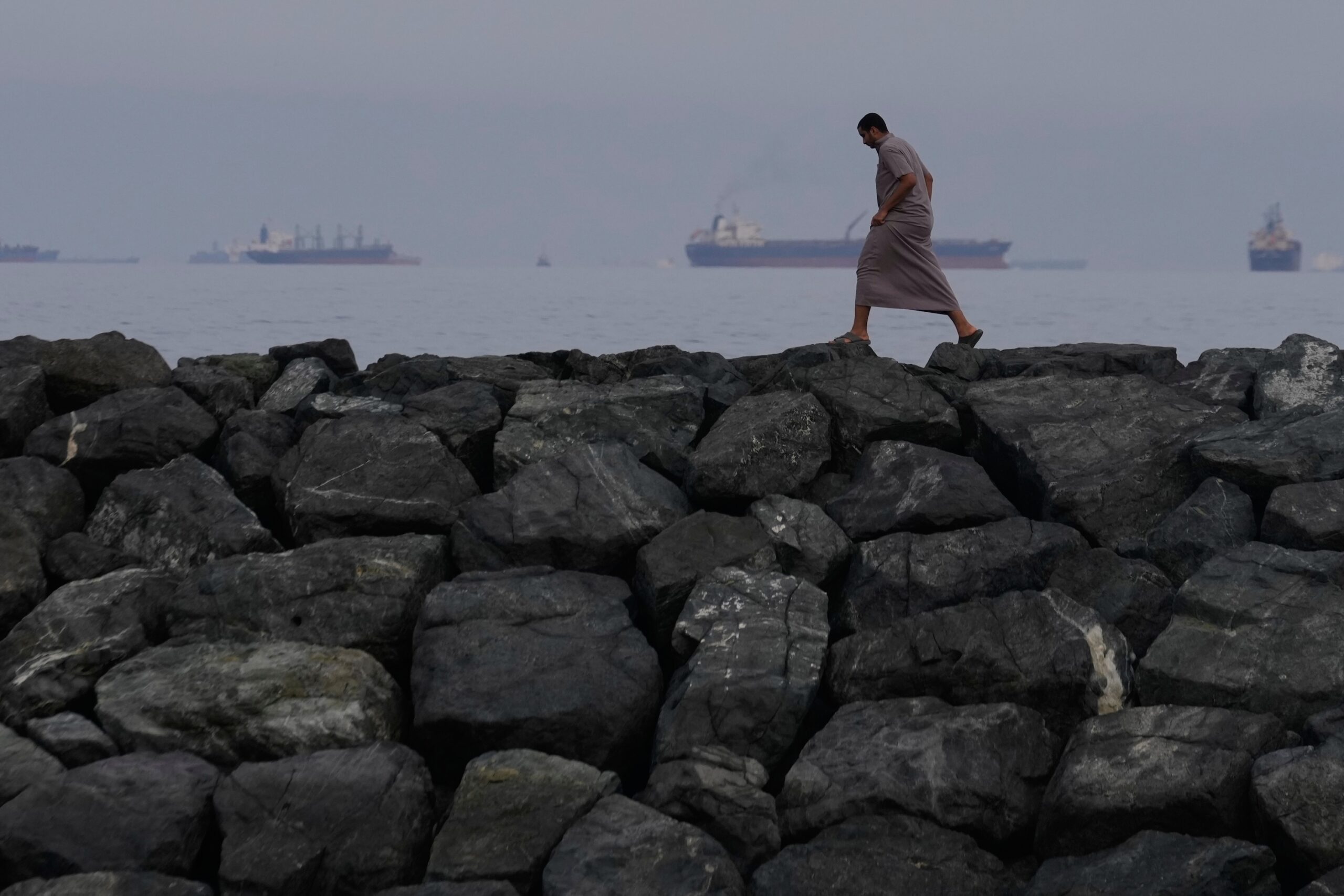
The Strait of Hormuz is critical for global oil trade, accounting for approximately 20% of the world’s petroleum liquids and liquefied natural gas. As tensions have escalated, prices for Brent crude oil futures have surged past $100 a barrel, a significant increase from around $70 prior to the conflict. Analysts warn that Iran’s strategy could lead to significant instability in the region, with repercussions for global markets.
Scarlett Suarez, a senior intelligence analyst at Dryad Global, stated, “These strikes target commercial vessels regardless of flag or ownership, including neutral or third-party ships and those connected to Gulf neighbors, fueling widespread fear and uncertainty.” She characterized Iran’s approach as one of “indiscriminate asymmetric attacks,” which can create chaos in maritime operations.
Looking back, the Tanker War phase of the Iran-Iraq War during the 1980s saw similar tactics, where Iran mined waters in and around the Strait of Hormuz. Notably, in 1988, an Iranian mine severely damaged the USS Samuel B. Roberts, leading to a substantial U.S. military response known as Operation Praying Mantis, which resulted in the destruction of several Iranian vessels and oil platforms.
Today, Iran employs a multifaceted strategy of asymmetric naval warfare, utilizing fast-attack boats, drones, shore-based missile systems, and various types of sea mines. Retired Navy Captain Bill Hamblet, editor-in-chief of the U.S. Naval Institute’s “Proceedings,” noted, “It’s a multidimensional threat.” He explained that locating and clearing mines is a slow and complex operation, further complicated by the need to protect mine-clearing efforts from additional threats like drones and small attack craft.
Iran reportedly possesses between 5,000 and 6,000 naval mines, including limpet mines, moored mines, and bottom mines, according to a 2025 congressional report. These mines pose significant risks to commercial shipping. In a Pentagon briefing, Secretary of Defense Pete Hegseth stated that there is “no clear evidence” of new Iranian mine placements in the Strait. He characterized Iran’s recent actions as “sheer desperation” in the region.
As the situation unfolds, the international community remains watchful of developments in the Strait of Hormuz, recognizing its critical role in global energy security. If tensions continue to escalate, the potential for further military action could reshape maritime safety and oil supply chains worldwide.