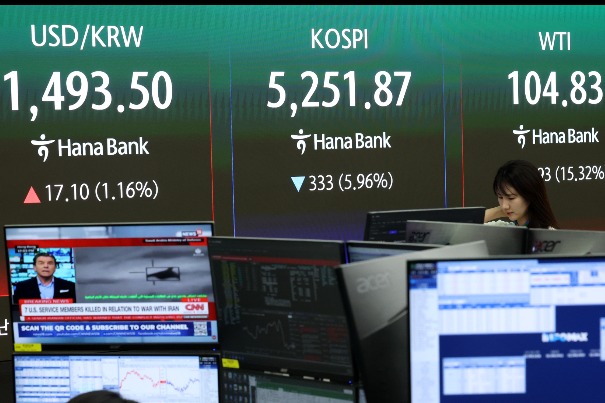
URGENT UPDATE: South Korean equities are in freefall, with the benchmark Kospi plummeting more than 8% today, March 9, 2023, as investors react to a dramatic spike in oil prices linked to the escalating US-Israel-Iran conflict. The index was forced to trigger a circuit breaker after briefly dipping below 5,100, closing at 5,251.87 in Seoul trading.
The Kosdaq also faced severe losses, ending down 4.5% at 1,102.28 after an initial drop of 7.6%. This sharp decline follows a brief period of recovery, indicating a turbulent market ahead.
Investors are fleeing risk assets as West Texas Intermediate (WTI) crude prices soared nearly 26% to $114.49 per barrel, marking its highest level since July 2022. Analysts warn that South Korea’s heavy reliance on Middle Eastern energy imports makes its economy especially vulnerable during times of geopolitical tension.
“Given South Korea’s heavy dependence on energy imports from the Middle East, a spike in oil prices amid a closure of the Strait of Hormuz could intensify risk-averse sentiment,”
stated Lee Sung-hoon, an analyst at Kiwoom Securities Co.
Trading disruptions occurred early in the session, with the Kospi opening down nearly 6% and triggering a sell-side circuit breaker after Kospi 200 futures dropped more than 5%. The Korea Exchange halted trading for 20 minutes to stabilize the market dynamics as panic selling took hold.
The South Korean won weakened to 1,495.50 per dollar, nearing the psychologically significant 1,500 level, its lowest since March 2009. Foreign investors led the sell-off, dumping a net 3.2 trillion won ($2.1 billion) in shares on the main board, while local institutions also offloaded significant holdings.
Major companies bore the brunt of the sell-off. SK Hynix dropped 9.5%, Hyundai Motor fell 8.3%, and Samsung Electronics lost 7.8%. The trend was mirrored in the Kosdaq, where Rainbow Robotics tumbled 11.2%.
This market turmoil follows a broader global risk-off sentiment, with the Dow Jones falling over 400 points on Friday due to rising oil prices and disappointing US labor data.
Strategists caution that the current market may not quickly recover. “The index has entered a deep-value zone,” said Lee Kyung-min of Daishin Securities Co. However, others warn that without significant changes in macroeconomic conditions, volatility will likely persist.
As the situation develops, investors are urged to monitor the unfolding geopolitical events in the Middle East and their potential impacts on global energy prices and South Korea’s economic stability. Share this breaking news to keep others informed about these urgent developments.