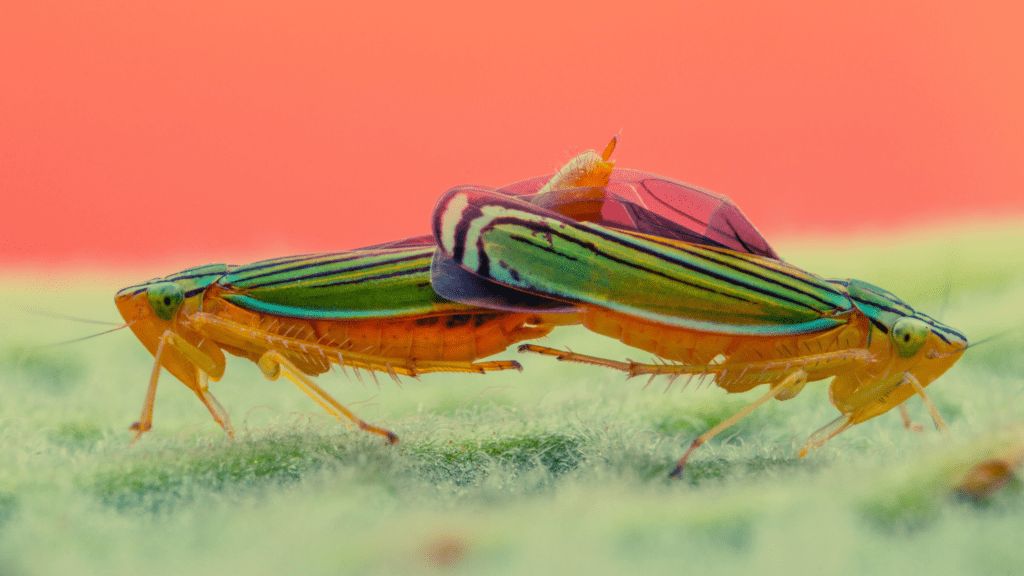
URGENT UPDATE: Researchers at Penn State University have just announced a groundbreaking discovery that replicates the remarkable ability of leafhoppers to become nearly invisible. This innovative research, detailed in the journal ACS Nano, reveals how scientists are harnessing nature’s design to create advanced materials that could revolutionize multiple industries.
Leafhoppers, small green insects often unnoticed, have a unique survival tactic: they coat themselves with tiny particles that reduce glare, making them difficult for predators to spot. This process is now being mimicked in a lab setting, providing exciting possibilities for new technologies.
The study focuses on structures called brochosomes, tiny hollow particles produced by leafhoppers. Each brochosome resembles a mini soccer ball, featuring intricately arranged holes that scatter light rather than reflecting it directly. This innovative design results in a substantial reduction of reflected glare by an impressive 80 to 96 percent across both visible and ultraviolet light.
The Penn State team crafted these particles using a novel microfluidic system. This system generates microscopic droplets containing dissolved polymers, which, as the solvent evaporates, form hollow spheres with light-scattering pores. By manipulating the polymer chemistry, the researchers achieved control over particle size and pore shape, successfully recreating five distinct brochosome designs observed in various leafhopper species, ranging from a few hundred nanometers to about two micrometers in size.
One of the most astonishing aspects of this method is its speed. The microfluidic system can produce over 100,000 particles per second, a rate that far surpasses traditional nanoscale manufacturing techniques. This rapid production capability suggests potential applications well beyond the laboratory.
The implications of this research are vast. Industries such as energy devices could see improved efficiency through surfaces that reflect less light. Optical materials might benefit from enhanced glare control, and military applications such as advanced camouflage are already being considered—though further testing is essential for practical use. Additionally, the unique properties of these particles open doors for biomedical applications, including targeted drug delivery.
What makes this study particularly compelling is the ordinary source of inspiration: a common backyard insect. The leafhopper has evolved a fascinating mechanism for managing light that researchers are now learning to replicate on a larger scale, showcasing the incredible potential of nature-inspired technology.
As scientists continue to explore the applications of these replicated structures, the world waits to see how this discovery will impact industries and daily life. Stay tuned for more updates on this developing story.