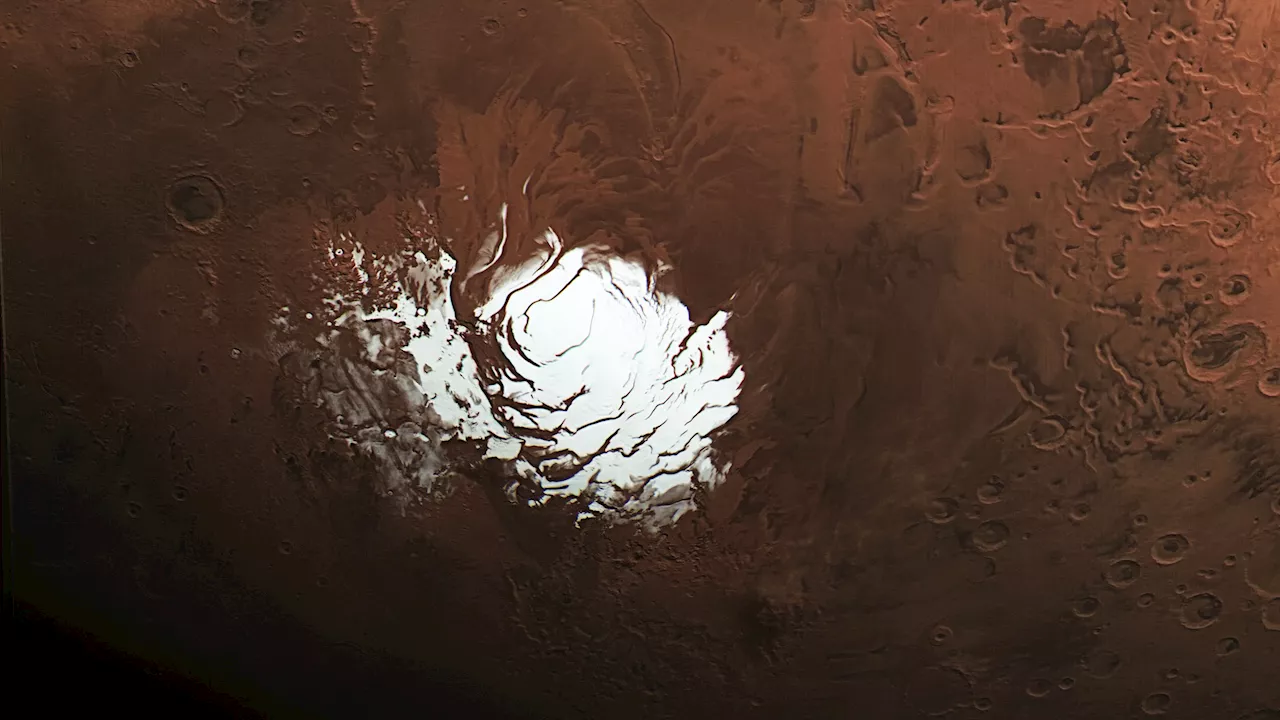
BREAKING: NASA’s Mars Reconnaissance Orbiter (MRO) has just revealed significant new findings regarding a mysterious feature beneath the Martian south pole, overturning previous assumptions about the presence of an underground lake. In a groundbreaking study published on May 26, 2023, researchers re-evaluated earlier data using an innovative radar technique, offering a fresh perspective on one of Mars’ long-standing enigmas.
This urgent development sheds light on a region previously thought to host liquid water, which has profound implications for the search for life beyond Earth. The unexpected results indicate that what scientists had interpreted as a lake may actually be a layer of rock and dust buried beneath nearly a mile of ice.
The initial discovery of the suspected lake in 2018 sparked excitement within the scientific community, as water is crucial for life. However, the latest data complicates that narrative, suggesting the area is more complex than previously thought. “While this new data won’t settle the debate, it makes it very hard to support the idea of a liquid water lake,” stated Gareth Morgan, one of the lead scientists from the Planetary Science Institute.
The MRO utilized a special maneuver, rolling 120 degrees to enhance the capabilities of its Shallow Radar (SHARAD) instrument. This advancement allowed the radar to penetrate deeper into the Martian subsurface, ultimately revealing a faint signal rather than the strong reflection expected from liquid water.
The southern ice cap of Mars, which has been extensively studied, is sitting atop heavily cratered terrain. Most radar images of the area show numerous peaks and valleys, suggesting a geologically diverse region. Morgan and his colleague Than Putzig are excited about applying this sophisticated radar technique to other unexplored regions of Mars, which could unveil potential resources for future missions.
With the Martian south pole’s ice cap covering a vast area of approximately 12.5 miles, this new research emphasizes the need for continued exploration. The radar results suggest that the bright signal previously detected by the European Space Agency’s Mars Express orbiter could be attributed to a unique geological feature, possibly an ancient lava flow, rather than a body of water.
“This map shows the approximate area where in 2018 ESA’s Mars Express detected a signal that scientists interpreted as an underground lake,” Morgan explained. The study highlights the importance of collaboration between NASA and the European Space Agency, as both organizations work together to unlock the secrets of Mars.
The implications of these findings extend beyond the immediate scientific community; they may alter future exploration plans. If liquid water exists in other areas, particularly near the equator where conditions are more favorable for human missions, it could significantly influence where astronauts are sent on Mars. “If it’s ice, that means there’s lots of water resources near the Martian equator, where you’d want to send humans,” Putzig added.
NASA’s Jet Propulsion Laboratory in Southern California manages the MRO mission as part of the agency’s broader Mars Exploration Program. Lockheed Martin Space in Denver built the MRO and continues to support its operations.
As researchers continue to analyze the data from this latest mission, the scientific community remains hopeful about uncovering more about the Red Planet’s mysteries. The advanced radar techniques could lead to groundbreaking discoveries in other scientifically intriguing regions of Mars, sparking excitement for the future of extraterrestrial exploration.
Stay tuned for more updates as NASA unveils new findings and developments surrounding this Martian mystery.