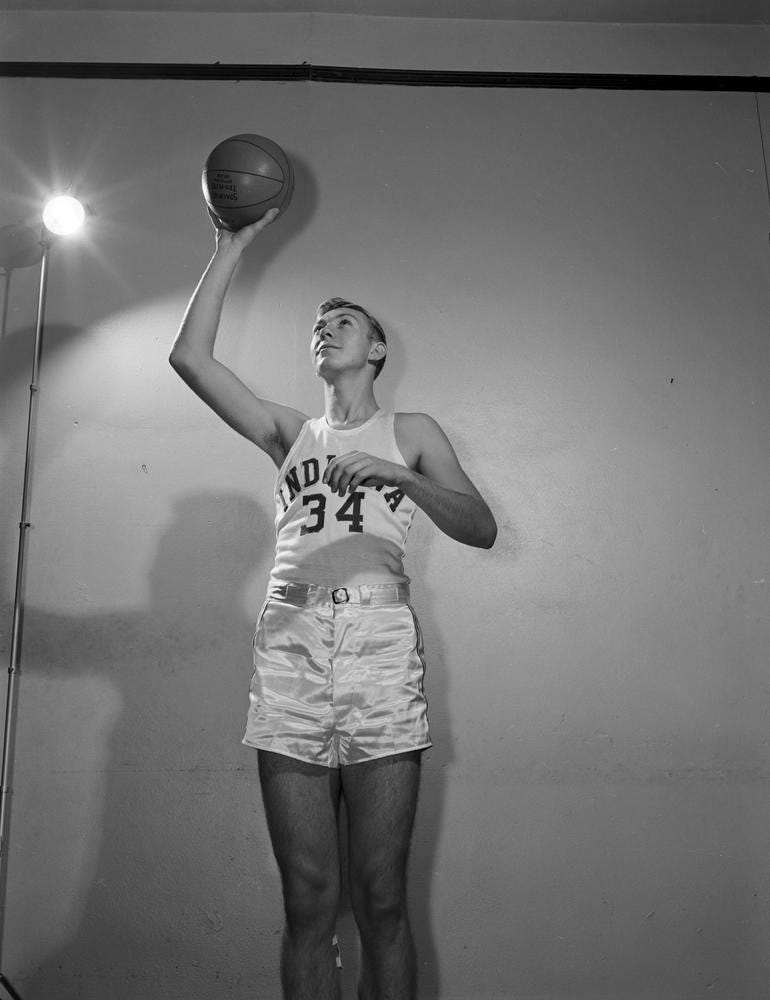
UPDATE: The legacy of Don “Ox” Schlundt, a pivotal figure in Indiana University basketball history, is gaining renewed attention as sports fans reflect on his remarkable achievements. Schlundt led the Hoosiers to a national championship in 1953, during a grueling tournament that required four victories in just six days. Yet, despite his extraordinary accomplishments, including scoring 41 points in an NCAA regional final and holding the school scoring record for over three decades, he remains an underappreciated figure in the sport.
Just announced: As fans reignite discussions about basketball legends, many are questioning why Schlundt, who played as a center standing between 6-9 and 6-10, isn’t a household name. This renewed interest has sparked a wave of nostalgia among those who remember the golden age of college basketball in the 1950s.
In his senior season, Schlundt averaged an impressive 25.4 points per game, securing the Chicago Tribune’s Silver Basketball as Big Ten Player of the Year. However, he never played in the NBA, rejecting a $5,500 offer from the Syracuse Nationals, a decision influenced by his successful career in insurance and his disinterest in the professional game’s demands. His widow, Gloria Gary, stated, “He really was actually tired of the traveling… He was just as happy to retire and sell insurance.”
Schlundt’s contributions to basketball are undeniable. He was ranked 75th in Bleacher Report’s top 100 college players and even 50th in Sports Illustrated’s list of NCAA tournament greats. Yet, the Naismith Memorial Basketball Hall of Fame has not recognized him, raising questions about the criteria used for induction. His son, Mark Schlundt, expressed curiosity about whether his father’s name was ever considered for the honor.
Teammates and sports historians describe Schlundt as “about 30 years ahead of his time,” illustrating his unique skill set that included an ability to shoot from outside, setting him apart in an era dominated by inside play. Former teammate Bob Leonard noted, “Don was a great college basketball player and could have been an outstanding pro basketball player, had he so desired.”
Born on March 15, 1933, in St. Joseph County, Indiana, Schlundt’s journey to stardom began on a dirt court against his brother. His talent blossomed after a significant growth spurt, transforming him from a pudgy freshman into a formidable player by his senior year. At Washington-Clay High School, he garnered attention for his scoring prowess, eventually leading the team to a sectional championship.
The turning point in Schlundt’s career came when he chose to attend Indiana University, where he quickly became a standout player. His first season culminated in a memorable performance against Purdue, scoring 29 points in an 82-77 victory. His college career peaked during the 1953 NCAA tournament, where he scored 30 points by halftime in the regional final against Notre Dame, a game that solidified his status as a basketball icon.
After his college career, Schlundt briefly played with the Peoria Caterpillars in the National Industrial Basketball League before trying out for the U.S. Olympic team in 1956. However, his basketball journey came to an end as he opted for a more stable life outside the sport, focusing on family and career.
While discussions about his legacy continue, it’s clear that Don Schlundt’s impact on Indiana basketball and college sports remains significant. His story serves as a reminder of the many athletes whose dedication and talent may not have received the recognition they deserved during their time.
As fans and historians reflect on Schlundt’s extraordinary career, the conversation around his contributions to basketball is more pertinent than ever. The debate continues on whether he deserves a spot in the Naismith Hall of Fame, while his family and fans advocate for his legacy to be celebrated in the annals of sports history.
Watch for ongoing discussions regarding Don Schlundt and his rightful place in basketball history, as more voices join the conversation about this forgotten legend.