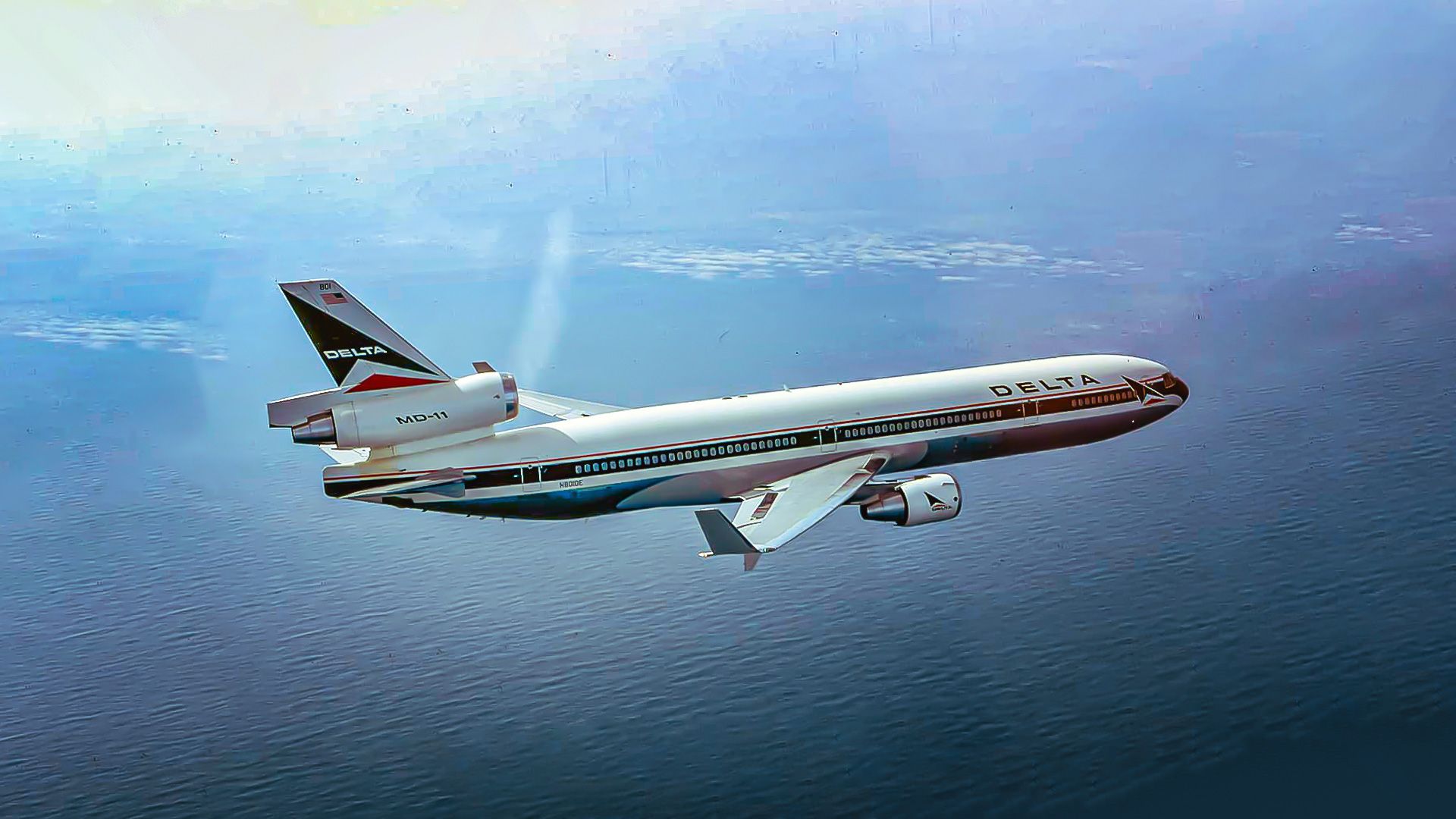
The McDonnell Douglas MD-11, known for being aviation’s last major three-engine aircraft, served various airlines across the globe from the early 1990s until the 2000s. Designed as an advanced evolution of the DC-10, the MD-11 introduced a stretched fuselage, updated avionics, and winglets, promising enhanced range and better fuel efficiency. Despite its initial appeal, the aircraft became a transitional model, as the airline industry shifted toward more economical twin-engine jets.
American Airlines: A High-Capacity Workhorse
American Airlines operated a fleet of 18 MD-11s, utilizing them as a high-capacity long-range solution during a period marked by expansive global networks. The aircraft was introduced in 1991 and retired by 2001. The MD-11 met American’s needs for an efficient jet capable of transporting large numbers of passengers and cargo without resorting to larger models like the Boeing 747.
During its service, the MD-11 represented a bridge between the classic widebody era and the emerging dominance of long-range twin-engine models. As fuel prices rose and the economics of the industry evolved, American’s MD-11s became less aligned with the cost efficiencies of newer aircraft, leading to their retirement.
China Airlines: Targeted Capacity Solutions
China Airlines operated four MD-11s, starting in 1992 and retiring them by 2002. For the airline, the MD-11 was not the centerpiece of its fleet but rather a tactical solution to meet peak demand on long-haul routes. The aircraft’s design allowed for a blend of passenger capacity and cargo capabilities, enabling the airline to leverage its strengths without committing to a large fleet of widebody jets.
The relatively short period of MD-11 operations at China Airlines reflects a broader trend as international carriers adjusted their fleets in response to advancements in twin-engine aircraft technology.
Delta Air Lines: Longevity and Specialization
Delta Air Lines maintained a fleet of 17 MD-11s, which entered service in 1990 and were retired in 2005. The aircraft provided Delta with a modern and efficient widebody option amid increasing international competition. While the MD-11 initially served well, the industry’s shift toward twin-engine aircraft ultimately led to its retirement, as newer jets offered comparable range with lower operational complexities.
Delta’s decision to operate the MD-11 for an extended period compared to peers indicates that it found suitable missions for the aircraft until economic pressures necessitated a transition to fuel-efficient twinjets.
Finnair: Geographic Logic in Operations
Finnair’s MD-11 operations included seven aircraft, introduced in 1990 and retired by 2010. The airline effectively matched the MD-11’s capabilities with its Helsinki-based network, which favored long-haul flying. Finnair successfully integrated the MD-11 into its plans, enhancing its intercontinental identity while balancing passenger traffic with cargo needs.
By the time of the aircraft’s retirement, competitive pressures and fuel economics favored the adoption of newer twin-engine models, marking a significant transition for the airline.
Garuda Indonesia: Brief Operations and Challenges
Garuda Indonesia operated a small fleet of five MD-11s from 1991 to 1998. Although the aircraft was suitable for long-haul routes, it faced economic challenges that made sustained operations difficult. The late 1990s saw rising fuel costs and maintenance expenses, leading Garuda to exit the MD-11 program quickly.
The airline’s experience illustrates the challenges smaller fleets faced when operating three-engine aircraft during a time of significant market changes.
Japan Airlines: Strategic Capacity Planning
Japan Airlines incorporated ten MD-11s into its fleet, beginning operations in 1993 and retiring them by 2004. The aircraft’s blend of passenger capacity and cargo volume suited JAL’s needs for international routes. However, as twin-engine models gained efficiency and range, JAL’s reliance on the MD-11 diminished.
The retirement of the MD-11 marked a shift in JAL’s long-haul strategy, as the airline increasingly turned to widebody twinjets to meet evolving market demands.
KLM Royal Dutch Airlines: An Iconic Operator
KLM Royal Dutch Airlines became the most iconic operator of the MD-11, maintaining a fleet of ten aircraft until 2014. KLM’s long-term commitment to the MD-11 demonstrated its reliability and performance within the airline’s network. The aircraft’s ability to serve various long-haul missions without the demand for larger aircraft was a key advantage.
Despite its successful integration, KLM faced the same market pressures that prompted other airlines to retire the MD-11. The industry’s move towards twin-engine aircraft ultimately led to the aircraft’s phased-out operations.
The MD-11’s legacy is a testament to the changing dynamics of the airline industry, illustrating a significant shift from three-engine aircraft to more efficient twin-engine models. As airlines transitioned their fleets, the MD-11, once a prominent player, gradually faded from service, yet it continues to hold a place in aviation history.