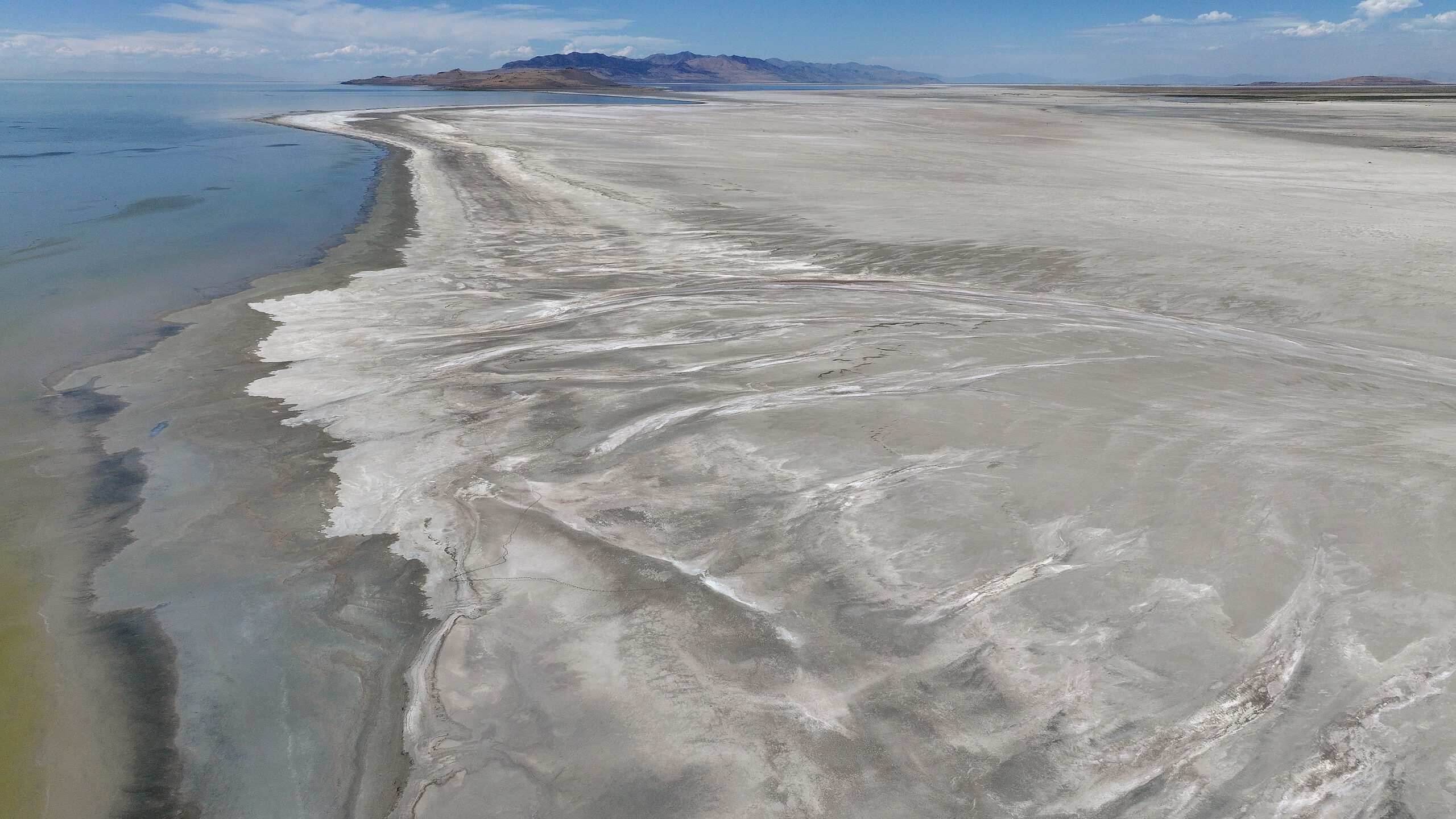
The Great Salt Lake, the largest saltwater lake in the Western Hemisphere, is facing a critical decline, prompting Utah Governor Spencer Cox to announce ambitious plans for restoration. Over the past several decades, the lake’s area has decreased from approximately 2,300 square miles in 1986 to around 1,700 square miles today. Governor Cox has committed to restoring the lake to full capacity by the time the 2034 Winter Olympic Games are held in Utah, a promise that entails significant efforts to combat its current “serious adverse effects” status.
To reverse the lake’s decline, Brian Steed, the Great Salt Lake Commissioner, indicated that the state will need to introduce an estimated 261 billion gallons of water, or 800,000 acre-feet. The lake’s diminishing water levels have been largely attributed to extensive municipal and industrial water usage, which diverts water from rivers and reservoirs before it can flow into the lake. Additional factors include rising temperatures that accelerate evaporation and insufficient rainfall in the region.
Utah lawmakers have prioritized the lake’s restoration in their current legislative session, as noted by Senate President Stuart Adams, a Republican from Layton. Among the proposals under consideration are several bills aimed at addressing the lake’s shrinkage:
– **Water Usage Reporting**: HB76, sponsored by Rep. Jill Koford, R-Ogden, mandates data centers to report their water consumption. Failure to comply could result in a daily penalty of $10,000 until reports are submitted.
– **Water Redirection for Farmers**: HB348, also sponsored by Koford, introduces a “dedicated water application” process, allowing farmers to temporarily redirect part of their water rights for storage in reservoirs or for instream flow.
– **Increased Water Costs for Lawns**: HB155, led by Rep. Doug Owens, D-Millcreek, proposes raising rates for additional water use to encourage homeowners to conserve water.
Additionally, SB250, sponsored by Sen. Nate Blouin, D-Salt Lake City, seeks to divert $200 million from the Bear River Development project to support the Great Salt Lake’s revitalization efforts.
The situation was further complicated when the mining company US Magnesium filed for bankruptcy in September 2023. The state acquired their land, water rights, and mining agreements for $30 million. This acquisition includes a significant portion of the Great Salt Lake’s southwest shore, which previously contributed over 52,000 acre-feet of lake brine and groundwater annually. The state is expected to retain nearly 17 billion gallons of water in the lake as part of its efforts to mitigate the crisis.
Concerns about public health are rising due to the potential dangers posed by dust from the exposed lakebed. Studies have identified contaminants such as arsenic and mercury, which pose health risks when inhaled. Kevin Perry, a professor of atmospheric sciences at the University of Utah, highlighted the lack of direct evidence linking arsenic levels in surrounding communities to the lake. Currently, there are only six dust monitors in northern Utah, and experts argue that more are needed in areas most likely to be affected, particularly cities like Syracuse, Layton, and Clearfield.
In a bid to increase precipitation, Utah’s Legislature approved a one-time funding of $12 million and an ongoing $5 million per year to support cloud seeding initiatives. This weather modification technique can enhance precipitation by dispersing substances like silver iodide into clouds. According to Utah’s Division of Water Resources, cloud seeding has previously resulted in a 5-15% increase in rainfall in targeted areas.
The state has also made strides in modernizing its cloud seeding operations with remote generators placed at higher elevations for greater effectiveness. This initiative has garnered support from various lawmakers, including Rep. Calvin Musselman, R-West Haven, who emphasized the need for innovative approaches to water management.
While community concerns over air quality persist, it is essential to note that the temperature inversions observed during January and February in the Salt Lake Valley are not primarily caused by dust from the lake. Perry clarified that these inversions trap pollutants but do not typically coincide with dust events, as the lack of wind and the lake’s moisture during this period mitigate dust dispersal.
The urgency to restore the Great Salt Lake reflects broader environmental challenges faced by Utah. With concerted efforts from state officials, lawmakers, and scientific communities, there is a glimmer of hope for the future of this vital natural resource.