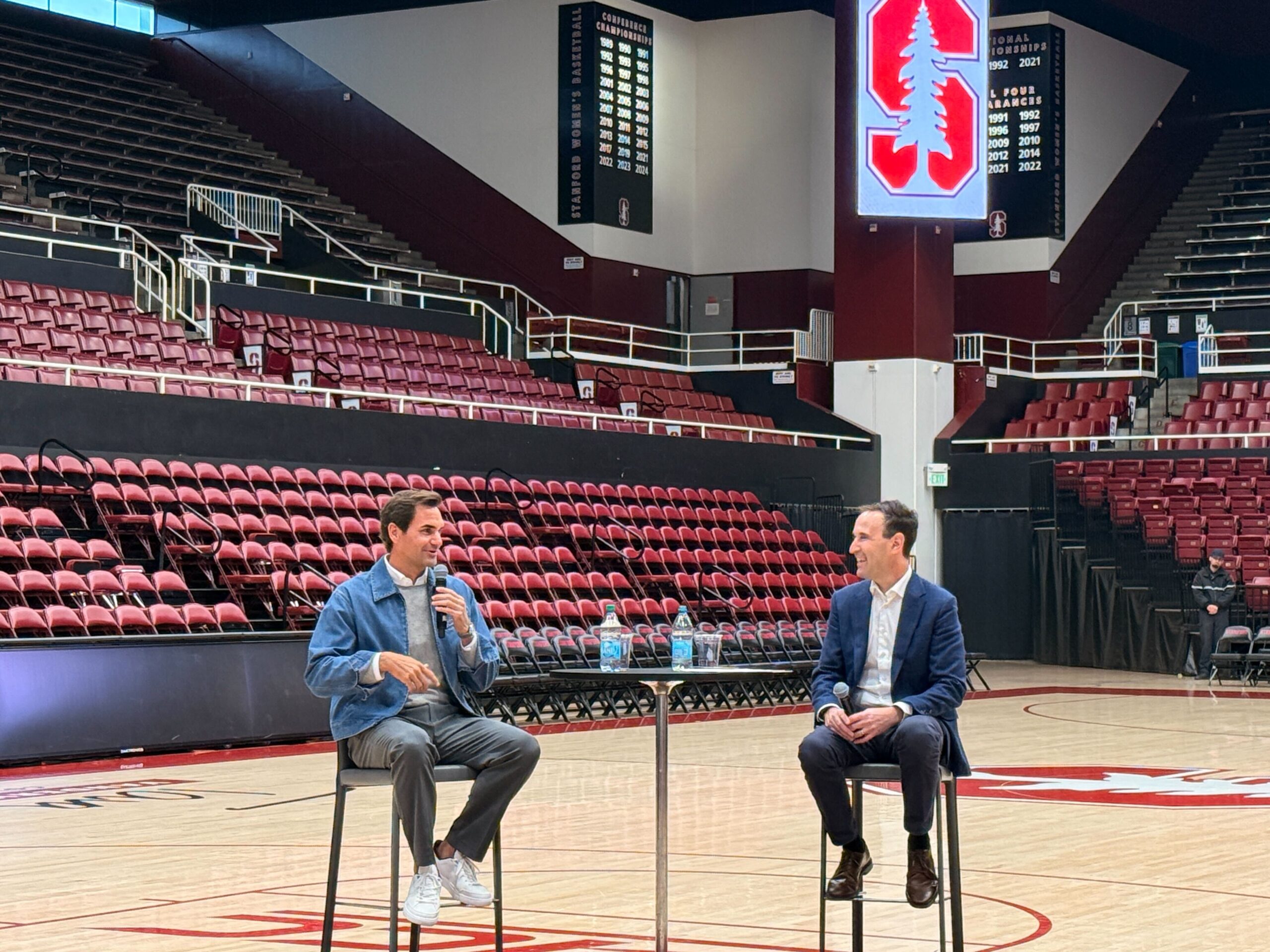
On Monday, Roger Federer, the renowned 20-time Grand Slam champion and former world No. 1 tennis player, engaged in a thought-provoking discussion with Jonathan Levin, president of Stanford University. The event, hosted by the Department of Athletics and the Office of Vice Provost for Undergraduate Education, was held at Maples Pavilion to accommodate an audience of approximately 1,600 attendees due to high demand.
Federer, who holds the record for 237 consecutive weeks as the world’s top-ranked player, was introduced by Nico Godsick, a member of the Stanford men’s tennis team. Godsick remarked on Federer’s character, noting, “He spends as much time talking to young players, ball kids, and tournament organizers as he does speaking with world leaders and fellow champions.” This sentiment underscores the impact Federer has had beyond the tennis court.
During the conversation, Federer reflected on his personal development throughout his career and the importance of resilience in overcoming challenges. He candidly shared moments from his early days on the court, recalling feelings of sadness and frustration when things did not go well. “When I used to play, I’d be very sad, crying, commentating [that I was] playing bad, everything’s bad,” he said. Realizing that these outbursts were detrimental to his performance led him to a pivotal mindset shift. “I need to be my own boss,” he emphasized, highlighting the significance of independence in sports.
Federer also addressed the mental health challenges faced by elite athletes, stating, “The sport, the grind, the pressure can really get to you.” He shared his journey through these pressures and how he emerged with greater knowledge and happiness. “I came out on the other side with knowledge, happiness…and very few regrets,” he added.
The former champion stressed the importance of surrounding oneself with an inspiring team. He recounted the decision to hire his idol, Stefan Edberg, during a challenging period in 2014. “To spend time in the presence of my hero — that’s super inspiring,” Federer noted. He acknowledged that building a sustainable mindset towards setbacks is essential for athletes, stating, “Only one guy leaves as a winner in the Grand Slam; all the other 20-plus players leave having lost.”
The event also delved into Federer’s rivalries with fellow tennis greats Novak Djokovic and Rafael Nadal. He humorously reflected on how their presence in the sport shaped his career: “You see how unfortunate I was: if they wouldn’t have been there, how much more I would have won?” Despite the competitiveness, Federer maintained a sense of camaraderie with his rivals, describing their connections as brotherly. “We are like brothers in many ways,” he said, noting the shared experiences from their lengthy careers.
The discussion concluded with a Q&A session, where Levin addressed questions from the audience. Federer, who retired from professional tennis in 2022 at the age of 41, spoke about his life after tennis. He shared that he has been traveling extensively with his family and expressed his desire to protect his schedule to allow time for creative pursuits. “Right now, I’m in a great spot defending or protecting my schedule as much as possible,” he said.
Levin praised Federer’s positive outlook, stating, “There’s something for everyone to learn in being able to view and have such a relentlessly positive approach and turn setbacks into opportunities.” The event served not only as a reflection on Federer’s illustrious career but also as an inspiring conversation for students and attendees, reinforcing the value of perseverance and resilience in all aspects of life.