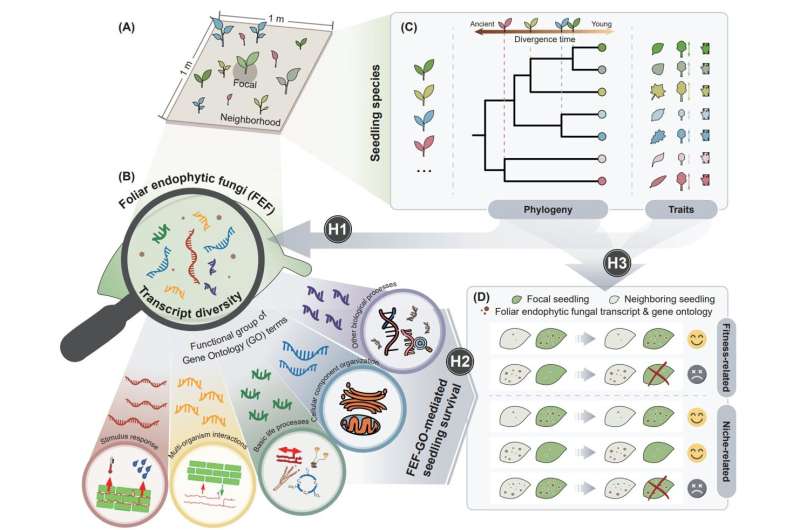
Research published in the journal Ecology Letters has highlighted the significant yet often overlooked role of plant-associated microorganisms, particularly foliar endophytic fungi (FEF), in enhancing seedling survival within subtropical forests. Led by Prof. Liang Yu from the Chinese Academy of Sciences, the study reveals how these fungi contribute to species coexistence and biodiversity maintenance.
The researchers conducted an extensive analysis that integrated transcriptomic data from seedlings of 103 woody species, functional traits, and long-term monitoring data from the Gutianshan forest plot. By extracting and annotating transcripts from FEF, the team successfully connected microbial functional genomics with contemporary coexistence theory.
This innovative approach clarified the pathways linking the molecular functions of FEF to the fitness and niche of their host plants, ultimately influencing seedling survival. The analysis uncovered that the diversity of FEF transcripts is shaped by both the phylogenetic divergence time of host species and their maximum tree height. FEF functions significantly enhance seedling survival through mechanisms related to fitness and niche differentiation.
The researchers identified 118 Gene Ontology (GO) terms that were significantly associated with seedling survival. Their findings revealed a dual regulatory mode impacting these effects. GO terms with a high dependence on host phylogeny improved survival through fitness differences arising from multi-organism interactions. Conversely, GO terms reliant on host traits facilitated survival through niche differentiation tied to essential biological processes.
These findings carry considerable implications for the conservation and management of forest biodiversity. Traditional ecological theories have primarily emphasized plant–plant interactions, often neglecting the critical contributions of microbial symbionts like FEF. The study underscores the importance of incorporating microbial roles into ecological restoration and conservation strategies to ensure long-term biodiversity outcomes.
By shedding light on the interactions between fungi and their host plants, this research opens new avenues for understanding and preserving the complex dynamics of subtropical forest ecosystems. The crucial insights from this study will help inform future biodiversity conservation efforts, ensuring that both plant and microbial communities are considered in ecosystem management.
For more detailed insights, refer to the research by Baocai Han et al., titled “Molecular Functional Diversity of Foliar Endophytic Fungi and Their Contributions to Seedling Survival in a Subtropical Forest,” published in Ecology Letters in 2025.