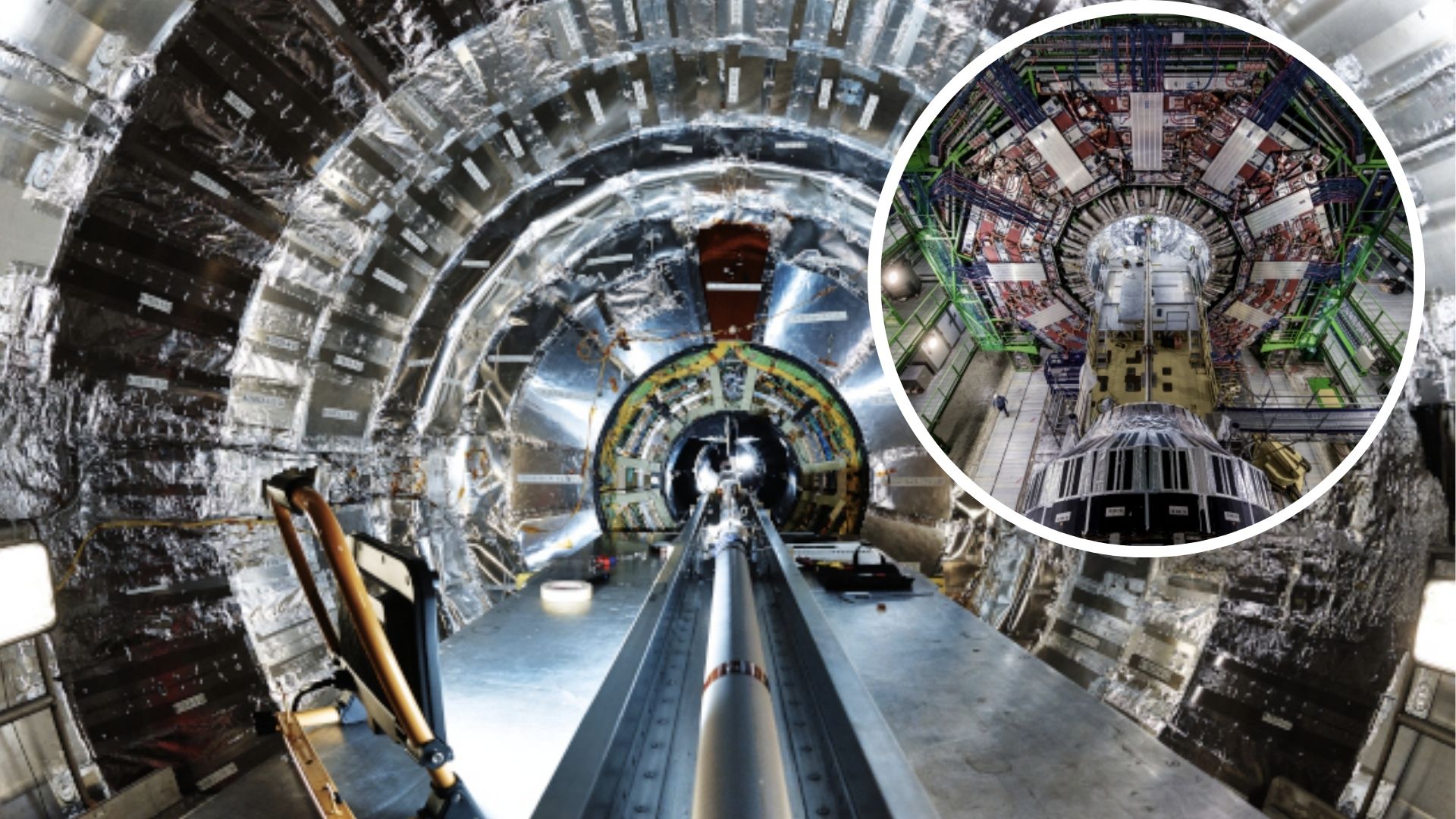
Researchers at the Large Hadron Collider (LHC) have made significant strides in understanding the behavior of particles resulting from heavy ion collisions. New measurements suggest that the observed pattern of “flow” in these particles is indicative of their collective behavior, shaped by pressure gradients under extreme conditions. This research sheds light on a state of matter similar to that which existed shortly after the Big Bang.
The findings, led by physicist Jiangyong Jia from Stony Brook University and Brookhaven National Laboratory, confirm that particles emerging from these collisions exhibit a fluid-like nature. Jia emphasized that the latest analysis from the ATLAS collaboration not only verifies previous observations but also introduces a new aspect of particle dynamics. The study focuses on “radial” flow, which has distinct geometric origins compared to the previously studied “elliptic” flow, offering insights into different viscosities within the quark-gluon plasma (QGP).
Complementary Research Enhances Understanding
The ATLAS findings are bolstered by complementary measurements from the ALICE detector, another experimental facility at the LHC. ALICE has published its results concurrently in the same issue of Physical Review Letters. Peter Steinberg, a Brookhaven physicist and co-author of the ATLAS paper, remarked that these radial flow measurements complete a narrative that began with the inception of the Relativistic Heavy Ion Collider (RHIC).
The initial data from RHIC, released in 2001, revealed distinctive directional differences in particle flow patterns from collisions of gold ions. Scientists observed an elliptical flow pattern where more particles were found along the reaction plane—the direction of the colliding ions—than perpendicular to it. This elliptical behavior was hypothesized to result from the unique shape of the overlapping region in off-center collisions, which produced asymmetric pressure gradients that pushed particles preferentially along certain axes.
Revolutionizing Particle Physics
The implications of these findings are profound. The discovery that quarks and gluons, when freed from their usual confinement within protons and neutrons, continue to interact strongly was initially surprising. Researchers identified this elliptic flow as arising from a nearly frictionless perfect liquid, characterized by extremely low shear viscosity.
As scientists delve deeper into the properties of the QGP, the exploration of radial flow offers new dimensions to the understanding of particle dynamics in high-energy collisions. This ongoing research not only builds upon previous findings but also enhances the scientific community’s grasp of fundamental processes that occurred in the universe’s infancy.
The collaborative work between the ATLAS and ALICE teams demonstrates the power of modern experimental physics in unveiling the mysteries of the universe. As the LHC continues its investigations, the insights from these studies are likely to pave the way for further discoveries in the realm of nuclear physics.