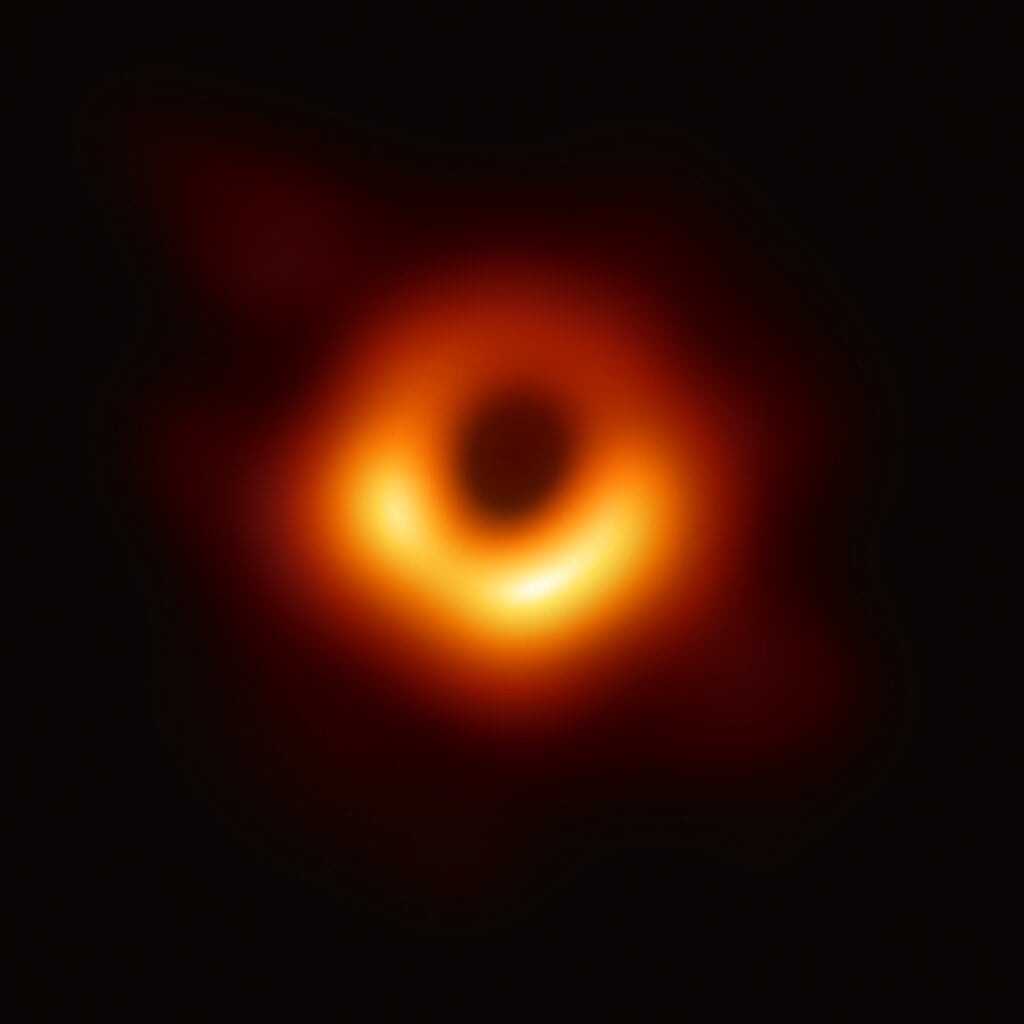
In a groundbreaking initiative, scientists have embarked on a £4 million project to create the first three-dimensional films of black holes. This effort aims to build on the monumental achievement of capturing the first images of these cosmic phenomena, with the initial photograph of black hole M87* unveiled in 2019 and the subsequent image of Sagittarius A*, located at the center of our own Milky Way galaxy, released in 2022. These images provided a vital glimpse into the nature of black holes, but they only scratched the surface of understanding the complex dynamics at play.
The new project, named TomoGrav, is spearheaded by Dr. Kazunori Akiyama, a key figure in the original imaging team, alongside Professor Yves Wiaux from Heriot-Watt University. Together, they plan to develop what they describe as “dynamic gravitational tomography.” This innovative approach will enable researchers to produce three-dimensional visualizations that capture how plasma flows and evolves around black holes over time, offering insights that traditional two-dimensional images cannot provide.
The Event Horizon Telescope (EHT), which was instrumental in capturing the initial black hole images, operates by linking multiple radio telescopes scattered across the globe. This method creates a virtual Earth-sized telescope capable of achieving extraordinary resolution. However, the challenge remains in converting the incomplete data collected by this network into coherent images. Dr. Akiyama previously developed one of the essential algorithms that enabled the creation of those first images, while Professor Wiaux has been at the forefront of artificial intelligence techniques that reconstruct images from fragmented data, techniques that are now revolutionizing various scientific fields.
The TomoGrav project is set to unveil dynamics that have eluded scientists until now. Black holes rotate, and this spin influences the amount of energy that can be extracted from the matter falling into them. This energy powers colossal jets that can extend thousands of light years and play a significant role in the formation and evolution of galaxies. While scientists can observe these jets, the underlying mechanisms of their formation have remained unclear. With time-resolved three-dimensional maps of the magnetic fields and plasma surrounding black holes, the project aims to illustrate this process in action for the first time, showcasing how infalling matter generates the magnetic fields that channel energy outward.
Moreover, the research promises rigorous testing of Einstein’s general relativity under extreme conditions. The team plans to collaborate with the proposed Black Hole Explorer space mission, which aims to accurately map photon rings—light that has orbited a black hole multiple times before escaping. These measurements will provide invaluable data on gravitational effects in regions where spacetime is severely distorted.
The TomoGrav initiative marks a significant step forward in astrophysics, pushing the boundaries of our understanding of black holes. As scientists work to visualize these enigmatic objects in three dimensions, the project stands to deepen our comprehension of the universe’s most extreme gravitational phenomena and their influence on cosmic evolution.