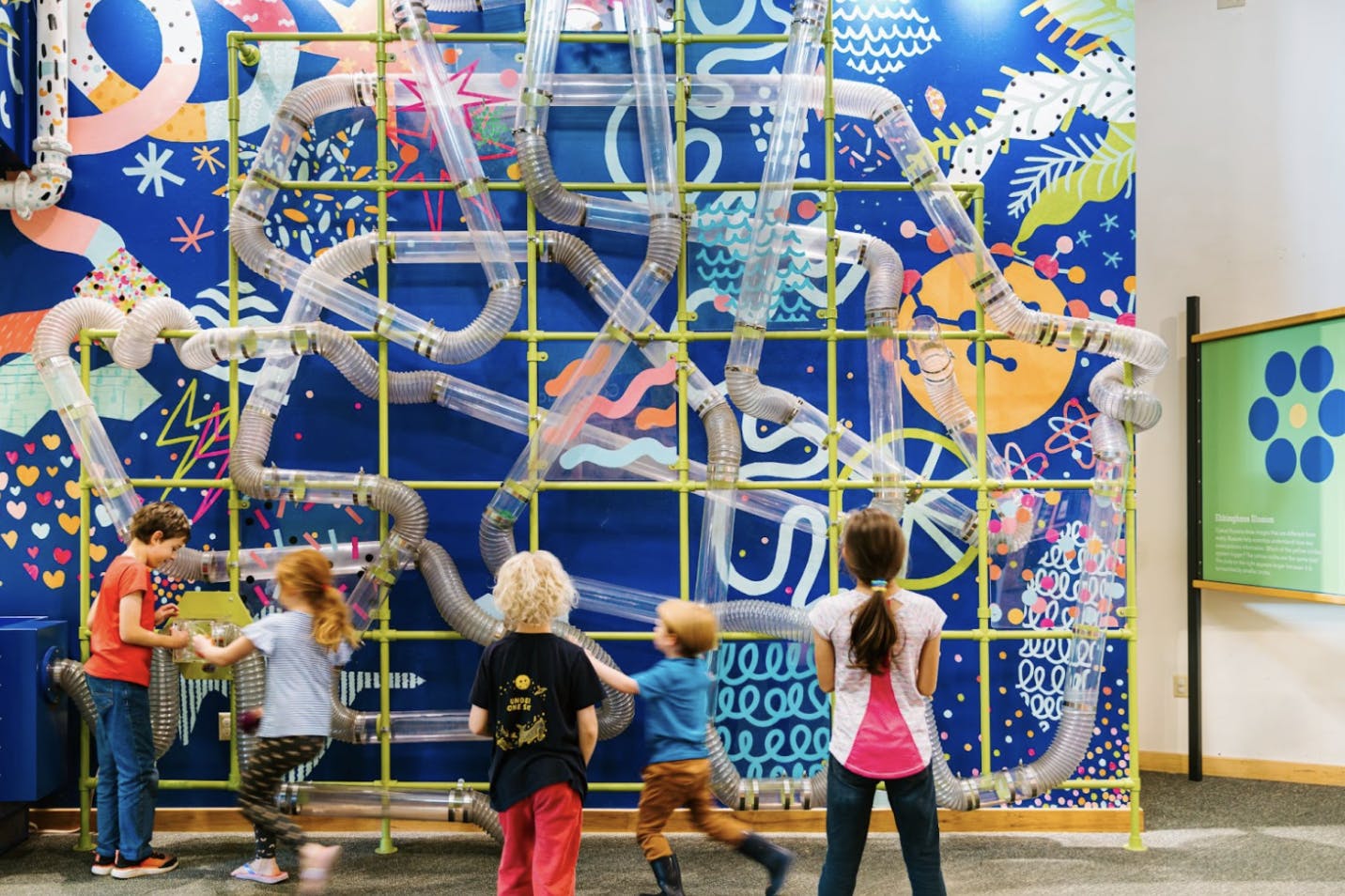
The Sciencenter in Ithaca, New York, marks a significant milestone as it celebrates its 30-year commitment to fostering curiosity through hands-on learning. Unlike many modern environments, the Sciencenter is devoid of screens and passive observers. Instead, the space is alive with the sounds of laughter and discovery, as visitors engage with interactive exhibits that encourage exploration and participation.
Sierra Coathup, the Sciencenter’s volunteer program manager, recently witnessed a moment that encapsulated this spirit. In the Saltonstall Animal Room, which houses a variety of amphibians, reptiles, and fish, she heard a child exclaim to their parent, “See, I told you it was real!” as they rushed to the axolotl tank. This scenario illustrates how learning at the Sciencenter is a shared journey, where children often become the teachers.
Curiosity is a fundamental human trait, yet traditional education systems often shift focus from exploration to rote memorization, particularly in science. According to Chris Schaffer, a professor of biomedical engineering, science remains a favorite subject for students until the end of middle school. He emphasizes that maintaining an environment conducive to curiosity is vital. “It really is an exploratory process for discovery that keeps them engaged in science,” he says.
Over three decades, the Sciencenter has meticulously designed its exhibitions to align with its mission to cultivate a community of curious and critical thinkers. Research supports the importance of hands-on activities in shaping lifelong interests in science. A 33-year study tracking Generation X individuals revealed that early experiences, particularly those involving laboratory work, profoundly influenced their engagement with science throughout their lives.
The Sciencenter employs a comprehensive approach to exhibit development that goes beyond simply placing vibrant displays in its halls. Every exhibit undergoes a rigorous process of audience research, prototyping, and testing, often lasting five years. For example, the Bridges to Bioengineering exhibition, a collaborative project with Cornell University’s Meinig School of Biomedical Engineering and the spectRUM Discovery Area in Missoula, Montana, is a testament to this method.
Currently in its third year, this 1,500-square-foot bilingual exhibition, available in both Spanish and English, aims to bridge the gap between complex biomedical engineering and public understanding. The project began with what Adrienne Testa, director of exhibitions, refers to as “front-end evaluation.” This phase involved gathering insights from students, parents, and professionals across middle schools in Tompkins County and Groton, New York.
As the project progressed, the team moved into a phase of ‘proof of concept’ prototyping. They tested whether the exhibit effectively captured attention, communicated its message, and could be built within budget constraints. In a workshop located in the Sciencenter’s basement, the team is currently engaged in phase three, where they are dynamically adjusting the exhibition based on initial public feedback.
“We’re monitoring how children interact,” Schaffer explains. “Did they seem to have fun? What knowledge did they take away? What changes occurred in their attitudes?” This iterative approach ensures that the final design resonates with visitors, encouraging them to not only observe but actively engage with scientific concepts.
The Sciencenter’s impact extends beyond its physical location. In 2025, the organization plans to bring its completed exhibitions to 14 states and two Canadian provinces, reaching hundreds of thousands of people. Testa also mentioned plans for an exhibition to be featured in a children’s science museum in Chengdu, China, potentially expanding this model of interactive discovery across cultural and geographical boundaries.
At the Sciencenter, curiosity is nurtured and preserved, countering the notion that it fades with age. Thanks to the dedication of staff, researchers, and numerous volunteers, the institution remains committed to making discovery tangible and enjoyable. The experience culminates in simple yet profound moments, such as a child confidently asserting, “See? I told you it was real!” as they engage with the wonders of science.