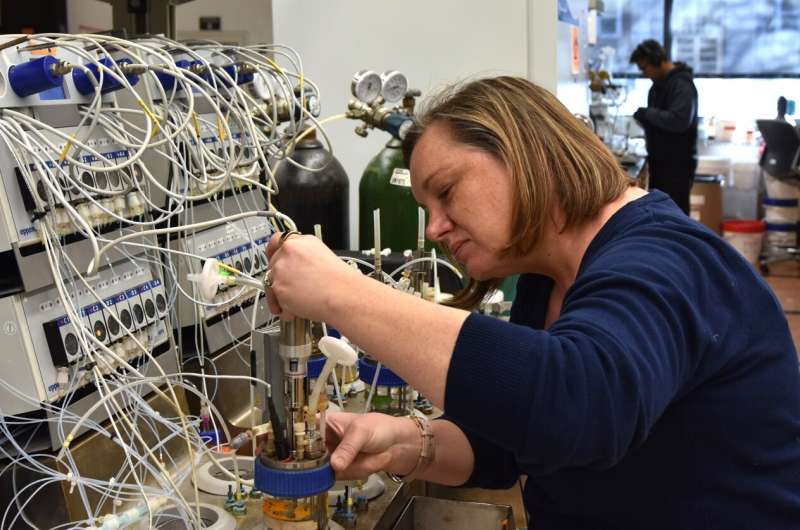
A team of scientists from the University of Illinois at Urbana-Champaign and Penn State University has developed a groundbreaking method for producing 3-hydroxypropanoic acid (3-HP) using engineered yeast. This innovation presents a cost-effective and sustainable approach to manufacturing acrylic acid, which is a key component in various everyday products such as disposable diapers, water-based paints, and fertilizers.
Acrylate is traditionally derived from petroleum through energy-intensive chemical synthesis. The new method, described in a study published in Nature Communications, leverages a unique strain of Issatchenkia orientalis yeast, enabling the fermentation of plant sugars into 3-HP. This biomanufacturing process not only reduces reliance on fossil fuels but also aligns with increasing environmental concerns.
Innovative Approaches to Biomanufacturing
The research team, part of the Center for Advanced Bioenergy and Bioproducts Innovation (CABBI) under the U.S. Department of Energy (DOE), has made significant strides in enhancing the yield and concentration of 3-HP production. Historically, bio-based production has struggled with low output and efficiency. However, the combination of metabolic engineering and the selection of I. orientalis for fermentation processes has yielded promising results.
The scientists employed advanced genetic techniques to optimize the fermentation process. They discovered that targeting the beta-alanine pathway facilitated the highest theoretical yield with minimal oxygen requirements. Through rigorous genomic analysis, the team identified three effective gene variants, which significantly improved the efficiency of the fermentation process.
The outcome was impressive, with the researchers achieving a yield of 0.7 grams of 3-HP per gram of glucose consumed and a titer of 92 grams per liter. These figures surpass the thresholds for commercial viability established in previous studies, marking a milestone in biomanufacturing.
Commercial Potential and Future Applications
The commercial prospects for 3-HP are substantial, particularly within the acrylic acid market, which was valued at approximately $20 billion in 2019, with a global demand of around 6.6 million tons. The research indicates that 3-HP can also serve as a precursor for producing other valuable industrial chemicals, enhancing its market appeal.
According to Huimin Zhao, lead author of the study and Professor in the Department of Chemical and Biomolecular Engineering, “The high-level production of this chemical from yeast can provide a pathway to acrylic acid production, significantly boosting the agricultural economy.” The team is now focused on scaling up the production process and integrating downstream processing.
Utilizing simulations, researchers assessed the financial viability and environmental benefits of this new biomanufacturing method. The findings support the establishment of I. orientalis as a next-generation platform for cost-effective 3-HP production, paving the way for potential industrial commercialization.
The implications extend beyond acrylic acid, as researchers are exploring other applications for 3-HP. Collaborations within CABBI aim to incorporate 3-HP into processes for producing malonic acid, a compound used in pharmaceuticals, biodegradable plastics, and agrochemicals.
This innovative research underscores the importance of sustainability in industrial manufacturing and the potential of biomanufacturing to create economically viable and environmentally friendly alternatives to traditional chemical production methods. The results highlight a significant leap forward in the quest for greener manufacturing processes and the reduction of reliance on fossil fuels.