Scientists at **Los Alamos National Laboratory** have proposed an innovative approach to studying nuclear weapons performance without full-scale explosions. Their research suggests that using neutrino detectors could provide valuable insights into the inner workings of nuclear weapons during a detonation. This method relies on detecting neutrinos, elusive subatomic particles released in large quantities during fission events, offering a novel alternative for assessing nuclear capabilities.
Recent advancements in neutrino detection technology have made it feasible to explore this diagnostic tool. The team is investigating whether an **inverse beta decay (IBD)** neutrino detector can capture meaningful data from nuclear detonations or from pulsed fission reactors, which generate controlled bursts of fission energy. Traditional nuclear tests produce a single, intense fission burst that is challenging to replicate in laboratory settings. Since the cessation of nuclear testing in the United States in **1992**, researchers have primarily relied on simulations and indirect measurements.
Neutrinos are particularly intriguing because they can pass through matter with minimal interaction. During a fission event, a significant number of antineutrinos are emitted, providing crucial information about the reaction itself. Richard Van de Water, the lead researcher on this study, stated, “With the great improvements in neutrino detection technology, the idea of using neutrinos as a diagnostic has come full circle. Because they’re produced so prolifically in a test event and in a pulsed fission reactor, neutrinos could offer a novel and complementary diagnostic tool for national security science.”
Modeling Nuclear Yield and Detection Feasibility
The research team modeled a hypothetical nuclear yield to calculate the resulting antineutrino spectrum. By combining these results with known interaction probabilities, they estimated how frequently antineutrinos would trigger inverse beta decay within a detector situated several kilometers away. Their calculations indicate that an IBD detector could register sufficient interactions to yield meaningful diagnostic data from a fission event, even from a safe distance.
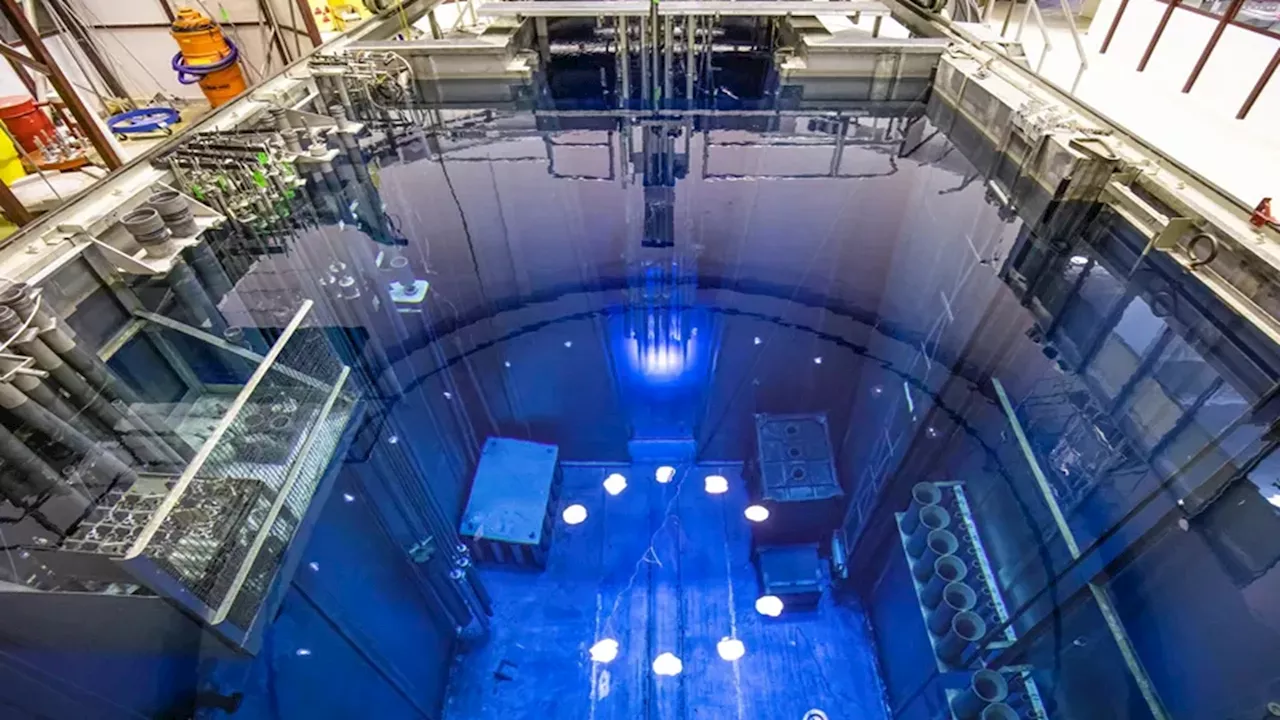
To further test this concept without conducting a nuclear weapons test, the researchers propose deploying a detector near a pulsed fission reactor. Such reactors produce short, repeatable bursts of fission energy that mimic certain aspects of a nuclear explosion. A potential candidate for this setup is the **TRIGA reactor** at **Texas A&M University**. Data collected from this configuration could refine existing simulations, reduce uncertainties in fission yield databases, and validate assumptions used in nuclear weapons physics models.
The historical context of this research at Los Alamos is notable. In the 1950s, physicists **Clyde Cowan** and **Frederick Reines** first proposed the detection of neutrinos during nuclear weapons tests. Practical constraints led them to utilize a nuclear reactor instead, resulting in the first confirmed detection of neutrinos in **1956**.
Expanding Beyond Weapons Diagnostics
The proposed neutrino detector, named **νFLASH**, is based on the Coherent CAPTAIN-Mills experiment at the Los Alamos Neutron Science Center. Initial simulations indicate that this detector could successfully capture antineutrino signals from pulsed fission bursts, a measurement that has not been conducted previously. The implications extend beyond weapons diagnostics; the setup could facilitate studies on sterile neutrinos, axions, or unexplained anomalies observed in reactor antineutrino spectra. The unique pulse structure and energy range of the reactor may provide advantages unavailable in steady-state experiments.
The researchers contend that measurements from pulsed reactors could yield data comparable to that from actual nuclear detonations. This advancement has the potential to significantly enhance both national security science and fundamental physics. The findings of this study have been published in the **Review of Scientific Instruments**, marking a significant step forward in the field.
This innovative approach to neutrino detection could revolutionize how scientists study nuclear weapons, offering a path toward safer and more effective methods of ensuring national security while minimizing the need for explosive testing.