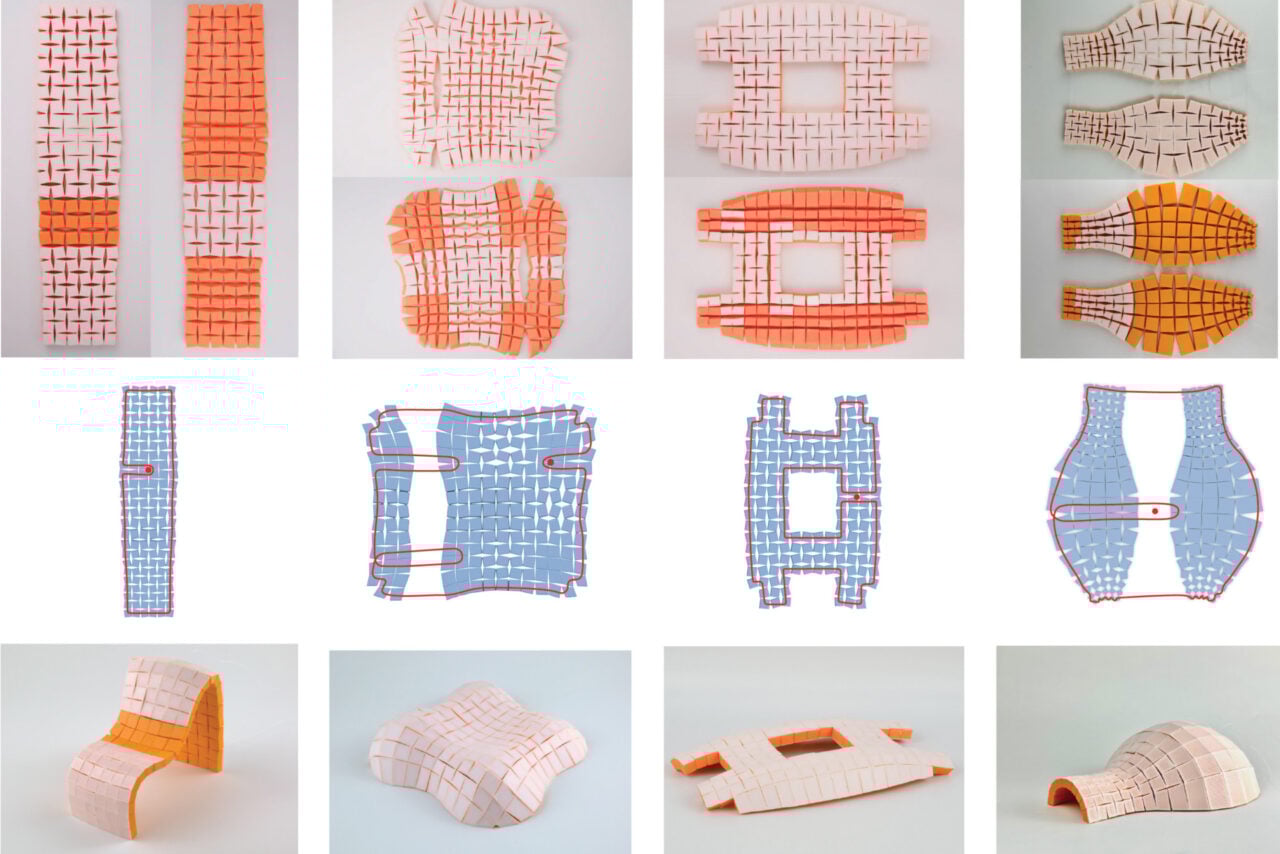
A team of researchers from the Massachusetts Institute of Technology (MIT) has developed a groundbreaking material that can morph into various three-dimensional shapes with a simple pull of a string. This innovative creation, drawing inspiration from the traditional Japanese art of kirigami, has the potential to revolutionize fields ranging from medical devices to space exploration.
The researchers revealed their findings in a paper published in the ACM Transactions on Graphics, detailing how the material operates. At first glance, the flat grid of quadrilateral tiles may seem unremarkable. However, it becomes a dynamic 3D structure when a user pulls the attached string. This transformation is facilitated by an algorithm designed to convert user-defined 3D models into flat patterns, mirroring the techniques used by kirigami artists who cut and fold paper.
Innovative Algorithm Enhances Functionality
The algorithm employs an auxetic mechanism, a unique property that allows the structure to expand in thickness when stretched and decrease in thickness when compressed. This mechanism is crucial for ensuring that the material can effectively transition from a two-dimensional form to its intended three-dimensional shape. The lead author of the study, Akib Zaman, a graduate student at MIT, highlighted the efficiency of this method: “All they have to do is input their design, and our algorithm automatically takes care of the rest,” he stated.
Following extensive simulations, the team successfully created real-world applications of their design. Among the prototypes were medical tools such as splints and posture correctors, as well as igloo-like structures. The researchers demonstrated that their method is adaptable to various fabrication techniques, using laser-cut plywood to construct a fully deployable, human-sized chair. Remarkably, the chair held its weight during testing, showcasing the material’s potential for practical use.
Future Applications and Challenges
While the current prototypes are promising, the researchers acknowledge that larger architectural projects may present “scale-specific engineering challenges.” Nevertheless, the team remains optimistic about the versatility of their method and is actively exploring ways to address these challenges, as well as developing smaller structures using the same technique.
“I hope people will be able to use this method to create a wide variety of different, deployable structures,” Zaman expressed, indicating the broader implications of this technology. The ability to create adaptable and transportable designs could have significant impacts in various sectors, especially in emergency response and space missions.
As the research progresses, the innovative material could play a vital role in shaping the future of design and engineering, making complex structures more accessible and functional for diverse applications.