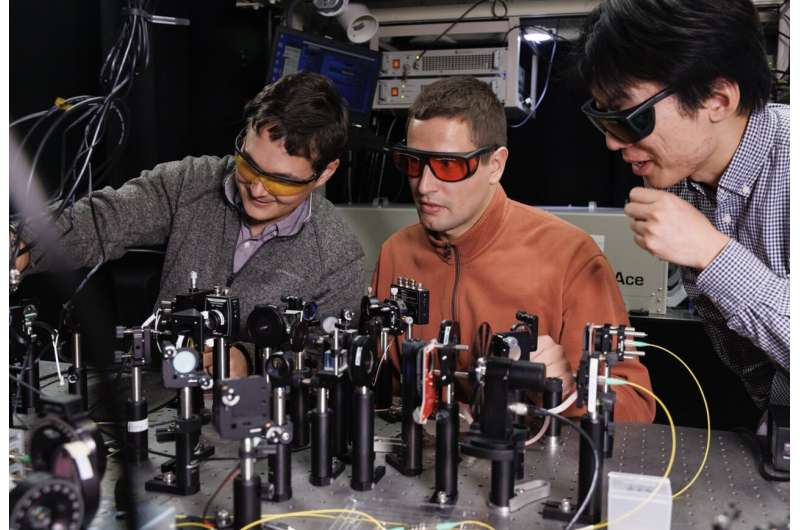
A team of researchers at Purdue University has successfully achieved all-optical modulation in silicon devices using a novel technique based on an electron avalanche process. This breakthrough, published in Nature Nanotechnology on December 11, 2025, represents a significant advancement in the field of photonics, potentially enhancing the performance of various technologies reliant on light, such as communication systems and quantum devices.
For years, advancements in photonic and quantum technologies have been hindered by materials with weak optical nonlinearity. This characteristic limits their ability to respond effectively to varying light intensities. The researchers recognized the need for a strong optical nonlinearity to develop ultrafast optical switches, which are crucial for modulating light-based signals in fiber optics and other critical applications.
Led by Prof. Vladimir M. Shalaev, the team sought to create an ultrafast optical modulator that could operate at the single-photon level. According to Demid Sychev, the first author of the study, the motivation stemmed from the realization that current methods for detecting ultrafast pulses are inefficient at the single-photon level, limiting their application.
The research team explored the potential of the electron avalanche effect, a phenomenon where a single energetic electron can free additional electrons from atoms, leading to a cascade of energetic electrons. This approach allows for the modulation of light using only light, a significant step for the development of photonic circuits.
In their experiments, the researchers demonstrated that shining a beam at single-photon intensity onto silicon could induce an electron avalanche. Sychev explained, “The process we use is very similar to what occurs in a standard photodiode when measuring light’s intensity.” The interaction resulted in increased conductivity in the silicon, enhancing its optical properties and enabling modulation.
The findings revealed that the new optical modulation strategy significantly increases the nonlinear refractive index of the silicon device, making it more efficient than previously known materials. “Our principle is unique in its ability to produce strong interactions between two optical beams, independent of their power or wavelength,” noted Sychev. This feature positions the technique as a game-changer for applications requiring high-speed data processing.
Additionally, the approach leverages the intrinsic properties of semiconductors, potentially eliminating the need for external electronic components. This compatibility with existing fabrication techniques, including CMOS, suggests that the technology could be more widely integrated into current systems.
Looking forward, the researchers aim to refine their electron avalanche-based optical modulation technique to create ultrafast optical switches. These switches could significantly scale up the capabilities of photonic circuits and quantum technologies. “Taken together, the features of our approach make it ideally suited for building ultrafast, large-scale all-optical photonic circuits,” Sychev added.
While the initial results are promising, achieving a practical single-photon switch will require further theoretical and experimental work. The team plans to explore the dynamics of the avalanche process over time and space, as well as improvements in device design and material exploration.
This innovative work not only paves the way for advancements in computing and communication but also suggests potential applications in bioimaging and other areas demanding strong optical nonlinearities. As Sychev concluded, “We believe the underlying idea has enormous potential, but realizing a practical single-photon switch will require substantial further development.”
This research represents a significant step forward in the quest for efficient optical modulation and its applications in modern technology.