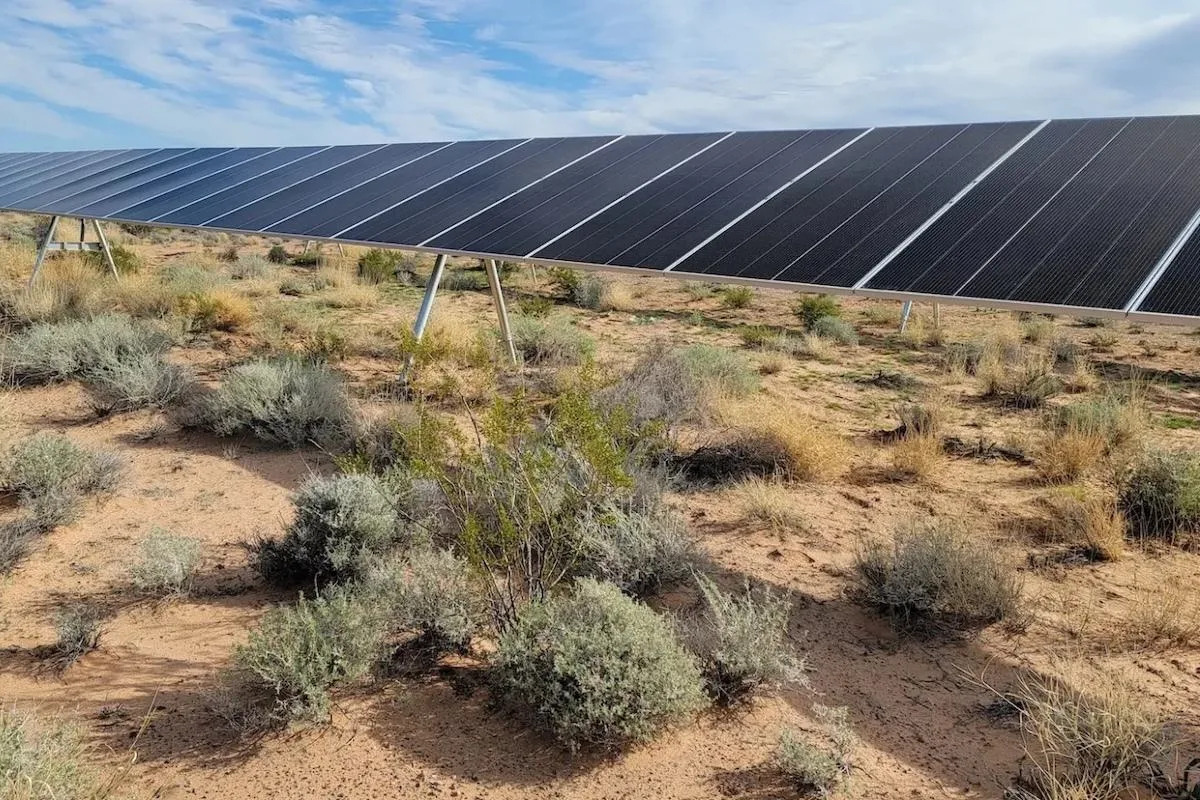
A recent study highlights the successful growth of a rare desert plant, the threecorner milkvetch, at the Mojave Solar Farm near Las Vegas. Traditionally viewed as a barren landscape, the Mojave Desert harbors a rich diversity of plants and animals. The threecorner milkvetch, a member of the pea family, has adapted to the harsh conditions of the desert, relying on rainfall to trigger its flowering and reproduction cycles. Although resilient, this species is under consideration for listing under the Endangered Species Act, making its preservation critical.
The study, published in March 2024, emphasizes the importance of minimizing ecological disruption during solar farm construction. Traditionally, energy companies have employed a “blade and grade” approach, which involves clearing vegetation and leveling soil, often destroying the seed banks crucial for plant regeneration. In contrast, the Gemini Solar Project adopted a more ecologically sensitive method. Prior to construction, scientists recorded only 12 threecorner milkvetch plants on the site. By 2024, however, their numbers surged to 93, indicating that the seeds had survived the building process.
The findings reveal that plants at the Gemini site not only grew in number but also exhibited enhanced growth compared to a nearby plot. Their increased height and flower production may be attributed to the shade provided by solar panels, which helps retain soil moisture. “So you just have the potential for a lot more plants,” stated Tiffany Pereira, an ecologist at the Desert Research Institute and lead author of the study. “The fact that the seed bank survived is phenomenal.”
This innovative approach, termed “ecovoltaics,” allows solar facilities to be developed with native species in mind. For example, specialists can sow native grasses and flowers to further support local ecosystems. “Some of those seed mixes do quite well at solar facilities, and they attract pollinators, birds, and other wildlife as a result,” noted Lee Walston, an ecologist at Argonne National Laboratory, who was not involved in the study.
The positive outcomes from solar farms extend beyond the Mojave Desert. In Minnesota, a study led by Walston demonstrated that two solar sites converted from cropland saw a sevenfold increase in unique flowering plant species over five years. The abundance of insect pollinators tripled, with native bee populations increasing by a factor of 20. Such biodiversity attracts various wildlife, including grassland birds and bats, who benefit from the increased food supply and nesting opportunities.
While the findings are promising, the success of these initiatives is not guaranteed. Different plant species have varying preferences for sunlight. In the Mojave, Pereira observed that only one threecorner milkvetch was found directly under a solar panel, with the majority thriving in sunnier areas. The height of the panels also plays a crucial role; taller structures allow larger plants to grow, although they come with increased construction costs. Solar projects may also consider specific heights to accommodate livestock such as sheep and goats, which can help manage invasive weeds and reduce fire risks.
Collaborating with developers is essential to optimize habitat conditions. Walston explained, “We’re trying to work with developers to say, ‘OK, well, if all you can do is 2 feet, what might be the best mix of seed mixes and management styles that could really optimize the habitat?’” This method mimics natural disturbances that have historically shaped ecosystems, such as grazing by deer and buffalo.
Ecovoltaics also presents opportunities for restoring former agricultural fields to their natural state. Johanna Neumann, senior director of the Campaign for 100% Renewable Energy at Environment America, emphasized the potential for solar farms to enhance biodiversity, particularly in prairie ecosystems, which evolved to require regular disturbances.
Conversely, the traditional blade-and-grade method can lead to long-term ecological damage. By removing native plants, soil stability is compromised, inviting fast-growing invasive species that can outcompete local flora. Additionally, these invasive plants often fail to provide adequate resources for native pollinators.
Moreover, the integration of crops into solar facilities, known as agrivoltaics, is gaining traction. Research indicates that crops like cucumbers thrive in the unique microclimate created by solar panels, which moderates temperature extremes and uses significantly less water compared to traditional farming methods. Ongoing studies aim to identify which high-value crops can flourish under solar panels, enhancing food production while generating renewable energy.
The advancement of ecovoltaics and agrivoltaics offers a dual benefit: promoting biodiversity and bolstering food supplies while producing clean electricity. “Rather than a moonscape of invasive species and dust blowing into cities, why not strive for something better?” Pereira remarked. “It’s a wild and beautiful place that we live in, and it’s our job to look out for these species as well.”