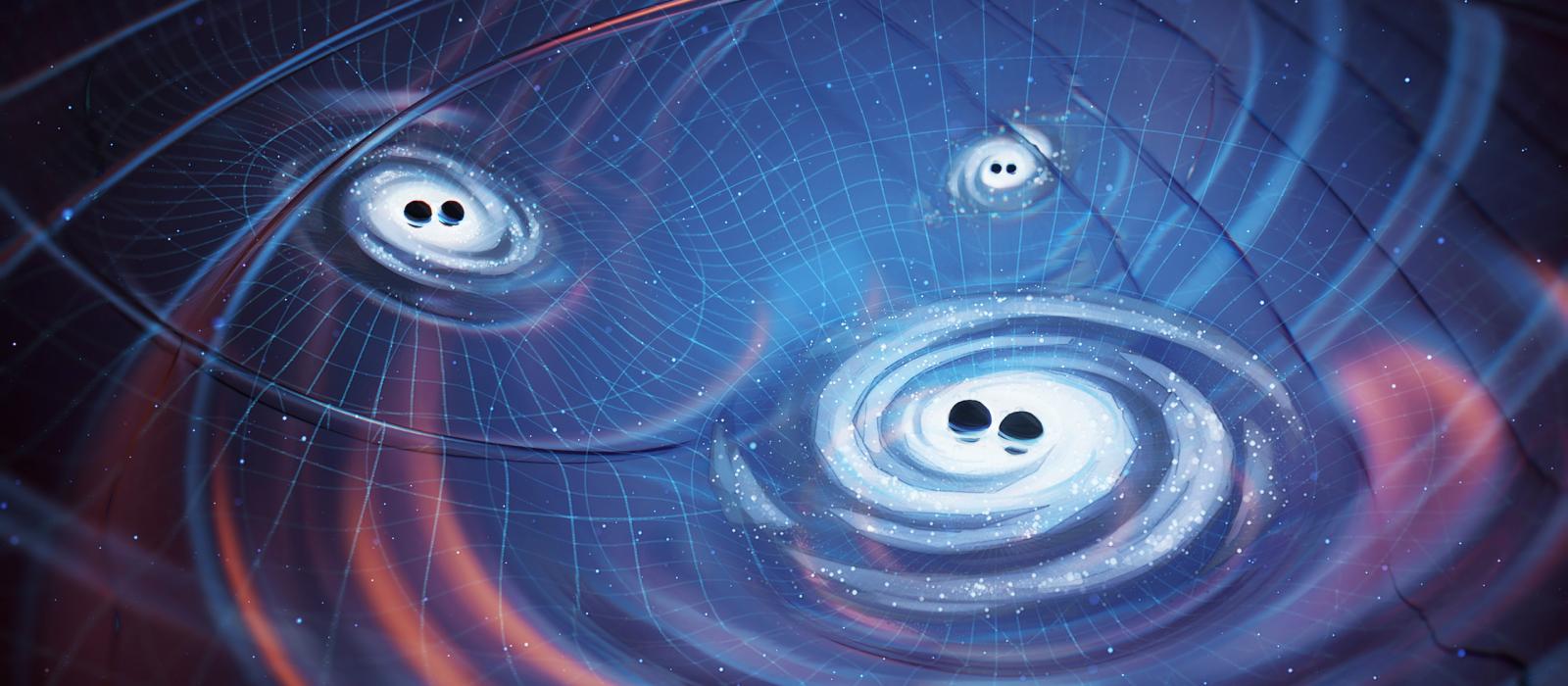
A groundbreaking study from the University of Amsterdam may transform our understanding of dark matter by utilizing gravitational waves (GWs) as a probing tool. This research, emerging from the Institute of Physics (IoP) and the Gravitation & Astroparticle Physics Amsterdam (GRAPPA), was led by scientists Rodrigo Vicente, Theophanes K. Karydas, and Gianfranco Bertone. Their findings, published in the journal Physical Review Letters, outline a novel approach to model how GWs can reveal insights about dark matter, a substance believed to constitute approximately 65% of the universe’s mass.
Gravitational waves, first detected in 2015, are ripples in spacetime created by the merging of massive objects, such as black holes and neutron stars. This detection confirmed a critical prediction of Albert Einstein’s Theory of General Relativity and set the stage for a new era in astronomical research. The recent UvA study proposes that by analyzing GWs produced in black hole mergers, scientists could uncover the elusive properties of dark matter.
Extreme Mass-Ratio Inspirals (EMRIs) are at the heart of this research. These phenomena occur when smaller compact objects orbit massive black holes, spiraling inward and creating detectable gravitational waves. The team emphasized that previous studies largely relied on simplified models, often using Newtonian gravity to describe the environments surrounding black holes. The UvA researchers have shifted to a more comprehensive framework based on General Relativity, which better captures the complexities of these interactions.
New Insights into Dark Matter Distribution
The research specifically investigates how dense concentrations of dark matter may influence the behavior of EMRIs. By employing advanced models and a relativistic lens, the team demonstrated that dark matter “spikes” or “mounds” could leave distinct signatures in gravitational wave signals. This innovative approach is expected to enhance our ability to detect dark matter’s presence and distribution across the cosmos.
The implications of this work extend beyond theoretical exploration. In approximately ten years, the European Space Agency (ESA) plans to launch the Laser Interferometer Space Antenna (LISA), a space-based observatory dedicated to studying gravitational waves. LISA will consist of three spacecraft equipped with six lasers, poised to detect over 10,000 gravitational wave signals during its mission. This technological advancement will allow for unprecedented data collection and analysis of GWs, enabling scientists to unlock further mysteries of the universe.
In addition to LISA, other detectors such as the Laser Interferometer Gravitational Wave Observatory (LIGO), the Virgo Collaboration, and the Kamioka Gravitational-wave Detector (KAGRA) will contribute to this expanding field of research. The collective effort aims to refine our understanding of dark matter’s nature and its composition, potentially altering the landscape of modern cosmology.
This research reflects a significant advancement in astrophysics, combining theoretical modeling with practical applications in detecting gravitational waves. As scientists continue to explore the universe’s mysteries, the potential to decode dark matter through gravitational waves marks a pivotal moment in our quest for knowledge.
Further reading can be found in the Physical Review Letters and on the University of Amsterdam website.