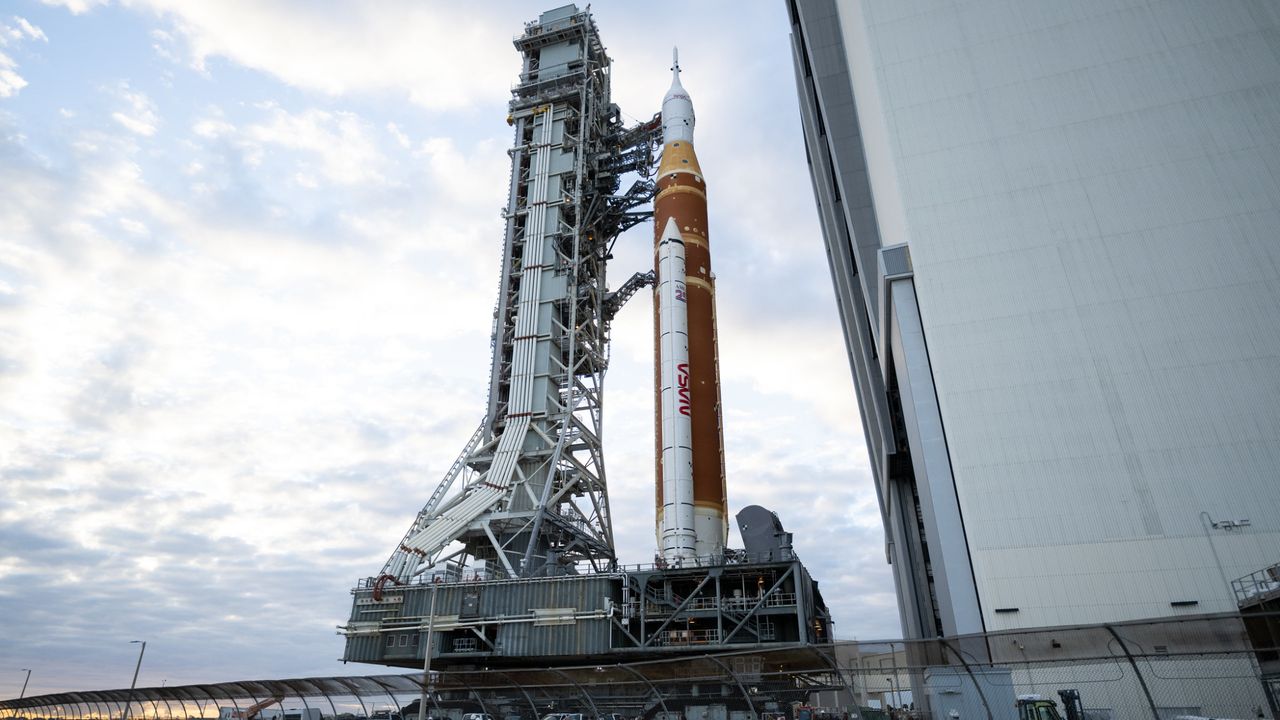
NASA’s Space Launch System (SLS) rocket, poised to carry astronauts to the moon for the first time since 1972, has begun its journey to the launch pad at Cape Canaveral, Florida. The rocket rolled out from the Vehicle Assembly Building (VAB) at Kennedy Space Center (KSC) on the morning of January 17, 2024, marking a significant milestone ahead of its anticipated launch window.
The SLS rocket, central to the Artemis 2 mission, commenced its slow movement at 7:04 a.m. EST (1204 GMT), embarking on a 4-mile (6.4 kilometers) trek to Launch Complex-39B (LC-39B). Engineers have dedicated the past eighteen months to preparing the rocket, which stands at an impressive 322 feet (98 meters) tall and weighs approximately 2,870 tons (2,600 metric tons) when fully fueled.
The SLS is equipped with two solid rocket boosters from the space shuttle program, each stacking up to 177 feet (54 meters) tall, and four RS-25 engines, collectively generating 8.8 million pounds of thrust at liftoff. This power will be crucial for propelling the Orion crew capsule and upper stages into space.
Upcoming Milestones and Launch Timeline
The journey from the VAB to LC-39B is expected to take between eight to ten hours, with the massive vehicle moving at less than 1 mph (1.6 kph). Once positioned at the launch pad, NASA will carry out a series of system integrations and checks. A critical step in the pre-launch process is the wet dress rehearsal planned for February 2. Should everything proceed smoothly, the earliest possible launch date for Artemis 2 is set for February 6, 2024.
Artemis 2 will feature a crew comprising NASA astronauts Reid Wiseman, Victor Glover, and Christina Koch, alongside Canadian Space Agency astronaut Jeremy Hansen. The mission is designed to last approximately ten days, orbiting the moon before returning to Earth.
NASA has outlined backup launch opportunities through February 11, with additional windows available in March and April, contingent upon the results of system checks once the rocket is on the pad.
Aiming for the Moon and Beyond
This mission is part of NASA’s broader Artemis program, which aims to establish a sustainable human presence on the lunar surface, particularly in the moon’s south polar region. Artemis 2 will be the first mission to carry a crew aboard the Orion spacecraft, following the uncrewed Artemis 1 mission that launched in November 2022.
While Artemis 1 faced significant challenges during its rollout and launch attempts, including cryogenic hydrogen leaks and weather-related delays, NASA officials express confidence in the readiness of the SLS for Artemis 2. They are hopeful that this mission will proceed without similar setbacks.
The flight will not enter lunar orbit but will instead follow a “free-return trajectory,” allowing the crew to loop around the moon and return to Earth regardless of any issues that may arise during the mission. This trajectory enhances safety, ensuring that the crew and spacecraft will not be stranded in lunar orbit.
Artemis 2 serves as both a test of Orion’s life support systems and a stepping stone toward future lunar landings. Should this mission succeed, it will pave the way for Artemis 3, which is expected to target a lunar landing.
As the Artemis 2 crew continues their preparations at KSC, they have been conducting launch-day rehearsals to ensure they are ready for the historic journey ahead. With the rocket now on the move, the excitement for this pivotal moment in space exploration is palpable.