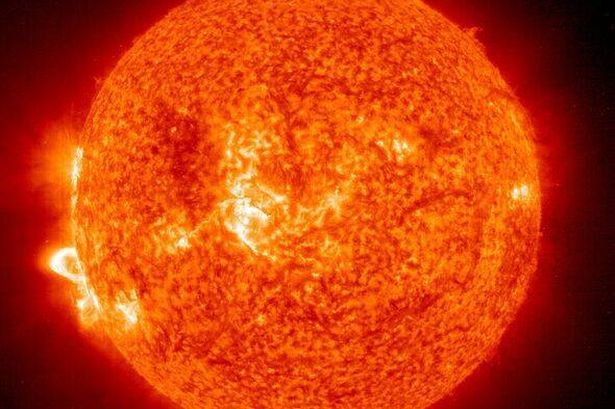
A significant sunspot cluster, designated AR 4294-4296, has emerged on the sun’s Earth-facing side, raising concerns about potential solar storms. This massive formation, which became visible on November 28, 2023, is comparable in size to the sunspot responsible for the most powerful solar storm recorded in history, known as the Carrington Event. Despite this alarming size, scientists are urging calm, emphasizing that a repeat of the Carrington Event is highly unlikely.
The sunspot group AR 4294-4296 consists of two magnetically linked components, AR 4294 and AR 4296. These areas were detected by NASA’s Perseverance Mars rover about a week prior to their visibility from Earth, indicating that monitoring of the sun’s far side is crucial for predicting solar activity. The newly identified sunspot cluster measures approximately 90% of the area of the historical Carrington sunspot recorded by British astronomer Richard Carrington in September 1859.
Sunspots are known to produce intense solar flares and coronal mass ejections (CMEs). These phenomena occur when the magnetic field lines within the sunspot twist and break, releasing massive amounts of energy. Such explosive events can cause temporary radio blackouts on Earth and send large clouds of plasma towards our planet, which can disrupt electronics and create stunning auroras visible in the night sky. According to Spaceweather.com, AR 4294-4296 is one of the largest sunspot groups observed in the past decade, with the potential to unleash supercharged X-class flares, the most powerful category on the National Oceanic and Atmospheric Administration’s (NOAA) solar flare classification system.
The Carrington Event of 1859 produced a record-breaking solar flare with an intensity classified as X45. If a similar flare were to strike Earth today, it could devastate satellites and significantly damage electrical infrastructure, with potential costs exceeding $1 trillion. Notably, an X45 flare is over five times stronger than the most intense flare recorded in the last decade, an X7 event that occurred in October 2024.
While the size of sunspots can indicate their potential to produce solar flares, the configuration of their magnetic fields and the frequency of eruptions are equally important factors. Although AR 4294-4296 is large and its magnetic fields are intricately connected, experts indicate that there is no immediate sign of a solar storm on the scale of the Carrington Event. Researchers are monitoring the sunspot’s magnetic field closely for any indications of increased activity.
If the sunspot cluster continues to rotate past Earth without significant eruptions, it is possible that it could return for another cycle as it orbits the sun. Observers are particularly interested in the upcoming days, as minor technological disruptions and auroras may occur. Nonetheless, scientists maintain that the likelihood of experiencing another Carrington Event in the near future is minimal.
As AR 4294-4296 positions itself toward Earth, specialists urge the public to remain calm. While some disruptions and beautiful auroras are expected over the coming week, the scientific community is confident that there is no need for alarm regarding a catastrophic solar storm. Researchers will continue to observe the sunspot cluster diligently, assessing its potential impact on our planet.