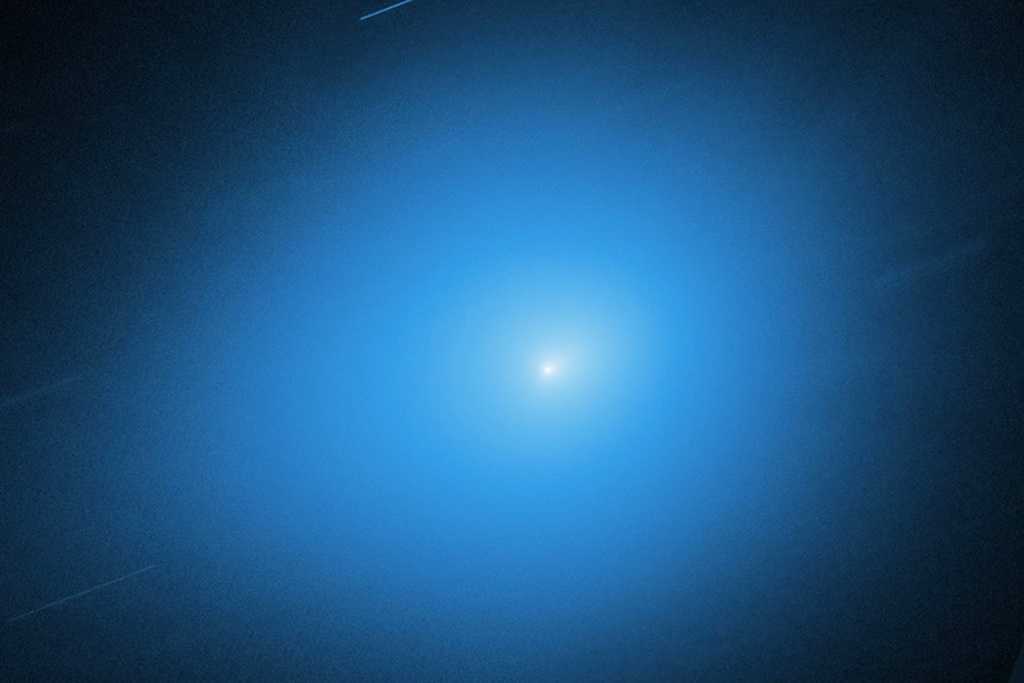
An interstellar comet known as 3I/ATLAS is set to make its closest approach to Earth on Friday, October 6, 2023. The comet, which was first identified in July as it traversed our solar system, will pass by at a distance of approximately 167 million miles (270 million kilometers) from our planet. Although this celestial event is significant, observers will need specialized equipment, as the comet is not visible to the naked eye.
During its approach, the comet has been the focus of intense observation by scientists and astronomers. The Virtual Telescope Project will host a livestream event at 4:00 a.m. UTC on Saturday, or 11 p.m. ET on Friday, to share views of the comet. This livestream follows a missed opportunity for viewing on Thursday night due to inclement weather, as noted by Gianluca Masi, an astronomer and director of the Virtual Telescope Project.
For those interested in viewing 3I/ATLAS, an 8-inch (20-centimeter) telescope or larger is required. While the prime viewing window, which began in November, has closed, scientists anticipate that the comet will remain observable through telescopes and various space missions for several months before it exits our solar system.
Scientific Investigations of 3I/ATLAS
Since its discovery, astronomers have closely monitored 3I/ATLAS to learn more about its origins and composition. The comet is expected to provide valuable insight into the materials present in the early solar systems from which it originated. Observations conducted using the Hubble Space Telescope and the James Webb Space Telescope have revealed the presence of carbon dioxide, water, carbon monoxide, and carbonyl sulfide being released from the comet as it draws nearer to the sun, according to the European Space Agency (ESA).
Preliminary research suggests that 3I/ATLAS is between 3 billion and 11 billion years old, as detailed in a study co-authored by Aster Taylor, a doctoral student at the University of Michigan. This age is particularly intriguing, considering that our solar system is estimated to be around 4.6 billion years old. The unique composition of 3I/ATLAS, including its volatile materials, may indicate that it has not encountered another star prior to its current trajectory.
Future Observations and X-Ray Discoveries
3I/ATLAS became too faint for ground-based telescopes in October, yet it remained within the observational reach of space missions such as PUNCH (Polarimeter to Unify the Corona and Heliosphere) and SOHO (Solar and Heliospheric Observatory). The comet made its closest approach to Mars on October 3, 2023, coming within 18.6 million miles (30 million kilometers) of the planet. Although data sharing from NASA missions has been limited due to a government shutdown, the ESA’s Mars Express and ExoMars Trace Gas Orbiter managed to capture images of the comet, albeit as a faint dot against the Martian backdrop.
In an exciting development, Japan’s X-Ray Imaging and Spectroscopy Mission (XRISM) observed 3I/ATLAS for an extensive 17 hours in late November. This observation revealed X-rays extending approximately 248,000 miles (400,000 kilometers) from the comet’s nucleus, likely caused by interactions between the gases emitted by the comet and the solar wind. Such observations could shed light on whether interstellar comets emit X-rays in a manner similar to those originating within our solar system.
As astronomers continue to study 3I/ATLAS, they remain optimistic about the potential discoveries that may arise from its unique characteristics and behavior. With several months of observation still ahead, scientists are poised to unlock new insights into this interstellar visitor and its implications for our understanding of cometary science and solar system formation.