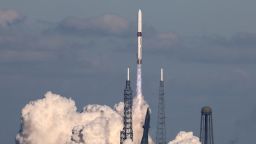
Michaela Benthaus, a 33-year-old aerospace and mechatronics engineer from Germany, has made history as the first wheelchair user to travel to space. She achieved this milestone during a flight on the Blue Origin New Shepard capsule, which launched on October 7, 2023, from Van Horn, Texas. The mission, designated NS-37, surpassed the Kármán Line, the widely recognized boundary of outer space, which is located 100 kilometers (62 miles) above sea level.
This flight marks the 16th suborbital space tourism launch conducted by Blue Origin, the space venture founded by Jeff Bezos in 2000. The company aims to broaden access to space for individuals who do not fit the traditional astronaut profile. Benthaus expressed her excitement and challenges regarding the journey prior to the flight, sharing that she had always dreamed of going to space but previously doubted it was achievable for her due to her spinal cord injury sustained in a mountain biking accident in 2018.
“I always wanted to go to space, but I never really considered it something which I could actually do,” Benthaus stated in a preflight interview. She admitted to questioning whether space was reserved for individuals who, despite disabilities, were still somewhat mobile. Her passion for exploration and engineering grew stronger after her injury, leading her to focus on overcoming barriers in fields where she could contribute.
The New Shepard flight lasted approximately 10 minutes, propelling Benthaus and her five crewmates to speeds exceeding three times the speed of sound. As the rocket ascended past the Kármán Line, the capsule provided passengers with a brief experience of weightlessness. Benthaus planned to use a specially designed strap to secure her legs while she enjoyed microgravity and the breathtaking view of Earth from the capsule’s windows.
“I want to see how this leg strap works — and if not, what could maybe be improved in the future,” she explained. Benthaus had prior experience with microgravity during a training flight, which helped her prepare for this journey. Rather than performing acrobatics in the cabin, she intended to focus on taking in the panoramic views from above.
To ensure her safety and comfort, Benthaus had Hans Koenigsmann, a former SpaceX executive and friend, flying alongside her. He was trained to assist her if necessary, highlighting the importance of support systems for individuals with disabilities in such pioneering settings.
In conjunction with her spaceflight, Benthaus is raising funds for the nonprofit organization Wings for Life, which focuses on spinal cord injury research. Her journey not only symbolizes personal achievement but also emphasizes the importance of accessibility in space exploration.
Benthaus’s successful mission is a significant step forward in breaking down barriers for individuals with disabilities, showcasing that space travel can be inclusive. As she returns from this historic flight, her experiences and insights may pave the way for future advancements in the industry, encouraging more diverse participation in space exploration.