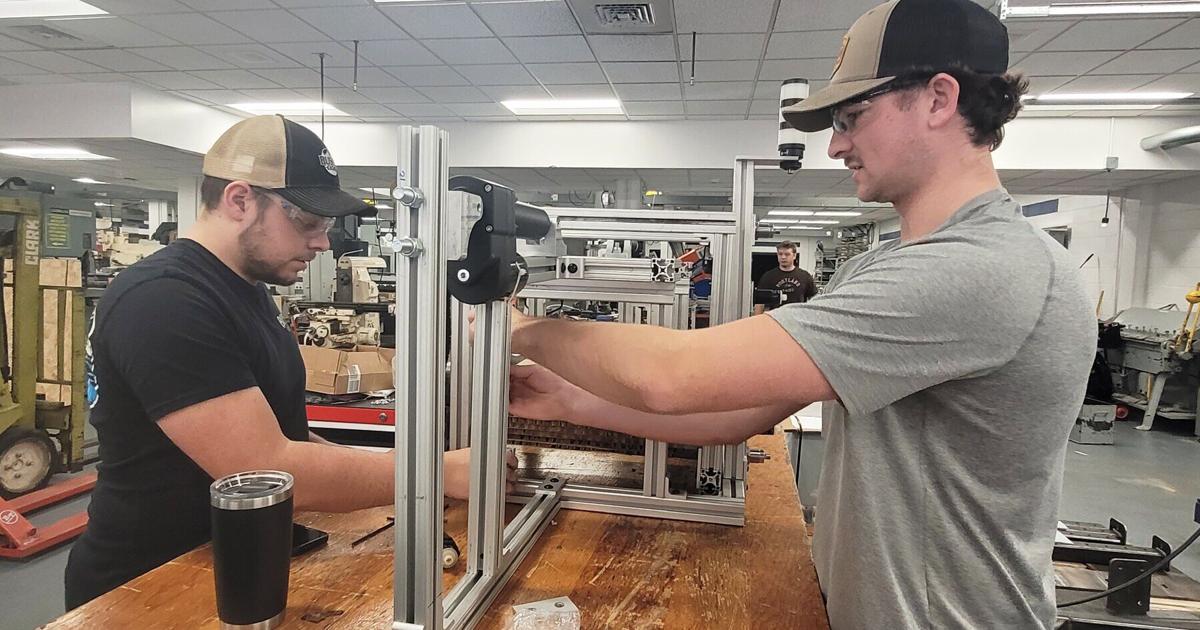
A group of engineering students at the University of Wisconsin-Stout has developed a prototype for a nonstandard pallet stacker, sponsored by Ashley Furniture. This initiative aims to enhance product efficiency in warehouse operations, showcasing the innovative capabilities of students while addressing real-world challenges in the furniture industry.
The project was undertaken by engineering seniors Chase Rodewald, Riley Stiehl, Zachary Morgan, and Luke Mertens. Their collaborative effort resulted in a functional prototype that meets specific requirements set forth by Ashley Furniture. The students utilized SolidWorks, a digital design software, to create detailed models of the product before constructing the physical prototype.
Collaboration and Innovation in Engineering Education
This project exemplifies the benefits of industry partnerships in educational settings. The collaboration with Ashley Furniture not only provided students with valuable insights into industry needs but also allowed them to apply theoretical knowledge in a practical context. The nonstandard pallet stacker is designed to optimize space and improve loading efficiency, addressing critical logistical challenges faced by manufacturers.
According to Stiehl, the hands-on experience gained through this project has been instrumental in their academic journey. “Working on such a real-world problem has deepened our understanding of engineering principles and their applications,” he remarked. The students had to work through various design iterations before arriving at a solution that met both functional and safety standards.
Future Implications for Industry Practices
The significance of this prototype extends beyond the classroom. As companies like Ashley Furniture seek to enhance their operational efficiencies, innovations from academic institutions can contribute significantly to industry practices. The students’ work not only demonstrates their engineering skills but also showcases the potential for future collaborations that can lead to practical solutions in manufacturing and logistics.
By integrating academic inquiry with industry needs, the University of Wisconsin-Stout is paving the way for future engineers to bridge the gap between theory and practice. This project serves as a testament to the importance of experiential learning in shaping the next generation of professionals equipped to tackle the challenges of modern industry.
The successful completion of this prototype is a promising step forward for both the students involved and the industry they aim to serve. The students’ dedication and innovative spirit highlight the critical role educational institutions play in fostering talent that drives economic growth and technological advancement.