Research conducted by the University of Rochester reveals that tiny particles from Earth’s atmosphere have been reaching the moon for billions of years, carried by the planet’s magnetic field. This unexpected finding suggests that the lunar surface might contain a long-term archive of Earth’s atmospheric history, along with potential resources beneficial for future lunar exploration.
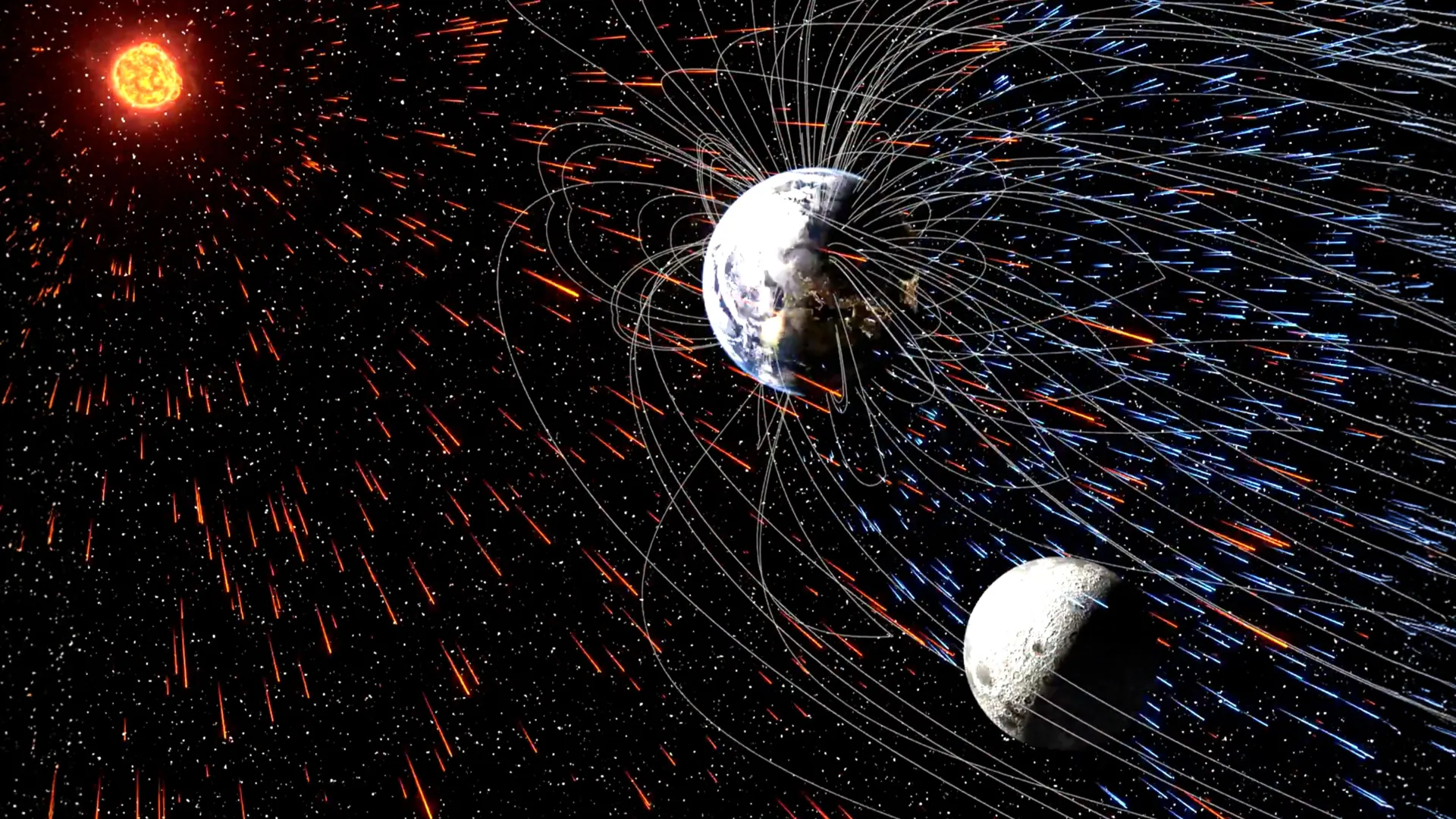
The study, published in the journal Nature Communications Earth and Environment, indicates that rather than acting as a barrier, Earth’s magnetic field can funnel atmospheric particles into space, allowing them to travel vast distances to the moon. This process has persisted for billions of years, resulting in a complex interaction between the two celestial bodies.
The moon, often perceived as barren and lifeless, may actually hold clues about Earth’s past. Researchers, led by Eric Blackman, a professor in the Department of Physics and Astronomy, utilized data from lunar soil samples collected during the Apollo missions alongside advanced computational modeling to explore how these particles migrated to the moon.
“By combining data from particles preserved in lunar soil with computational modeling of how solar wind interacts with Earth’s atmosphere, we can trace the history of Earth’s atmosphere and its magnetic field,” Blackman noted.
The Apollo samples, brought back to Earth in the 1970s, are critical to this research. They demonstrate that the moon’s regolith—its surface layer—contains volatile substances such as water, carbon dioxide, helium, argon, and nitrogen. While some of these materials originate from the solar wind, the quantities found are too significant to attribute solely to that source.
In a pivotal 2005 study, scientists from the University of Tokyo hypothesized that these volatiles came from Earth’s atmosphere early in the planet’s history, before a magnetic field developed. The Rochester researchers, however, propose a different mechanism at play. Their simulations reveal that under present-day conditions, particles can be liberated from Earth’s upper atmosphere by the solar wind and subsequently follow the magnetic field lines into space, some reaching the moon’s vicinity.
Understanding the Particle Journey
To delve deeper into the mechanics of this particle transfer, the research team, including graduate student Shubhonkar Paramanick, tested two scenarios using computer simulations. One scenario depicted early Earth without a magnetic field, while the other represented modern Earth with its established magnetic protection. The results indicated that the transfer of particles to the moon is significantly more effective in the current scenario, suggesting that Earth’s magnetic field plays a crucial role in facilitating this exchange.
Over billions of years, this slow process acts like a natural funnel, continuously depositing small amounts of Earth’s atmosphere onto the lunar surface. This raises the exciting possibility that lunar soil could yield valuable insights into Earth’s climatic and biological evolution over geological time.
Future Implications for Lunar Exploration
The findings have broader implications for future human activities on the moon. The presence of volatile elements like water and nitrogen may support long-term human endeavors, reducing the necessity to transport resources from Earth. Such discoveries could pave the way for sustainable lunar bases, essential for extended exploration and potential habitation.
“Our study may also have broader implications for understanding early atmospheric escape on planets like Mars,” Paramanick explained. “By examining planetary evolution alongside atmospheric escape across different epochs, we can gain insight into how these processes shape planetary habitability.”
This groundbreaking research was partially funded by NASA and the National Science Foundation, highlighting the ongoing interest in lunar studies and their relevance to our understanding of planetary systems. As scientists continue to analyze lunar soil and its implications, the moon may become a key resource in humanity’s quest for exploration beyond Earth.