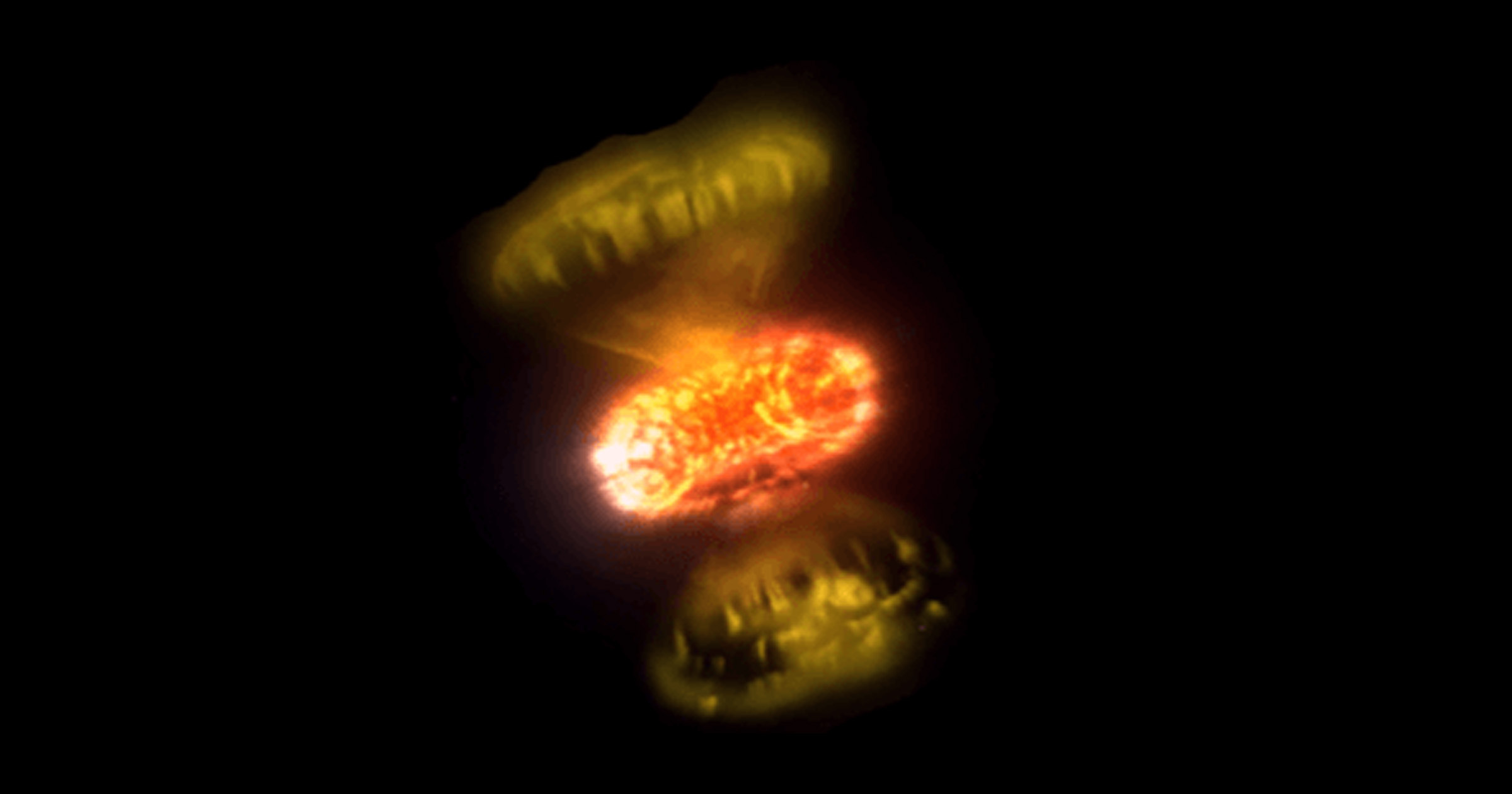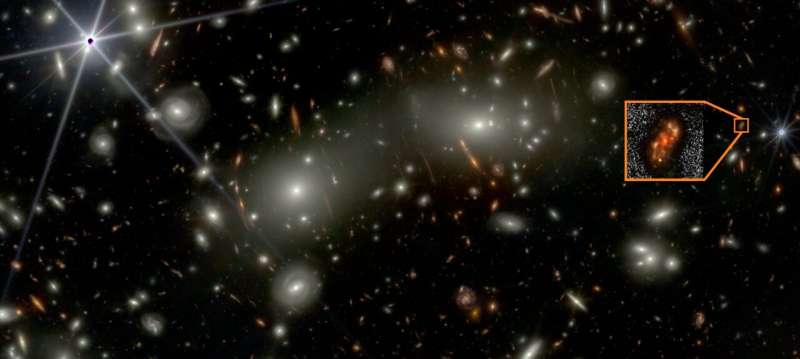
A groundbreaking discovery has emerged from the depths of the cosmos, as astronomers have identified a massive spiral galaxy named Alaknanda—one that formed just 1.5 billion years after the Big Bang. This revelation, made possible by the James Webb Space Telescope (JWST), challenges previous understandings of galaxy formation during the universe’s infancy.
The research team, comprising Rashi Jain and Yogesh Wadadekar from the Tata Institute of Fundamental Research in Pune, India, made this discovery public in the journal Astronomy & Astrophysics. Alaknanda exhibits remarkable characteristics akin to our own Milky Way, raising questions about the timeline and processes involved in galaxy development.
Alaknanda’s Structure and Formation
Traditionally, astronomers believed that well-structured spiral galaxies required billions of years to evolve, typically forming chaotic and irregular shapes in their early stages. Alaknanda, however, presents a strikingly organized spiral structure, complete with two prominent arms and a bright central bulge, spanning approximately 30,000 light-years across.
What’s particularly astonishing is Alaknanda’s rapid star formation. The galaxy is creating new stars at a rate about 20 times that of the current Milky Way, with half of its stars forming within just 200 million years. This rapid assembly suggests that the processes governing galaxy formation are far more efficient than current models predict.
Jain states, “Alaknanda has the structural maturity we associate with galaxies that are billions of years older. Finding such a well-organized spiral disk at this epoch tells us that the physical processes driving galaxy formation can operate far more efficiently than current models predict.”
Aiding Discovery through Gravitational Lensing
Located within the gravitational field of a massive galaxy cluster known as Abell 2744, or Pandora’s Cluster, Alaknanda benefits from gravitational lensing. This phenomenon magnifies and bends light from distant cosmic objects, allowing the JWST to capture detailed images of the galaxy’s structure.
The team analyzed images taken through as many as 21 different filters, each revealing unique aspects of Alaknanda’s light. This extensive data set, part of JWST’s UNCOVER and MegaScience surveys, has provided unprecedented insights into the galaxy’s distance, dust content, and ongoing star formation rates.
This discovery adds to a growing body of evidence indicating that the early universe possessed a surprising level of maturity and complexity. Alaknanda stands out as one of the clearest examples of a textbook grand-design spiral galaxy at such an early epoch.
Wadadekar emphasizes the significance of their findings: “Alaknanda reveals that the early universe was capable of far more rapid galaxy assembly than we anticipated. Somehow, this galaxy managed to pull together ten billion solar masses of stars and organize them into a beautiful spiral disk in just a few hundred million years.”
Future observations will aim to unravel the mechanisms behind Alaknanda’s spiral formation. Researchers are considering whether the galaxy grew steadily by drawing cold gas or if gravitational interactions with smaller galaxies triggered the spiral arms.
The implications of this discovery extend beyond mere cosmic curiosity. Understanding how galaxies like Alaknanda formed could reshape our comprehension of the universe’s history and evolution. If galaxies could reach such maturity quickly, it suggests that the conditions necessary for forming worlds like Earth may have arisen earlier than previously thought.
As the JWST continues to explore the cosmos, Alaknanda serves as a pivotal example of the rapid development of complex structures in the early universe. This discovery not only enhances our understanding of galaxy formation but also invites further investigation into the origins of galaxies and the conditions that fostered the emergence of life-sustaining planets.