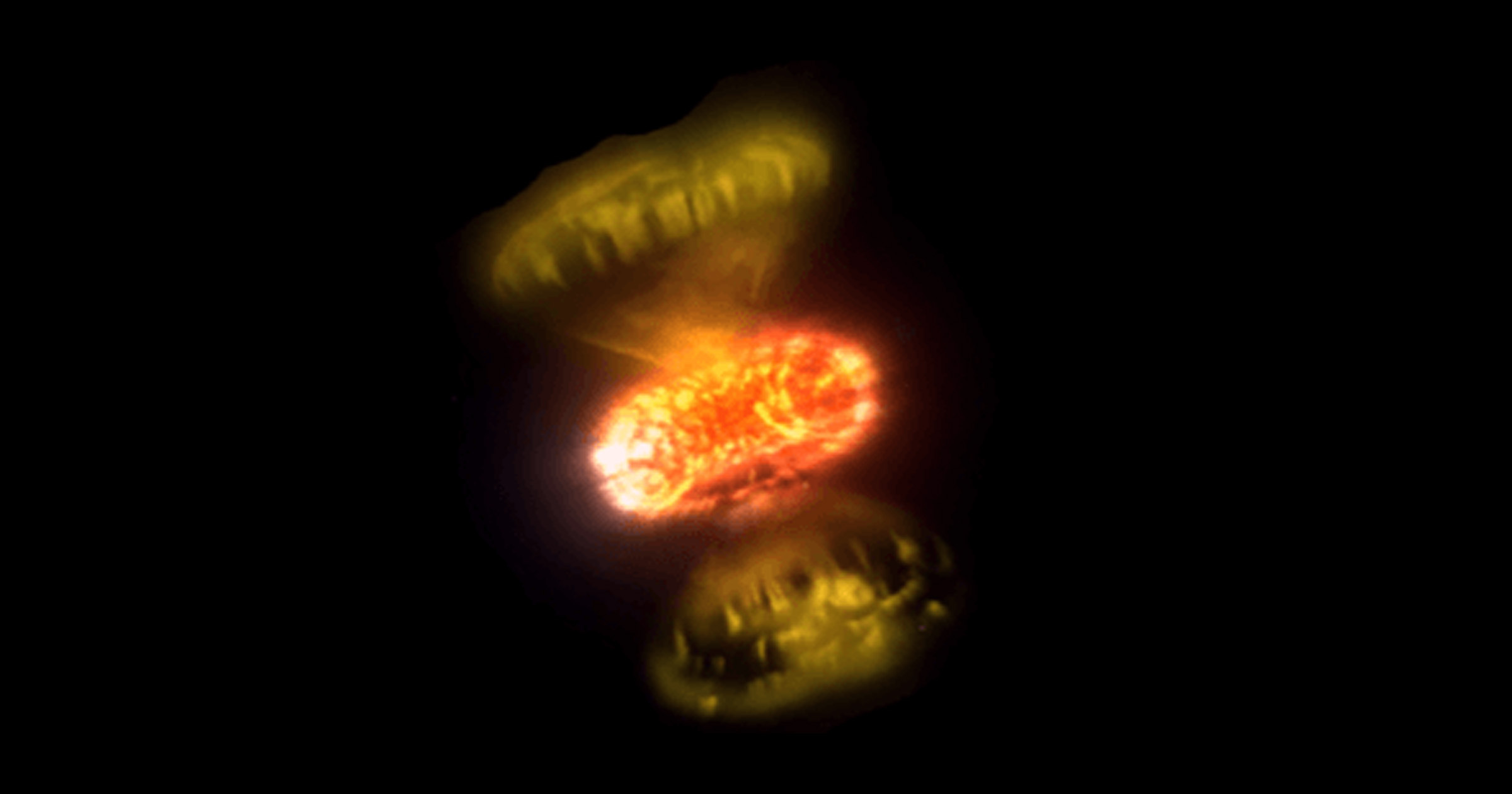
New images taken at the moment two stars exploded provide unprecedented insights into stellar phenomena. These remarkable photographs, captured using multiple telescopes at the CHARA Array at Georgia State University, depict a process known as a nova. This occurs when a white dwarf—a dense remnant of a star similar to our Sun—draws material from a nearby companion star, leading to a thermonuclear explosion that the white dwarf survives.
As the white dwarf siphons off material, primarily hydrogen, it accumulates on its surface until reaching critical mass, resulting in an explosion that releases energy equivalent to what our Sun emits over 100,000 years. Despite their brilliance, astronomers have historically struggled to observe the early stages of these explosions, as the ejected material appears as a single point of light.
Revolutionary Observations Unveil Cosmic Complexity
The new images offer a glimpse into the complexity of these stellar events. Elias Aydi, lead author of a study published in the journal Nature Astronomy, emphasized the significance of these observations, stating, “Instead of seeing just a simple flash of light, we’re now uncovering the true complexity of how these explosions unfold.”
Using a technique called interferometry, astronomers merged light from various telescopes to analyze the resulting interference patterns. The CHARA Array, consisting of numerous antennas spread across a wide area, functions as a single, powerful telescope when focused on the same celestial object. The analysis was further enhanced by data from other observatories, including NASA’s Fermi Telescope, which monitors high-energy emissions like gamma rays, and the Gemini Observatory in Hawaii.
The findings challenge previous assumptions about the nature of novas. One of the observed novas, V1674 Herculis, is noted for its rapid evolution, achieving peak brightness before fading away in just several days. It displayed two distinct gas outflows, indicating that the explosion involved multiple powerful material ejections interacting with one another. Notably, these ejections emitted gamma rays detected by NASA’s Fermi, revealing that novas can produce emissions typically associated with black hole-forming supernovas.
Insights into Stellar Dynamics and High-Energy Physics
The second nova, V1405 Cassiopeiae, exhibited a more gradual explosion, taking over fifty days to fully eject its material. During this time, the white dwarf enveloped itself in a sphere of stripped gas, creating a rare structure known as a common envelope. When this envelope eventually dispersed, it generated a blast of gamma rays that were also observed by NASA’s Fermi.
The dual detection of gamma rays from both novas indicates that they serve as “laboratories for extreme physics,” according to Laura Chomiuk, coauthor and professor of physics and astronomy at Michigan State University. This research could help scientists connect the dynamism of nuclear reactions on the star’s surface with the geometry of the ejected materials and the high-energy radiation detected from space.
These groundbreaking observations not only deepen our understanding of stellar explosions but also illustrate the potential for future research into the fundamental processes of the universe. As astronomers continue to unravel the mysteries of novas, they pave the way for further exploration into the complex interactions within our cosmos.