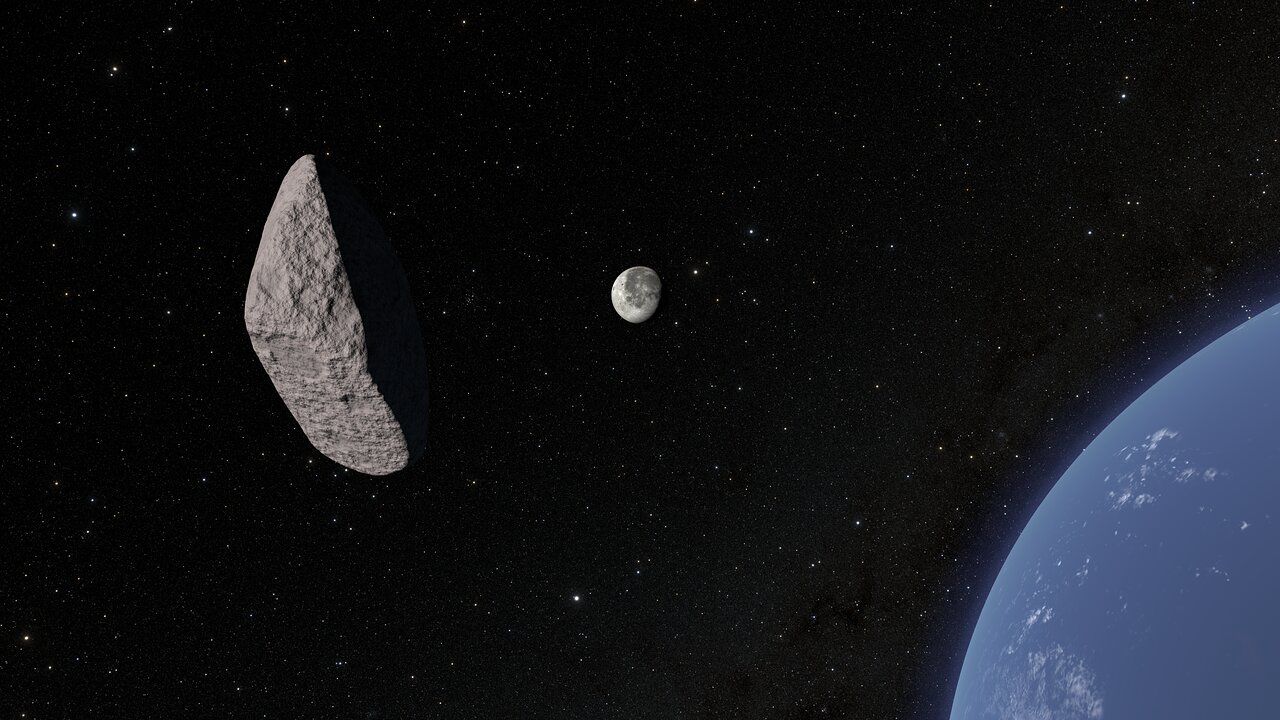
Recent observations have confirmed that the asteroid known as 2024 YR4 will not collide with the Moon as previously feared. Initially, there was a 4.3% chance that this celestial body could impact the Moon on December 22, 2032. However, advancements in tracking the asteroid’s trajectory have revealed that it will safely pass at an altitude of 13,200 miles (approximately 21,200 kilometers) above the lunar surface.
The asteroid, first identified on December 27, 2024 by the NASA-funded Asteroid Terrestrial-impact Last Alert System (ATLAS), was once considered among the most dangerous asteroids detected due to its potential size of about 197 feet (or 60 meters2024 YR4‘s orbit led scientists to seek more precise measurements. Originally, astronomers believed they would have to wait until 2028 for the next opportunity to observe the asteroid. However, researchers at the Johns Hopkins University Applied Physics Laboratory (JHUAPL) discovered that the James Webb Space Telescope (JWST) could observe the asteroid between February 18 and February 26 this year.
During this observation window, the asteroid moved against a background of stars whose positions had been accurately measured by the European Space Agency’s (ESA) Gaia mission. By tracking the asteroid’s movement against these known positions, the JWST was able to refine its orbit with remarkable precision. The precision was critical as the JWST’s Near-Infrared Camera has a limited field of view of just 2.2 square arcminutes, making measurements challenging.
Collaboration among various organizations played a significant role in this achievement. Scientists from JHUAPL worked closely with engineers from the JWST, as well as teams from ESA‘s Near-Earth Object Coordination Centre and NASA’s Center for Near-Earth Object Studies. This joint effort resulted in new measurements that have effectively ruled out any possibility of a collision with the Moon.
The near encounter would have provided a unique opportunity for scientific study. Had the asteroid struck the lunar surface, it would have created a new crater approximately 0.62 miles (or 1 kilometer) across, releasing energy equivalent to 6 million tons of TNT. Such an impact could have resulted in a brilliant flash visible from Earth and potentially produced millions of pounds of debris, some of which might have escaped the Moon’s gravity and posed a risk to satellites in Earth’s orbit.
Now that the trajectory of 2024 YR4 has been clarified, scientists can redirect their focus towards monitoring other potential threats from space. As asteroid observation technology continues to advance, the scientific community remains committed to staying vigilant for any future risks that may arise.