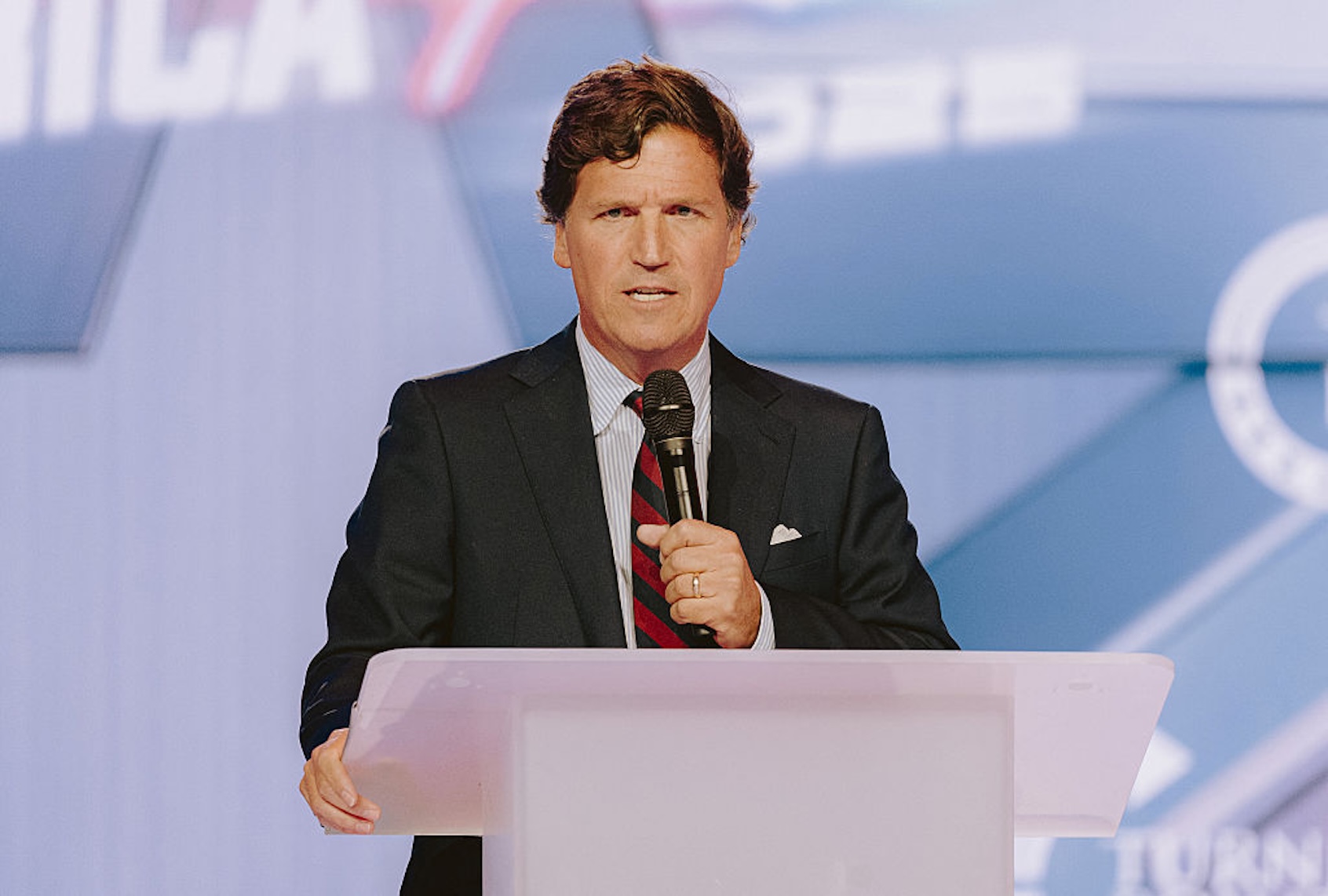
In a pivotal moment for American media, comedian Jon Stewart confronted Tucker Carlson on the debate show “Crossfire” in 2004, fundamentally altering the landscape of political commentary. At the time, Stewart was the acclaimed host of “The Daily Show” on Comedy Central, where he had built a reputation for incisive political satire. His guest appearance on “Crossfire,” which had been airing on CNN since 1982, was marked by a fierce critique of the show’s format, which he deemed a superficial spectacle rather than a meaningful political discussion.
During the broadcast, Stewart did not hold back, referring to Carlson, one of the show’s co-hosts, as a “d**k.” He lambasted the entire panel as “hacks” who were “hurting America” by trivializing politics. This confrontation resonated widely, leading to the eventual cancellation of “Crossfire” shortly thereafter. Despite Stewart’s moral clarity during this exchange, the subsequent trajectory of Carlson’s career diverged sharply from the values Stewart championed.
Carlson, initially appearing to take Stewart’s critiques to heart, transitioned from a relatively earnest journalist into a prominent figure within the Republican Party. Over the years, he has cultivated an audience by embracing the very sensationalism and partisanship Stewart criticized. According to Jason Zengerle’s biography, “Hated by All the Right People,” Carlson’s evolution from a respectable journalist to a polarizing conservative commentator is a central theme of his narrative. The “Crossfire” incident serves as a significant turning point in this story.
Carlson’s career has been characterized by his ability to tap into the darker instincts of the right. He has often been described as a master of pandering to the grievances of his audience. Each time his career appears to face setbacks, he resurfaces, often stronger and more influential. This resilience has allowed him to play a significant role in reshaping the Republican Party, steering it toward a more extreme ideology.
From Stewart’s Critique to Carlson’s Rise
Carlson’s response to Stewart’s scrutiny was not immediate but evolved over time. Initially, he grappled with the ethical dilemmas of supporting the Iraq War while harboring private doubts. He sought to establish himself as a reputable journalist, even taking a position at MSNBC and co-founding the Daily Caller as a genuine news outlet. However, as his views solidified, he began to reinterpret the “Crossfire” clash as an attack from a self-righteous liberal who failed to grasp the realities of political life.
This transformation led Carlson to embrace a worldview where progressives were not merely opponents but an existential threat to American values. His commentary now casts left-wing figures, including Stewart, as architects of a vast conspiracy aimed at undermining traditional values. This narrative has proven compelling for many within the right-wing media ecosystem, which has created a fertile ground for Carlson’s brand of commentary.
Carlson’s approach hinges on providing his audience with a sense of moral absolution, framing their beliefs as under siege by a nefarious left. He skillfully constructs a narrative where the right is perpetually victimized, with phrases such as “They want you to believe” becoming central to his rhetoric. This tactic not only absolves his audience of guilt regarding their beliefs but also justifies extreme positions.
The Legacy of the Crossfire Confrontation
Looking back on the past two decades, it becomes evident that Carlson has thrived by rejecting the journalistic principles that Stewart espoused. Rather than presenting facts as a foundation for discourse, Carlson has tapped into the demand for a narrative that reinforces the beliefs of his audience. This has led to a significant shift in how political commentary is consumed, moving away from traditional journalism toward more sensationalized, opinion-driven content.
While Carlson has faced public scrutiny for his controversial statements and associations, including hosting figures with extremist views, he continues to expand his influence within the conservative movement. His ability to navigate and manipulate the media landscape demonstrates a deep understanding of his audience’s desires, allowing him to persist even in the face of criticism.
In conclusion, the confrontation between Jon Stewart and Tucker Carlson on “Crossfire” marked a notable moment in media history, one that has had lasting implications for political discourse in the United States. Carlson’s evolution from a reluctant participant in the political arena to a leading voice in right-wing media illustrates the complex relationship between commentary, audience demand, and the broader political landscape.