Iran’s supreme leader, Ayatollah Ali Khamenei, issued a stark warning on January 21, 2024, asserting that any military attack by the United States would lead to a “regional war” in the Middle East. This statement escalates existing tensions as U.S. President Donald Trump has threatened military action in response to Iran’s violent crackdown on recent protests. The remarks come as the aircraft carrier USS Abraham Lincoln and its accompanying warships are stationed in the Arabian Sea, a move ordered by Trump following a series of protests that have resulted in thousands of deaths.
Khamenei’s comments mark a significant escalation in rhetoric. He described the nationwide demonstrations as “sedition,” equating the unrest to a coup attempt. The protests, which began on December 28, 2023, were initially sparked by the economic collapse of the Iranian rial but quickly evolved into a direct challenge to Khamenei’s authority.
Protests and Government Response
According to the Human Rights Activists News Agency, over 49,500 individuals have been detained during the government’s crackdown on the protests, which have reportedly led to at least 6,713 fatalities, predominantly among demonstrators. In contrast, the Iranian government claims the death toll stands at 3,117, labeling many of the deceased as “terrorists.” The discrepancy in numbers highlights the challenges in verifying information due to internet blackouts imposed by Iranian authorities.
Khamenei emphasized that while Iran is not the aggressor, any perceived threat from the U.S. would provoke a strong response. “The Americans must be aware that if they wage a war this time, it will be a regional war,” he stated during a speech in Tehran. His remarks were made during a commemoration of the 1979 Islamic Revolution, further embedding the historical context of anti-U.S. sentiment in Iran.
The Iranian leadership has also signaled its intentions to conduct a live-fire military drill in the strategically critical Strait of Hormuz, a vital passage for global oil shipments. The U.S. Central Command has warned Iran against threatening American military assets during these exercises.
Regional and International Reactions
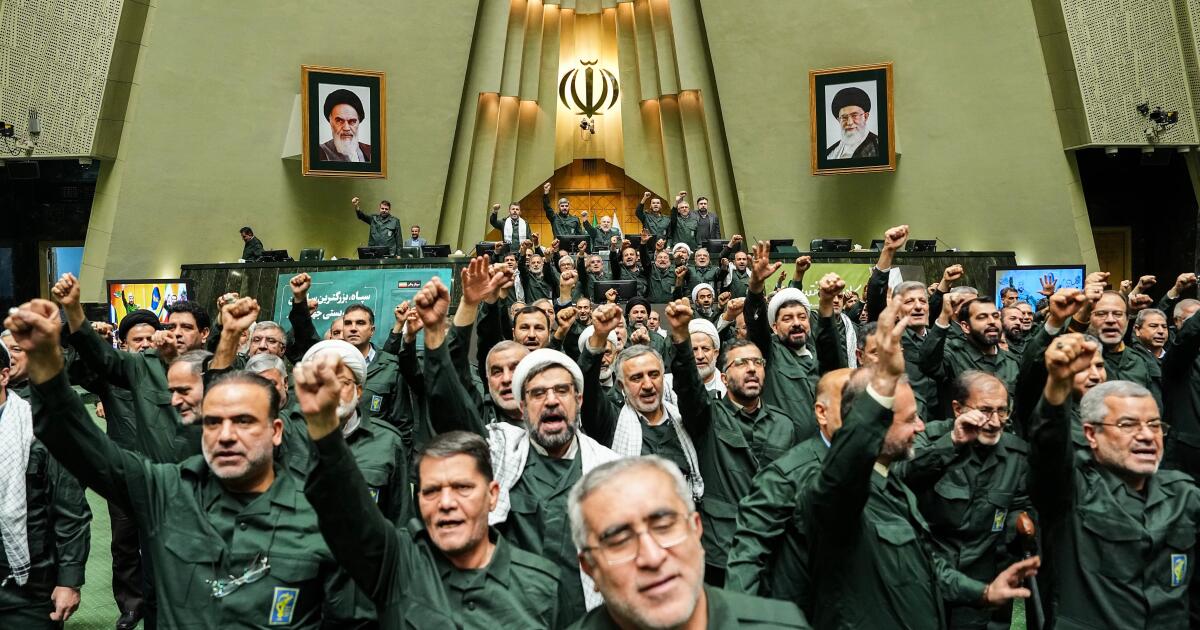
In a related development, Iran’s parliament speaker, Mohammad Bagher Qalibaf, declared that all European Union militaries would now be considered terrorist organizations. This statement followed the EU’s designation of Iran’s Revolutionary Guard as a terrorist entity due to its involvement in the suppression of protests. The Guard, which operates under Khamenei’s command, plays a critical role in Iran’s military and economic landscape.
As tensions rise, Trump’s administration has set clear red lines for potential military action, focusing on the treatment of peaceful protesters and the possibility of mass executions of detainees. While Trump has suggested that Iran is open to discussions regarding its nuclear program, he remains cautious about committing to military intervention. Speaking to reporters, Trump acknowledged the complexity of the situation, stating, “I don’t know that they will [negotiate]. But they are talking to us. Seriously talking to us.”
The potential for a larger conflict looms over the region, as Khamenei’s firm stance against U.S. intervention and the ongoing violence within Iran create a volatile mix. The coming days will be critical in determining the trajectory of both domestic unrest and international relations involving Iran.