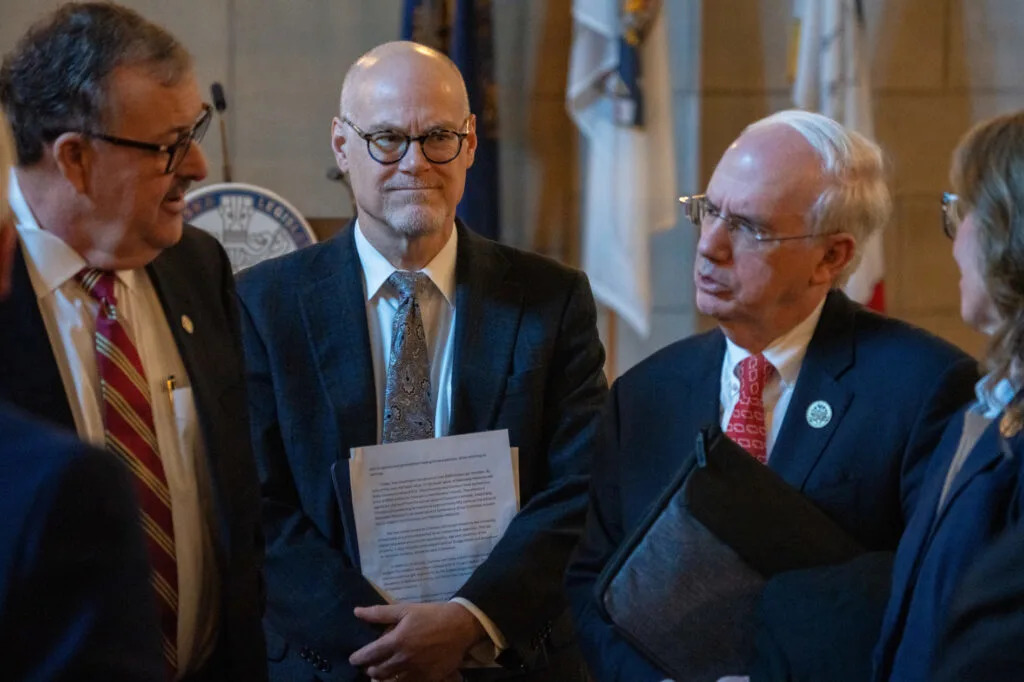
The University of Nebraska and Clarkson Regional Health Services have raised concerns regarding the constitutionality of a proposed bill requiring legislative approval for transactions involving Nebraska Medicine. The bill, known as Legislative Bill 1125, was introduced by State Senator Tony Sorrentino and discussed during a hearing held on January 14, 2026, in Lincoln.
During the hearing, no supporters of the bill appeared, while representatives from both NU and Clarkson voiced their objections. They argued that the proposed legislation could violate the Nebraska Constitution. Matt Blomstedt, NU’s associate vice president for government relations, stated, “Accountability is part of the job, but LB 1125 would change a governance structure that has served Nebraska well for generations.”
Senator Sorrentino’s legislation would mandate that any acquisition by NU of a controlling or sole interest in a hospital or healthcare facility valued over $100 million receive legislative approval. Additionally, it would restrict any hospital or academic health center affiliated with the University of Nebraska Medical Center (UNMC) from selling their interests to out-of-state or for-profit entities without confirmation from the state attorney general and the NU Board of Regents that such a transaction is “in the public interest.”
Since 1997, Nebraska Medicine, which serves as the clinical and medical services partner to UNMC, has been co-owned equally by NU and Clarkson. The current transaction involves NU’s proposal to acquire Clarkson’s 50% share of the nonprofit for approximately $500 million, in addition to purchasing related properties for $300 million. Clarkson initiated discussions with NU regarding this buyout in July 2024 and has pledged to donate $200 million back to NU for its ambitious $2.19 billion “Project Health” initiative aimed at advancing healthcare in Nebraska.
“This bill is not an abstract policy exercise,” Sorrentino remarked during the hearing. “It is a necessary response to a highly consequential transaction that stands to reshape our state’s health care landscape and the financial future of the university system.” He highlighted his background in mergers and acquisitions, indicating that while he could have made the legislation more restrictive, he deemed it unnecessary.
Senator Sorrentino raised several questions regarding the deal, including its prudence and whether proper oversight was exercised. He emphasized that the bill was not a reflection of distrust towards NU or any associated individuals. Blomstedt defended the governance of NU, asserting that the Constitution empowers the regents with comprehensive oversight of academic direction and financial stewardship.
The Nebraska Supreme Court has historically upheld NU’s governing authority, as seen in the 1977 case, Board of Regents v. then-Governor Jim Exon. A fiscal analysis presented by NU’s chief financial officer pointed out potential constitutional issues with the bill, suggesting that it could lead to multiple indeterminate fiscal impacts, indicating NU’s intention to assert its constitutional rights.
The proposal has garnered mixed reactions, with approximately 40 Nebraskans submitting letters in support of the legislation, arguing for greater scrutiny of the deal and cautioning against potential misuse of public funds. In contrast, Dr. Bill Lydiatt, CEO of Clarkson, characterized LB 1125 as “targeted legislation” that applies specifically to the Nebraska Medicine transaction, potentially setting a problematic precedent for future collaborations.
Dr. Lydiatt noted that the Nebraska Attorney General’s Office had previously reviewed the deal in November and found no objections. He expressed concern that the bill could disrupt established processes and discourage future partnerships with NU.
Among the other attendees at the hearing was Andreia Nebel, president of Clarkson College, who spoke neutrally about the legislation. She refuted public comments suggesting potential operational changes to the college, describing the recent turmoil surrounding the deal as “disruptive.”
The Executive Board of the Nebraska Legislature took no immediate action on Sorrentino’s bill. The NU Board of Regents has already voted unanimously on January 15 to proceed with the transaction, and it is expected to be finalized by June 30, 2026.