A groundbreaking study reveals that infants as young as two months can distinguish between various objects, a capability earlier than previously recognized by scientists. The findings, published in the journal Nature Neuroscience on March 4, 2024, may provide valuable insights into cognitive development during infancy.
Lead author Cliona O’Doherty from Trinity College Dublin stated, “It really tells us that infants are interacting with the world in a lot more complex of a way than we might imagine.” This research challenges earlier assumptions that infants only begin to categorize objects around the age of three to four months.
Study Overview and Methodology
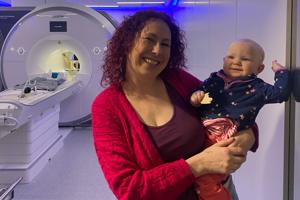
The study involved 130 infants who underwent brain scans using functional magnetic resonance imaging (fMRI) while awake. These infants were shown images from a range of categories, including trees, animals, and various inanimate objects. The researchers recorded distinctive brain activity patterns as the infants responded to different visuals.
O’Doherty explained that when the babies viewed an image of a cat, their brains exhibited specific activity patterns. In contrast, when they looked at an inanimate object, the brain activity varied. This advanced imaging technique allowed for a more precise examination of visual processing than previous studies, which often relied on measuring the duration of an infant’s gaze at an object.
While earlier research indicated that infants could differentiate categories at three to four months, O’Doherty’s study demonstrates that the ability to categorize objects emerges much earlier. “What we’re showing is that they really already have this ability to group together categories at two months,” she said. “So it’s something much more complex than we would’ve thought before.”
Longitudinal Insights and Future Implications
In an exciting follow-up component of the study, many of the infants returned for additional testing at the age of nine months. Researchers successfully gathered data from 66 of them. The results indicated that by nine months, the infants showed significantly enhanced brain activity when distinguishing between living and non-living things compared to their two-month-old counterparts.
According to Liuba Papeo, a neuroscientist at the National Center for Scientific Research in France, the scale of the study adds to its credibility. “The number of babies in the study is one thing that makes the work impressive and unique,” she noted. The challenges of conducting brain imaging on very young infants are substantial, particularly the need for the infants to lie still and comfortably in the fMRI scanner while awake.
O’Doherty emphasized the importance of creating a comfortable environment for the babies during the scans. Inside the scanner, they rested on a snug bean bag, with visuals projected above them. “The images appear really big above them while they’re lying down,” she said. “It’s like IMAX for babies.”
The implications of this research extend beyond mere observation. Researchers hope that by understanding how brain activity in infancy relates to cognitive outcomes later in life, they might better identify developmental milestones and potential delays. This study not only sheds light on the cognitive abilities of infants but also opens avenues for future investigations into early brain development.