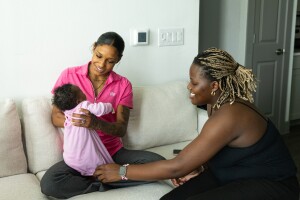
The doula profession in the Austin area is gaining momentum as advocates seek to improve access to birthing support, particularly for marginalized communities. Following a positive birth experience in March 2025, Josephine Adegbite, supported by doula Alicia Rivera-Clemente, is part of a growing movement to highlight the benefits of doula care. This trend is crucial as research indicates that doulas can significantly enhance birth outcomes, especially for Black women who face higher maternal mortality rates.
Adegbite’s second birthing experience at a midwife-led center in Manor was a stark contrast to her first, which involved an emergency cesarean section. Reflecting on her feelings during that first birth, she stated, “I felt like I didn’t really have a voice.” In contrast, her doula provided continuous support, which she credited for her empowerment during labor. “I think that’s what gave me so much more power and strength to give birth,” Adegbite remarked.
Doulas play an essential role in improving maternal health, as studies show they are linked to lower rates of preterm labor and cesarean deliveries. In Texas, data from the Texas Mortality and Morbidity Review Committee highlights that Black women experience maternal mortality rates 2.5 times higher than their white counterparts. This alarming statistic has prompted legislators and health leaders to introduce bills aimed at increasing access to doula services.
Advocating for Accessibility
Despite the proven benefits of doula care, accessibility remains a challenge. Traditionally, doula services have not been covered by insurance, making them financially unattainable for many. In response, the Maternal Health Equity Collaborative in Austin is working to offer free services to local families, focusing particularly on Black and brown women. Rivera-Clemente connected with Adegbite through the organization Healing Hands Community Birthing Project, emphasizing a collaborative approach to ensure no family is left without support.
“If one organization doesn’t have the capacity, we’re not just telling you no,” Rivera-Clemente explained. “We can refer you to somewhere else.” This cooperative spirit is a hallmark of the advocacy efforts the doula community aims to expand across Texas.
According to DeAnna Vonbartheld, Vice President of the Texas Doula Association, Austin’s proximity to the state Capitol has fostered a supportive environment for doula advocacy. “You have local representatives who support and have a better understanding of the doula work,” she noted. The association recently conducted a survey to assess the doula workforce in Texas, revealing that nearly 30% of responding doulas work in Travis County.
Challenges and Future Goals
While the survey highlighted the growing presence of doulas in urban areas, it also underscored the isolation faced by rural practitioners. Many doulas expressed a need for more public understanding of their role. Vonbartheld stressed the importance of educating policymakers about doula services, especially as legislation related to these services continues to evolve.
The push for Medicaid reimbursement for doula services is gaining traction, with approximately half of U.S. states now offering some form of financial support. However, efforts in Texas to establish a Medicaid pilot program for doulas have stalled. In 2023, legislators did pass a law allowing limited reimbursement for specific case management activities, yet many doulas feel this falls short of addressing the core aspects of their work.
“I personally want to see more doula work covered before I really make the push to do the case management,” said Darline Turner, Executive Director of Healing Hands. This sentiment is echoed by many in the community, including Rivera-Clemente, who expressed a desire to become more involved in advocacy efforts. “The compensation, to me, doesn’t equate to the work that’s being done,” she stated.
As the Austin doula community rallies together, the hope is to create a more equitable landscape for birthing experiences in Texas. Adegbite, inspired by her positive experience, is now pursuing a career as a labor and delivery nurse to help other women navigate their childbirth journeys. “It felt like I could do it. I knew what I was doing, I had support,” she reflected. “That’s really what every woman deserves during labor.”