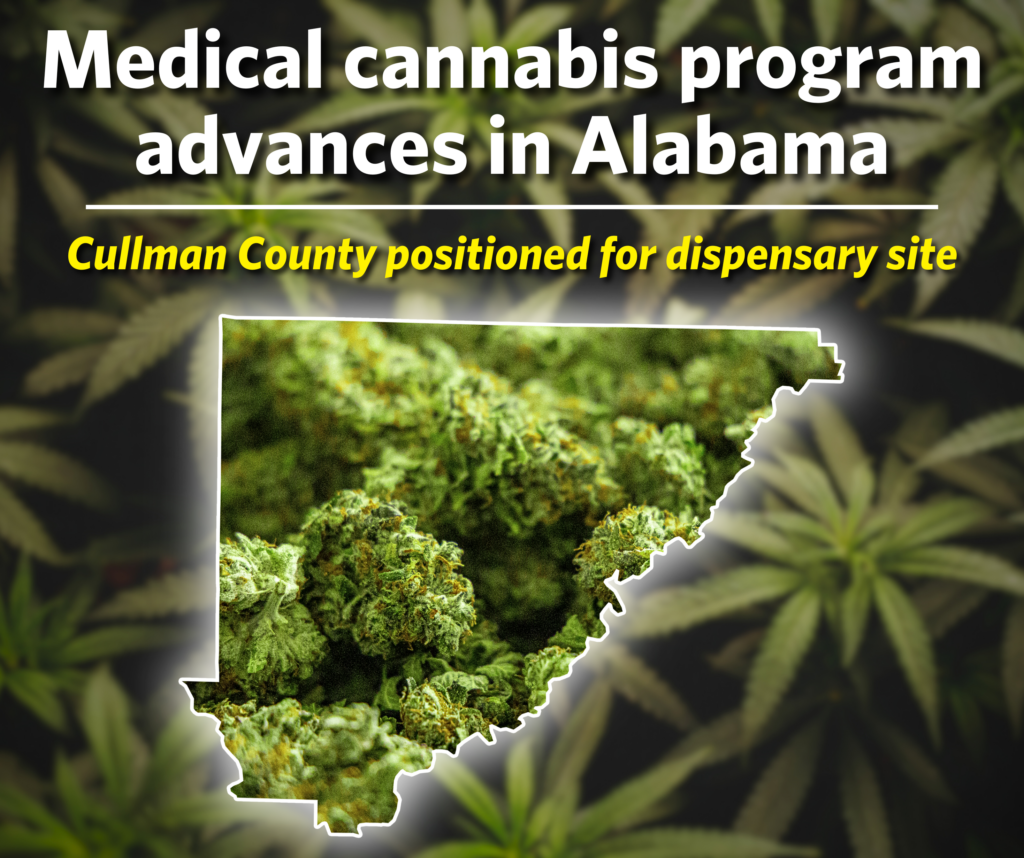
Alabama’s long-awaited medical cannabis program is taking significant steps toward becoming operational, as recent actions by the Alabama Medical Cannabis Commission pave the way for dispensaries. Cullman County has emerged as a potential location for one of these dispensaries, following years marked by regulatory delays and legal challenges.
The program was established by the Alabama Legislature in 2021 through the Darren Wesley “Ato” Hall Compassion Act. This law permits the use of marijuana strictly for medical purposes within a tightly regulated framework. Recreational marijuana remains illegal throughout Alabama. In a pivotal vote in December 2025, the commission approved the issuance of the state’s first dispensary licenses, signaling a major advancement after more than two years of interruptions due to legal disputes and regulatory setbacks.
Several dispensary sites are planned across Alabama, including in Cullman County. As of now, no products are available for purchase, and an official opening date has yet to be announced. State officials indicate that the program is entering its final administrative phase, highlighting the urgency of the rollout.
Alabama’s medical cannabis program is among the most restrictive in the United States. Notably, smoking or vaping marijuana is prohibited, and raw plant material will not be sold. Approved products include capsules, tablets, tinctures, topical creams, gels, oils, transdermal patches, suppositories, nebulizers, and measured inhalers. All medical cannabis must be cultivated, processed, and dispensed within Alabama by licensed businesses under the commission’s oversight.
Cullman County’s involvement in the program has been significantly influenced by local company Wagon Trail Med-Serv. The firm sought an integrated facility license allowing them to cultivate, process, and dispense cannabis. In June 2023, the commission initially awarded integrated facility licenses, but shortly afterward, an emergency meeting resulted in a hold on those licenses due to inconsistencies in application evaluations. Wagon Trail Med-Serv was among the affected entities.
When the commission reissued licenses in August 2023, Wagon Trail Med-Serv faced another setback when their application was denied a second time. Despite these challenges, company leaders appealed the decision and maintained communication with state regulators. In December 2023, the commission voted to grant integrated facility licenses once again, and Wagon Trail Med-Serv was selected as one of the businesses eligible for licensing, with pre-issuance inspections indicating progress.
Joey Robertson, CEO of Wagon Trail Med-Serv, expressed optimism about the project despite the prolonged delays. “We have had such good support locally; it’s been tremendous and so positive,” he stated. “We just want to get this medicine to people that need it.”
Unfortunately, legal complications resurfaced in January 2024, when a temporary restraining order blocked the issuance of integrated facility licenses statewide. Robertson noted that inspections demonstrated the company was ready to move forward, saying, “The pre-issuance inspection went well. We were able to demonstrate that everything in our application was factual and ahead of our initial projected timelines.” Court actions eventually resolved much of the ongoing litigation, enabling the commission to continue its licensing efforts throughout 2024 and into 2025.
By late 2025, the commission proceeded with issuing dispensary licenses, marking a transition from planning to implementation. Currently, there are no cannabis cultivation or processing facilities operational in Cullman County, but state licensing records list the county as a future dispensary site once all final approvals, zoning, and permitting are completed.
Under Alabama law, physicians may now register and become licensed to recommend medical cannabis for eligible patients. Doctors must hold an active Alabama medical license and complete necessary training before registering with the Alabama Medical Cannabis Commission. Once approved, physicians can certify that a patient has a qualifying condition and that medical cannabis is an appropriate treatment option. Importantly, physicians do not issue traditional prescriptions for medical cannabis, but rather provide a certification entered into the state’s medical cannabis registry. This certification allows patients to apply for a medical cannabis card through the state system and purchase products solely from licensed dispensaries.
Patients must be state residents with qualifying conditions to legally purchase medical cannabis in Alabama. They must be evaluated in person by a physician licensed by the state and certified by the commission. Telemedicine evaluations are not permitted. If approved, the physician enters the recommendation into the state registry, and patients complete their registration through the Alabama Medical Cannabis Commission to receive their medical cannabis card. Registered caregivers undergo background checks and are limited in the number of patients they can serve.
State and local law enforcement agencies stress that marijuana remains illegal outside the confines of the Compassion Act. Possession without a valid medical card or outside the program’s limits is a criminal offense, and laws regarding impaired driving remain unchanged.
Physicians who participate in the program are regulated by the Alabama Board of Medical Examiners and are prohibited from holding financial interests in cannabis businesses or receiving compensation from licensed operators.
With dispensary licenses issued and significant legal challenges resolved, state officials indicate the focus is now on final inspections, permitting, and patient certification. Dispensary operators are securing locations, physicians are preparing to certify patients, and the Alabama Medical Cannabis Commission continues its administrative oversight. For residents of Cullman County with qualifying medical conditions, the forthcoming months may provide the first opportunity for legal access to medical cannabis locally, though officials caution that the rollout will remain closely monitored and regulated.