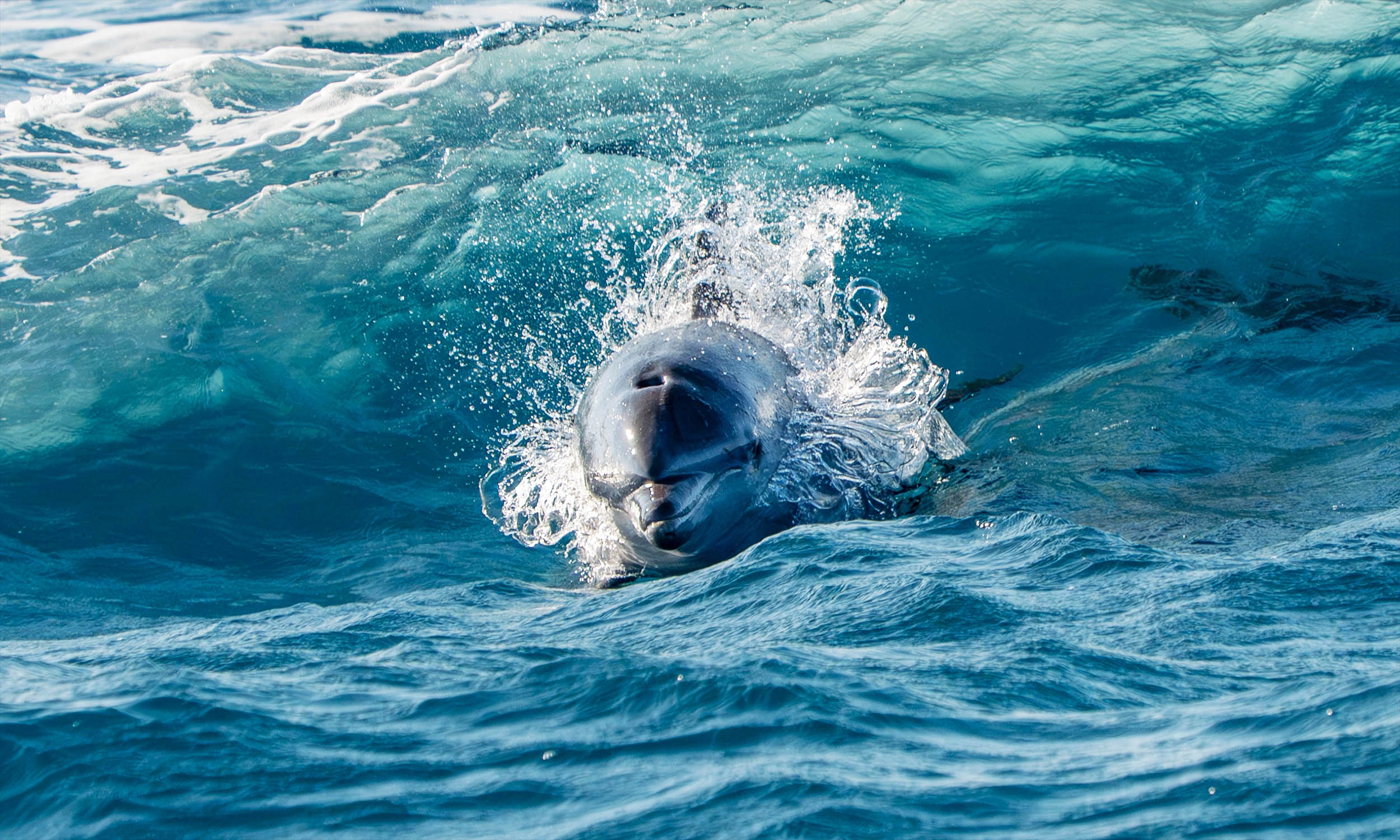
Supercomputer Simulations Reveal How Dolphins Achieve Explosive Swimming Speed
Dolphins owe their incredible speed to large, powerful rings of swirling water, new supercomputer simulations reveal, offering breakthroughs for designing faster underwater robots. Researchers at The University of Osaka in Japan used the Fugaku supercomputer to dissect the complex water flow behind dolphins, uncovering that giant vortex rings—rings of rotating water—are the primary source of thrust that propels dolphins forward with remarkable smoothness and speed.
Yutaro Motoori, the lead researcher specializing in fluid dynamics, explained, “Using a supercomputer, we can simulate and break down flow patterns to identify which components generate the dominant force.” This detailed simulation mapped about 1.9 billion grid points tracking the interaction of water with a dolphin’s tail, modeled after the Pacific white-sided dolphin. The results demonstrate that the largest swirling rings created during the tail’s downward stroke generate the main share of thrust by pushing water backward and driving the dolphin forward.
Why Large Water Rings Matter More Than Turbulent Swirls
The simulation challenges earlier ideas that small turbulent swirls caused most propulsion. Instead, while numerous tiny eddies fill the wake, these smaller swirls primarily result from energy cascading down from the larger vortex rings but contribute little momentum. The dolphin’s tail kick forms each vortex ring, which detaches and drives water backward, creating an equal and opposite forward force that accelerates the dolphin.
“The biggest rings carry the strongest backwards momentum,” Motoori confirmed. “Their formation at the tail edge where muscle meets water creates the dominant thrust for swimming.” This insight pinpoints the intricate physics of how dolphins translate tail motion into speed, moving beyond simple blurbs about fast swimming to reveal a precise flow mechanism.
Implications for Next-Gen Underwater Robots and Energy Efficiency
The findings arrive just as biomimetic engineers seek to improve underwater vehicles such as inspection robots and ocean sensors. Many aquatic robots still lose power inefficiently by creating disorderly water flow patterns. The study urges designers to focus on generating strong, well-timed vortex rings mimicking dolphin tails rather than just increasing tailbeat frequency or amplitude.
Such innovation could allow drones and robots to travel farther on the same battery power, reducing energy consumption and operational costs—an outcome with clear applications in ocean research, infrastructure inspections, and search-and-rescue missions.
Simulations Push Understanding Beyond Physical Limits
Using one of the world’s most powerful supercomputers, located in Kobe, Japan, the team overcame challenges that real-world filming struggles with due to water turbulence and speed. While the model fixed the dolphin’s swimming patterns without factoring in live muscle feedback or fatigue, its scope focused sharply on hydrodynamics—the direct physical forces at play.
The research, published in Physical Review Fluids, also suggests a broader pattern in nature: similar sized vortex structures created by bird wings, fish tails, and insect wings may explain how these animals efficiently generate propulsive forces by separating useful momentum from background turbulence.
Next Steps: Verifying Simulations and Expanding Applications
Future studies will aim to validate these findings with animal-safe measurements and physical robot trials, further bridging the gap between dolphin biology and robotic engineering. For now, this study delivers a clear and actionable blueprint: strong large vortex rings are the engine behind dolphins’ speed, not the chaotic swirl of small eddies.
For US readers and engineers, especially those exploring innovative underwater tech near coastal research hubs from North Carolina to California, this discovery could revolutionize how ocean vehicles are designed and operated in the years ahead.
“We can simulate and decompose the flow to determine which components play dominant roles,” said Yutaro Motoori, University of Osaka researcher.
Subscribe to The NC Voice for the latest cutting-edge science discoveries and technology breakthroughs impacting North Carolina and the US now.