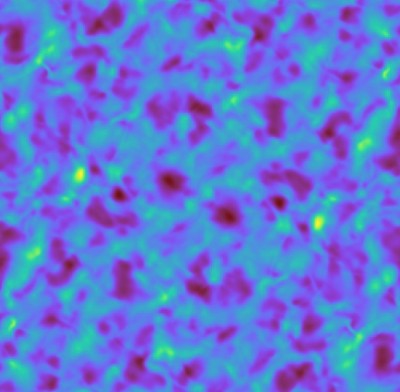
An international team of researchers has made significant strides in understanding the universe’s expansion by simulating magnetic forces from the early cosmos. Their findings suggest that these primordial magnetic fields could potentially resolve the ongoing discrepancy known as the Hubble tension, which has puzzled scientists for years.
The Hubble tension refers to the difference between two methods of measuring the universe’s expansion rate. Observations from the Hubble Space Telescope indicate a higher rate than what is calculated from the cosmic microwave background radiation. This discrepancy has raised questions about our understanding of fundamental cosmic principles.
The researchers conducted a series of simulations to model the impact of magnetic fields present shortly after the Big Bang. Their results indicate that these magnetic forces could influence the behavior of cosmic structures during their formation, leading to a different expansion rate than previously estimated. According to the study, published in a recent edition of a leading scientific journal, these forces act on a scale that could reconcile the observed and calculated values.
Implications for Cosmology
This research provides a compelling avenue for addressing key cosmic mysteries. The existence of primordial magnetic fields is not merely theoretical; simulations show that they could have played a crucial role in the universe’s evolution. By integrating magnetic dynamics into cosmological models, scientists may gain a more accurate understanding of the universe’s history and its expansion.
The implications of this work could extend beyond resolving the Hubble tension. Understanding magnetic fields in the early universe may offer insights into other phenomena, such as galaxy formation and the distribution of dark matter. This study thus represents a significant leap forward in the field of cosmology, prompting further investigations.
The team emphasizes that while their findings are promising, additional observational data is necessary to validate these theories. Further research may include scrutinizing the effects of magnetic forces in various cosmic epochs. This could enhance our comprehension of the universe’s intricate web of interactions.
Next Steps in Research
As the scientific community digests these findings, researchers are keen to explore the potential of primordial magnetic fields. The next phase involves collaborative efforts to gather observational evidence that could confirm or refute the simulated scenarios.
In the coming years, advancements in both observational astronomy and computational modeling will be crucial. By refining these models and collecting more data, scientists aim to bridge the gap between theory and observation.
In summary, the international team’s innovative approach to simulating magnetic forces in the early universe marks a promising step toward resolving the Hubble tension and unlocking further cosmic mysteries. Their work highlights not only the complexities of the universe but also the importance of interdisciplinary collaboration in addressing fundamental scientific questions.