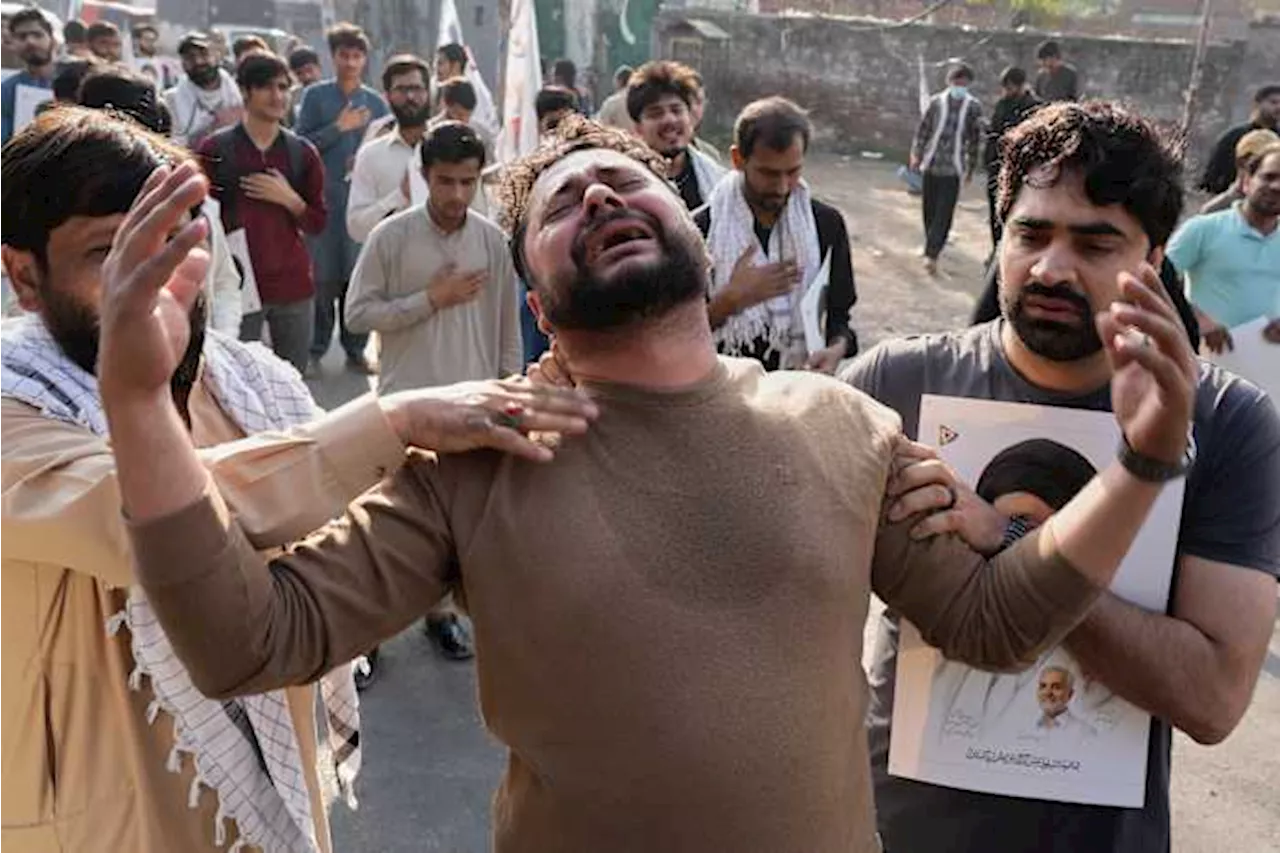
Pakistani Shiite Muslims took to the streets in cities such as Karachi and Lahore on March 1, 2026, to protest against the United States and Israel following the death of Iranian Supreme Leader Ayatollah Ali Khamenei. The demonstrations quickly escalated into violence, particularly in Karachi, where protesters stormed the U.S. Consulate, leading to multiple casualties and injuries.
Reports indicate that at least six individuals lost their lives, with approximately a dozen others wounded during clashes with police and paramilitary forces. A police surgeon at Karachi’s main government hospital, Summaiya Syed Tariq, confirmed that six bodies and several injured persons were admitted to the facility.
The unrest began shortly after the United States and Israel conducted an attack on Iran, resulting in the death of Khamenei. Senior police official Irfan Baloch stated that demonstrators briefly breached the perimeter of the U.S. Consulate but were subsequently dispersed. “The situation is now fully under our control,” Baloch asserted, refuting claims that any part of the consulate building was set ablaze. However, protesters did ignite a nearby police post and smashed windows of the consulate before order was restored.
Despite police efforts to control the situation, witnesses reported that dozens of Shiite protesters remained gathered about a kilometer from the consulate, calling for others to join their demonstration. Shiite Muslims make up roughly 15% of Pakistan’s population, which totals about 250 million, and represent one of the largest Shiite communities globally. Historically, they have organized anti-Israel and anti-U.S. rallies, although clashes of this magnitude are rare.
In addition to events in Karachi, protests also took place in Lahore, where police prevented demonstrators from approaching the U.S. Consulate. According to senior police official Faisal Kamran, protesters attempted to march toward the consulate but were met with resistance from law enforcement, prompting authorities to disperse the crowd.
The protests reflect deep-seated tensions regarding U.S. involvement in the region and the recent developments surrounding Iran’s leadership. The situation remains fluid, with authorities closely monitoring the unrest and preparing for potential further demonstrations in the coming days.
As the international community watches closely, the implications of Khamenei’s death and the violent protests in Pakistan are likely to resonate beyond the immediate region. The events have sparked fears of escalating tensions and possible retaliatory actions, as Iran’s influence in the Middle East remains a critical concern for many countries.
This article draws on reports from the Associated Press, with contributions from journalists Babar Dogar in Lahore and Asim Tanveer in Multan.